









Your numbers might look healthy.
Revenue’s up. Projects are flowing. The pipeline feels… fine.
But underneath? Margins are eroding. Cash is tighter than you’d like. And no one’s totally confident in the data they’re using to make decisions.
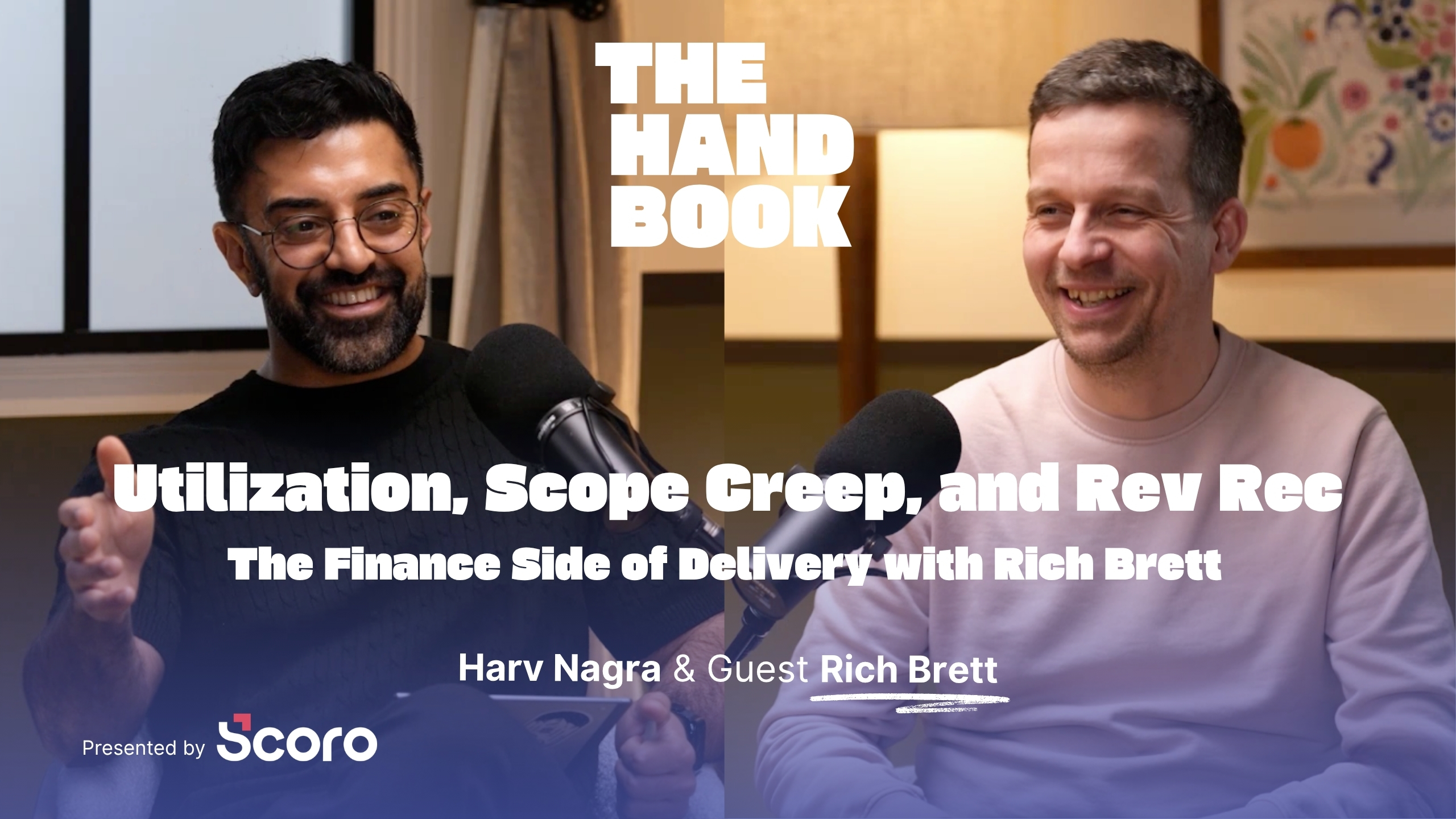
In this episode of The Handbook, Harv Nagra sat down with finance and business ops advisor Robert Patin to unpack what’s really going on beneath the surface of many professional service businesses right now – and why operational maturity is the difference between surviving and thriving.
Here’s what we dive into:
- The financial red flags leaders consistently overlook – especially around forecasting, cash flow, and margin erosion
- Why revenue is a vanity metric if your gross profit assumptions are wrong
- How to turn project postmortems into a pricing engine that actually improves over time
- The link between operational maturity and financial performance – and why finance and ops can’t sit in silos
- How data fragmentation creates “business whack-a-mole” and makes AI harder, not easier
- Why AI will increase pricing pressure – and how to get ahead of it before the market catches up
This conversation is a practical look at how to level up your maturity across finance, systems, and decision-making – so you can scale with confidence instead of guesswork.
Additional Resources:
👉🏽 Follow Robert on LinkedIn: https://www.linkedin.com/in/creative-agency-success
🌐 Robert’s resources for The Handbook listeners
👨🏽 Follow Harv on LinkedIn.
📈 Measure your business maturity and find out how to get to the next level: https://bit.ly/assess-business-maturity
📬 Stay up to date with regular ops insights. Subscribe to The Handbook: The Operations Newsletter.
Transcript
[00:00:00] Harv Nagra: Hi all. Welcome back to the Handbook the Operations podcast. I’m Harv Nagra. I talk about business maturity a lot, and lately I’ve been thinking about the state of financial and data maturity in agencies and consultancies, especially in a market where pipelines feel fragile and profitability is always on everyone’s mind.
What I hear from people I speak to. There are reports and spreadsheets everywhere, but the underlying picture is still fuzzy. Data isn’t fully trusted. Finance and operations aren’t joined up, and leaders are making big decisions without the visibility they need. Those cracks used to take months and sometimes years to become unavoidable, but in a world of tighter margins, a faster pace, AI disruption, and changing client expectations, they’re being exposed much earlier.
So today I wanted to bring on someone who not only understands those financial warning signs, but also how they connect to the bigger operational picture, including the impact of ai. We’re gonna be joined today by Robert Patin, an expert who works at the intersection of finance, delivery operations, pricing, and strategy for agencies and consultancies. He’s helped leadership teams clean up their numbers, fix their models, and scale with more predictability, and he has strong views on how AI is changing the game. We’re gonna cover a lot of ground from margins and pricing, to operational maturity and ai, but I wanted to start with the fundamentals because if you don’t understand your financial reality, no amount of automation or AI wizardry is gonna save you.
Let’s get into it.
Thanks for listening to the Handbook: the Operations podcast. This podcast is brought to you by Scoro. There’s a question I’m hearing more and more lately. If AI can connect all my tools, do I even need a PSA anymore? That’s a fair question. With AI agents, MCP and a bit of vibe coding, it can feel like you can stitch something together yourself.
But here’s what actually happens in practice. AI is great at generating ideas, automating tasks, and surfacing insights. What it’s terrible at, is being a dependable backbone for running a business.
It’s probabilistic, it’s fragile, and it relies completely on the quality and structure of data underneath it. A PSA isn’t there to be clever. It’s there to be boring in the best possible way. Scoro gives you a stable, secure system of record for your projects, people, finances and performance.
It’s built for scale, compliance, reporting, and trust. The stuff your leadership team actually relies on. AI then sits on top of that foundation, making it faster, smarter, and easier to use. So no AI doesn’t make PSAs obsolete.
It makes the choice of PSA more important than ever.
Go to scoro.com/demo to see how Scoro fits into a modern AI enabled ops stack and for the VIP treatment. Tell them Harv sent you.
Now let’s get to the podcast.
Robert, welcome to the podcast. Thank you so much for being here.
[00:02:52] Robert Patin: and it’s a pleasure to be here.
[00:02:53] Harv Nagra: I wanted to start by taking the opportunity to pick your brain on finance. That’s,an area of expertise for yourself. So let’s start with some patterns that you’re seeing these days.
What are financial red flags that leaders are consistently overlooking, maybe.
[00:03:07] Robert Patin: So one of the first things that I see happen, and this is true across the vast majority of businesses, is that they’re missing two key components. So we’re looking at revenue generation most frequently, right? How much revenue am I bringing in? But the piece that we’re lacking is actually future projections.
And so what does revenue look like next month? What does revenue look like two months from now?
[00:03:26] Harv Nagra: Right.
[00:03:26] Robert Patin: is I can’t fix tomorrow, but I can fix maybe a month from now. And so the further out that you’re looking and understanding exactly what’s going on, you can make more pragmatic decisions on how your business is performing. And then obviously these have a direct correlation, but profitability and cash flow are actually different things. And so I’ve seen so many organizations end up being in a pretty significantly bad place by not looking at their cash flow projections as
well.
And so making sure that you’re looking at both, so what does revenue and expenses look like next month and then the following month, and ideally in a 90 to six month timeline of what things are looking like, and then making sure that you have a pretty regular 90 day cash flow projection as well.
[00:04:07] Harv Nagra: Yeah, Really good point. You know, it’s very easy for us to analyze what happened last week, last month, last year. But it does take more work to get the kind of foundations in place to be forward looking and looking at leading metrics
But it really helps you navigate, what’s coming and be able to make decisions to guide the path rather than just reacting to everything. So it’s just so important.
[00:04:28] Robert Patin: 100%. The other thing that I see happen quite a lot is there’s a significant amount of margin erosion
in
any service-based business. And so that is related to bad budgeting, bad projections, where you have work in progress build up, unbilled time, delayed invoices, ar aging sort of stuff going on.
But, one of the things that I see as a huge component in the industry is that we have this kind of vanity component to revenue generation. So you’re thinking, Hey, I’ve got this amount that I’m actually billing versus how much is actually service-based revenue and then the growth for all else.
So there’s, um, a client of mine in, in, based outta New York that, we had a difference of opinion. She really wanted to focus on revenue generation. And I, looking at her financial statement, they were doing 11% net profit, which to me is just is not enough. It needed to be twice that. And she was really wanting us to focus on how are we generating more leads?
How are we getting out there from a biz dev perspective, which should be done, but it wasn’t the primary focus for me. They were underpricing, they were over servicing and it was compounding discounting, and, the reality. So we ended up spending the vast majority of the first year focused on what their pricing structure looked like, so the base business fundamentals, making sure that they had the right financial framework in place. And over the course of that first year, they ended up going from that 11% over 20%, and then now in the third year, they’re at 43% net profit.
So they
hit 8.7 million this year in revenue at a 43% net profit, which is substantial. we’re talking an $800,000 amount of profitability that would’ve been this year if they just continued with where they had been previously in that growth trajectory
versus
nearly 3 million, or a little over 3 million in, their profitability for this year or this past year, 2025.
So it’s just, A huge amount of impact. When you’re looking at those core business fundamentals and making sure that you’re having a retrospective of how are you operating, what exactly are you doing that allow for you to be able to have a meaningful amount of progress. the reality for every business is that it’s there to generate profit, and if it’s not generating the right amount of profit, then there needs to be some reflective conversation about it.
[00:06:40] Harv Nagra: Absolutely. That transformation that you’re talking about with that business that you just mentioned, that’s, a huge difference. Can you talk about what kind of changed over that period of three years?
[00:06:51] Robert Patin: So there, there was several things that we looked at. One of the core things to start off with that really spiked the profit from one year to another was that they were looking just at the core assumptions of what they had for their actual costs.
So, you know, the, the pricing sheet that they were utilizing was entirely hour based, which is fine theoretically, as long as it’s accurate. And it wasn’t from the amount of time that it was taking for them to execute on their deliverables. But even more so is that they were targeting the wrong percentage of gross profit.
So the reality
for a service based business is that you should be plus 50% gross profit. So for total amount of revenue that you’re generating, half of that should go to deliverable costs, at the max, half of it should go to deliverable costs,
and
the remaining piece is gonna be left for profit and operational expenses. They were targeting 30%, so they were far sub of where they should have been. Fortunately for them operating pretty lean from an operational perspective, which is what then led to the 43% net in future years. But they were targeting the wrong percentage. And then a couple of other things that they didn’t mathematically consider was you know, total overhead burden.
The burden of each one of those team members. So you’ve got payroll taxes, the health benefits, the underutilized time, vacation time, all those things that were not being considered
need to be
broken across every hour in the business. So those were a lot of those just core fundamental things that mathematically just were not assumed in their base pricing.
[00:08:15] Harv Nagra: Hmm. Robert, when it comes to pricing, I think what I see with a lot of businesses is that they don’t handle it particularly strategically. And that example you gave, I think, just illustrates that.
what’s the right moment to reevaluate pricing and what data should inform that?
[00:08:31] Robert Patin: So per the, when should they be analyzing pricing? I think perpetually.
[00:08:34] Harv Nagra: Mm-hmm.
[00:08:35] Robert Patin: Really the core of how I see it is that, at the end of every project is when you should be evaluating the base assumptions that you put into it, right? So in a, the beginning of a pricing exercise, you have to think about it in the length of time throughout a project, but to begin with what you’re going through, pricing you should be putting in, what is it that you exactly assumed?
[00:08:53] Harv Nagra: Hmm.
[00:08:53] Robert Patin: I’m assuming from an account management perspective over the six week project, let’s say, that I’m gonna be meeting with the client once a week, and that we’re gonna be meeting internally this many times, that it’s gonna take this much amount of time for X, Y, and z Reason. It’s half days for a week for the creative director for the first week of the project, what those base assumptions are. And then at the end of the project, you look at how many hours did it actually take, what exactly did it take to execute on it? And then where was I wrong on the assumptions? Because the reality is that I can plan the best laid plans really, is the kind of idea, it’s like, how do you look at what did I assume, what actually took place?
What do I wanna look at reflectively? Can I change my operational process that
made
the assumptions more accurate? Or is this just what it’s going to take so that I can update my base assumptions going forward? the first agency I ever worked at, an experiential agency out of Los Angeles. the first thing that I did working there, was put together their base pricing assumption and how exactly they went from the initial assumption to the execution of budgeting throughout the actual event management and activation management to the postmortem, and then being able to truly utilize the, that project postmortem because now I’m creating an aggregate of a library, if you will, of past projects and how they performed.
So initial assumptions, end result. And this is where money ultimately went on this project, so that when I have a similar activation or a similar scope of work, I can then look at what did it actually take and then bring up not just one, but two, three, even five, that are similar to this type of activation or this type of scope of work that allows for me to test my assumptions.
Am I being overly optimistic? Am I being overly pessimistic so that you’re able to. Have the right weight, right? You have, you can obviously overprice, which then you’re pricing yourself outta the market, but then you can also go incredibly low, which then makes it not feasible from a business perspective.
There has to be a good balance between them and only with, for me at least, we’re, I think generally, I know as a species we’re emotional creatures and, it’s important for us to recognize that data, at least for me, gives me a whole lot of comfort in being able to pressure test the emotionality of where I
am, that makes
it easier, more pragmatic in the decisions that I’m making.
[00:11:06] Harv Nagra: So I guess one question is like, operationalizing those learnings,you do a project and for various reasons it may have gone over budget. Somebody might think that’s not enough of a pattern to now go and update pricing.
I think my, my point is that sometimes we get, we, we end up justifying everything that, oh, that the edge case happened, everything’s an edge case, and then it never becomes a pattern, and then everything’s overrunning.
I know it’s important that you were saying perpetually, but can you give us any advice on when to recognize those patterns and to embed those learnings?
[00:11:38] Robert Patin: I don’t know that there’s, just a one direct answer that
is gonna say
in every single scenario, this is the way that you wanna go about it. But here’s the question that I’d be asking of myself.
So let’s say that I’m in the end of a project and the reality of what we went, and let’s say that we went, you know, 25% over budget. there’s multiple pieces. Like it’s not just one thing that took place that caused it.
[00:11:58] Harv Nagra: Yep.
[00:11:58] Robert Patin: there’s, the way that we onboarded the client that maybe made them a bit more anxious, they made them lean in a bit and they ended up becoming too controlling. That ended up taking a whole lot more of our time. There was maybe we were not launching the project well enough to allow for us to be able to have communication across every single team member on the team that allowed for them to be up to speed. They cause revisions and work, and so there’s a pragmatic reflection that you need to have within each component.
Right? So it’s, when it comes to the evaluation of how a project actually transpired.
I see
it as a couple of things. There’s the external pricing, the base assumptions that we win and then maybe that they need do, need to go up in that example,
maybe not.
or maybe that it’s an operational problem that we need to be looking at, thinking about things a bit differently.
So I would look at what took place. Is this a an edge case? Or is this very similar to what takes place on most projects? And
if it is very
similar to what’s tending to happen, then we need to be a bit more reflective in it and then actually take some action from it and make a choice in that specific scenario. And if you’re seeing it happen, three times, three projects in a row, then that’s a pattern and you should be taking some action from it.
[00:13:06] Harv Nagra: Mm-hmm.
[00:13:07] Robert Patin: or, you know, what is your base base hypothesis? here’s the situation that happened in this project. My hypothesis is X, and then maybe I’m not gonna take any action, but I’m
[00:13:15] Harv Nagra: Hmm.
[00:13:15] Robert Patin: it on this next project to see whether it’s the same.
And
[00:13:18] Harv Nagra: Right.
[00:13:18] Robert Patin: is the same. So now I’m gonna take an action.
[00:13:20] Harv Nagra: Yep.
[00:13:21] Robert Patin: it depends on the specific scenario and also the risk associated with it, right? If it’s a million dollar scope of work that went $500,000 over budget, you probably are gonna wanna do something about it immediately.
[00:13:31] Harv Nagra: right. Really, really good examples.
So I, I want to talk about when you start working with a business, what are the kind of metrics or set of metrics that you start looking at first? I think that might give us some inspiration. Those of us listening at what we should be looking at in our own businesses.
[00:13:46] Robert Patin: So interestingly, the first one is a bit more of a soft oriented piece, being that I’m a very numbers oriented
person. It’s
more focus and clarity. So the place that I always first start is in alignment amongst the leadership team. So department heads along the organization, making sure that everyone is very clear of where are we headed, what are we looking to accomplish, what are those goals?
What is it gonna take? There’s always sacrifices. That need to be made in progress and in, in, adaptation and making sure that we understand exactly what that’s gonna be, what are those boundary lines that we are gonna have? And one of the things that I find always incredibly interesting is that, and it’s, it shows that imposter syndrome is quite prevalent.
[00:14:31] Harv Nagra: Mm-hmm.
[00:14:32] Robert Patin: but then when I always do this with every single client that I have each person write down the goal that they want to accomplish in the next 10 years, and then write it down on a sheet of paper and hand it to me versus saying it out loud so each person is submitting it to me quietly so that I can then put them down.
Then I say the highest number, and then I say the lowest number. And I think there’s only been one example where the owner. Was not the lowest number.
[00:14:54] Harv Nagra: Right.
[00:14:55] Robert Patin: always think that the growth objective over a 10 year period of time is smaller than what the rest of the team wants to, and it just, it, I like to do this because it starts to, it just breaks down the disparity of how we’re actually seeing the world.
And then we can start to have a bit more of a pragmatic conversation. But those self-doubt, those limitations, those goals, that clarity and focus is incredibly vital. ’cause otherwise, you as the owner maybe feel like you’re pulling the team uphill versus actually working as a team, pushing the agency uphill, and it just makes it a whole lot easier. The other thing, me being a finance guy, I’m always looking at the financials.
at this point in my career, I will look at a financial and I can
read it
like a book of, here’s the, here’s a benchmark. This is the typical three things that are going on within the organization.
So I’m first looking at average hourly earning. you can look at it as revenue per full-time employee, or average hourly earning. I like to do average learning ’cause it allows for me to take an overhead burden into it as well. But what is it for every single hour that is available in the business?
How much revenue am I generating from it? And that allows for me to understand then where are, where’s that agency across the industry and how is that comparing? And then based on the number that I see, it allows for me to understand, all right, is profitability in line with what I’m expecting based on that number. And then evaluating gross profit, evaluating their operational load, understanding exactly what’s going on across the business so that I can understand where are the true issues so that I can then go start opening up the right closet doors to find the skeletons, really.
[00:16:21] Harv Nagra: Mm-hmm. So, those are the key things that you start with.
Robert, when an agency or consultancy is scaling really quickly, what might be signs that the financial practices aren’t gonna support the next stage of growth?
[00:16:33] Robert Patin: The first thing that I see that tends to be the the blocker for rapid growth is cash reserves
Because
not having the cash reserves available, it means meaningful opportunity loss because reality there’s a ton of opportunity out there in the market. There’s a ton of opportunity that crosses our desks every single day, and we may not have the financial resources to be able to capitalize on them. And the shorter the noose, if you will, of cash flow or cash reserves that you have that, making it too tight becomes a problem, but you can also make it too long, which then you have too much grace for yourself. So it’s typical place that I like to see things from an operational perspective, between two to three months of total operational costs for the business.
[00:17:19] Harv Nagra: Mm.
[00:17:19] Robert Patin: if I’m looking at bringing on an additional cost space, then I’m looking at increasing cash reserves a little bit to allow for that to happen. So I’m gonna reserve some more cash to allow for that to happen.
[00:17:28] Harv Nagra: Yeah.
[00:17:29] Robert Patin: Um, and. Making sure that I do have those financial resources available because it, it changes the decision making framework that we have.
Because if I’m coming from a place of scarcity, I don’t have any cash, I can’t afford this, I can’t capitalize on
this, then
you’re not going to, which then you lost that opportunity.
[00:17:45] Harv Nagra: Hmm. I think it’s really interesting that you mentioned not having too much reserve. I’ve never really heard anybody say that. Can you just elaborate on that point? Why? Why is that the case?
[00:17:54] Robert Patin: Sure. So the first agency I ever worked at was a good example of this, before I started, they had built up and amassed a substantial amount of cash reserves and then they lost an anchor client that was, you know, some 80% of their revenue. and they continued to hold onto their team. They continued to hold onto all of their operational costs that they had and eroded all of their reserves. And so they, because they had so much cash reserve, they ended up deferring and delaying the decision because a decision that we don’t wanna make, laying off team members, getting rid of expenses that we, that ends up feeling like one we failed. but two, the loyalty component, like letting go of someone is never fun.
it’s horrible and it’s not fun. And it is one of the, the least, exciting components of owning a business. But it is still something that you may have to do at some point.
[00:18:44] Harv Nagra: Right.
[00:18:45] Robert Patin: having too long of, or too much cash reserves allows for you to defer that decision for too long, and it just becomes a problem.
End up eroding profitability. End up, you know, taking away from your own retirement to your own wealth that you’ve built up for yourself, which just is not the right choice to make.
[00:19:00] Harv Nagra: Really good point.
So Robert, let’s talk about data maturity and data fragmentation next. At the lower stages of maturity, we often see businesses running on a load of different platforms, and as a result, they never quite have a clear picture of what’s actually happening in the business.
Tell us a bit about why you think businesses end up in this situation and what staying in the state too long ends up costing them.
[00:19:25] Robert Patin: So I wanna first hit on why I think that this takes place. I think it actually comes from, a place of really wanting to be more mature. So they end up with this like tool sprawl because hey, we’re having a problem with X, so we’re gonna buy this tool, and then we end up with another problem Y.
And so we buy this tool,
What you end
up with this like software Frankenstein of a bunch of tools that don’t talk to each other, and then it takes too much time for you to migrate information from one to another, which then means that the tool becomes effectively useless and then you end up holding onto the tool for too long and it ends up having erosion of profitability by holding onto these tools.
[00:19:58] Harv Nagra: Yep.
[00:19:58] Robert Patin: And one of the things that’s really important when it comes to that tool sprawl and data fragmentation is that if you don’t have the information connecting from, your initial SOW and assumption from the pricing sheet, to what took place in resourcing, to what took place in the actual hours, to how that actually corresponded to each team member and each activity for each team member, to what service lines that, that, that scope of work had to do with, to the amount of communication you had internally, to all sorts of these different components. Um, that, I mean, you can go further on to, you know, lead gen and sales components too.
[00:20:31] Harv Nagra: Mm-hmm.
[00:20:31] Robert Patin: the further fragmented your data, the harder it is for you to make a choice and actually being able to identify the problem. And frankly, identifying the problem is the vast majority of the solution. Really. It’s like what is actually the problem that I need to solve for today? especially in the, the information age. There’s so much information out there about this problem y, this problem Z, you’re having this challenge, that means that this is the problem, and that may not actually be true for you. So I frankly, I see so many business owners kind of playing business Whack-a-Mole because they have so much data fragmentation, they don’t understand what the actual core of the problem is.
And then you ask them, what are you utilizing as the basis for this assumption that this is the problem within your business and they can’t tell you.
The amount
of times that, like I’ve asked for a financial statement from someone, it’s like, oh, well we haven’t done our financials in six months.
Like,
[00:21:21] Harv Nagra: Mm-hmm. Mm.
[00:21:22] Robert Patin: Um, just even things like that too, you know, it’s like
[00:21:25] Harv Nagra: Yeah.
[00:21:26] Robert Patin: if you want to have a mature Business and operate as a leader, a true CEO or operational leader of the business, you should be running it by numbers.
[00:21:38] Harv Nagra: Right.
[00:21:39] Robert Patin: running it by metrics. You need to be running it by
data. And
if you’re not, you’re doing it entirely on instinct, and I’m sorry, but you might, but by luck accomplish what you’re looking for.
[00:21:52] Harv Nagra: Right.
[00:21:52] Robert Patin: frankly, for me, I am not gonna live my life based on luck. I want to know that I’m headed in the right direction, or at least. I have a reasonable, like I’m headed reasonably in the right direction,
[00:22:01] Harv Nagra: Absolutely.
[00:22:02] Robert Patin: may not have every single data point, but,
[00:22:04] Harv Nagra: Yep.
[00:22:05] Robert Patin: it makes me feel more comfortable in the decisions that I’m making.
[00:22:07] Harv Nagra: Mm-hmm. I think you’re right that when we’re starting out you kind of, um, just wanna run your business. So you grab whatever you’ve used in the past, assortment, assortment of spreadsheets and tools and like you grab something to fix a problem, and then it turns into this kind of huge nightmare to manage.
And I think it’s recognizing that might work in the early stages and maybe even a bit longer. At some point, you do need to grow out of that so you can get this visibility. being able to look forward like you’re, like you’re mentioning there.
So Robert, you’re a big believer that financial performance and operational maturity are linked. how do you advise teams not to see finance and ops as completely separate disciplines, but to join them up more effectively?
[00:22:49] Robert Patin: So the first piece is, I think is, a very mindset oriented piece. Um. The way that I’ve always viewed it, I’ve worked as VP of finance, CFO for well over a decade and a half at this point. Um, and, I’ve always viewed operations, whether that’s the creative team, the account team, the sales and marketing team, the ops team, they’re our clients for finance. So they’re the ones that are ultimately spending those financial resources and the way that they’re being invested needs to be analyzed and how it is that I’m providing them with the information that they need to do their jobs as best as they possibly can. So how am I managing the financial resources?
How am I managing the budgetary requirements? How am I looking at that? And ultimately, everything is linked. I ended up, the first agency I worked at, ended up poking my nose, and that’s just a bit of who I am, poking my nose in far too many areas of the business just ’cause I was wanting to have financial, benefit for it and do my job as best as I possibly could, but you know, as an example, like the reason why I started with the pricing piece is that I saw, gross profitability wasn’t where it needed to be, so I needed to understand what was going on in sales and marketing. And obviously there’s a direct link between how it is that you’re positioning yourself that allows for you to be able to sell at a higher price point. And if you’re not able to position yourself well enough, then you are still competing based on price. And it’s a very difficult thing for you to be able to hit those financial bench marks that you’re looking to hit.
[00:24:13] Harv Nagra: Mm-hmm.
[00:24:14] Robert Patin: just understanding the input output component to how everything is. Like your financial statement is the end ultimate output.
But there’s been a funnel of decisions that led to that point
[00:24:26] Harv Nagra: Right.
[00:24:26] Robert Patin: a funnel of activities that led to that point, and then understanding, all right, here’s the end point of what took place, and then here’s all the 5, 10, 15 different potential pieces. Which ones are out of alignment and which ones are the problem, and that when you look at the financial statement as an aggregate of everything that you’ve done for the month, for the quarter, for the year, it allows for you to understand, okay, now how do I take and have an impact to this in future that makes a different decision? Or, what information do I need to gather in order to allow for the this specific number to adjust and shift, and how exactly is that gonna be happening?
And then you, from, and I’m just gonna hit a couple of examples. So, sales and marketing, obviously it’s positioning and closure rates and leads that are coming in. From an operations perspective, it’s, how much time are people spending on administrative work that’s then causing under utilization and un unbillable time.
From an account side of things, it’s client retention. It’s the amount of upsell opportunity that you have. It’s the amount of cross-sell opportunity that you have from a creative perspective, it’s how much time are you actually having from a utilization on the team, but also how much are you actually going over the assumptions from a budgetary perspective.
So like, how effective are we operating
And
understanding how each one of those actions, every single team member is immediately impacting the financial statement and understanding that is, a core foundation to how I see what I do
[00:25:54] Harv Nagra: Yep.
[00:25:54] Robert Patin: in finance, frankly.
[00:25:56] Harv Nagra: Right. And
the point is that an operations person needs to have financial awareness. A finance person needs to have operational awareness, and I’m not sure that by default all of us kind of come up through the work landscape to develop those skills.
So what I’m trying to ask, Do you see people already doing this well or what’s the education needed on either of these roles to really develop that skillset and be sitting together and looking at this to understand it?
[00:26:21] Robert Patin: I generally think that it’s a, there’s an education component to it. and I will say two things. One, me having grown up in my father, having been a finance person and CPA,I just grew up around it. So it was just a knowledge piece that I had. And the first time working at an agency, working with a load of creatives, I had assumed wrongly that they had this base of information.
[00:26:45] Harv Nagra: Hmm.
[00:26:45] Robert Patin: and one of the stories that I was telling earlier about that agency, that 8.7 million agency that’s now doing 43% net profit. They, one of the things that we had to do was an education of the wider team. and frankly, this was a very uncomfortable thing. It’s a, an agency predominantly women, and me coming in as a guy that I felt like I was a bit mansplaining to the entire team, but I was talking about the base financials of how an agency makes money. So what happens if the project goes over a timeline in just days, not oh hours, but days or weeks? What
happens
if we go over budget two hours every week for this specific project? What happens if we go over budget just in general? What and how does this have implication? How much does it actually erode the profitability?
Because this each decision, as I was saying earlier, that each team member is making a decision every single day. Each activity is then having financial implication. And there was debate on this team of, you know, well, we’re technically under hours but we’re six months over timeline. And it’s like, well, that’s not it. You may think that you’re profitable, but the reality is that time went away.
You
didn’t bill for 20 hours for that week. And so that actually has a meaningful implication to the financial perspectives for the business.
[00:27:59] Harv Nagra: Right.
[00:28:01] Robert Patin: I saw how, what their vantage point was. What they needed was further clarity of what it was that was taking place.
So the core of it, I knowledge is power really. And how do they understand what decisions they need to be making and being sure that the team members have the information that they need to make the best possible choice. as anyone in management, our jobs is to provide our team members with the information that they need and the tools that they need to do their jobs well, and if they don’t have the education or they don’t have the information, then it’s our job to help furnish them with it so that they’re able to make those choices and pragmatically those choices. And so sometimes it is providing them with a report. Sometimes it’s providing them with a north star with the metrics. Sometimes it’s providing them with the understanding of how those metrics are able to be affected. What if you do X? What if you do
Y? What if you do Z? And it, it allows for people to better action.
I, I generally believe that A players, and actually just generally, I think that anyone on a team wants to do a good job. Like people don’t show up to work thinking, I’m just gonna just phone it in. I
just don’t
care and I’m just gonna be a bad team member. I’m gonna be a bad employee. I’m gonna be just bad at my job.
people don’t show up to work every single day with that mindset, right?
[00:29:16] Harv Nagra: No.
[00:29:17] Robert Patin: that doesn’t mean that they’re gonna excel every single day either. And harness that desire for them to do good at their job
[00:29:24] Harv Nagra: Right.
and help them do it by providing them with the information that they need to do. Absolutely. And bring in the training if you don’t have it in-house and get these people to sit together and work together, which is, I think the main point that you’re highlighting there,a lot of the issues that we were, we’ve been highlighting in this conversation are being made more visible and more urgent by AI coming in. So let’s shift towards that a little bit.
You work with businesses at really different levels of operational maturity. what signals tell you that a business is really ready to layer ai over their data , versus still stuck in that kind of lower maturity stage.
[00:29:58] Robert Patin: Uh, there’s obviously a lot of nuance to this, but I would say that data clarity, so I’m gonna push back to that, data fragmentation component, right? the more chaotic your data, the harder it is for you to leverage ai. and so if you don’t have data going from one system to another and the information isn’t talking to each other, it becomes very difficult.
So you wanna start there more in base automation, like the, not the AI version of it, but just, getting information to be able to talk to each other, either adjusting systems or
adapting
your existing tools.but frankly, I mean, what AI is is a data synthesis tool. That is what it is at its core and bad data in is gonna be bad data
out.
And so if your data is unclear, if your data is having massive gaps, then the output of what AI is gonna be providing to you may be right based on what you furnish to it. But it’s wrong based on your scenario.
And so
[00:30:54] Harv Nagra: you have to be. If you want to use ai, you have to be operationally focused. especially in the creative space, me working with designers and creatives and brand agencies and that sort of thing, they, historically, the vast majority of them, they don’t think of themselves as data oriented people. And frankly, they’re not like the, I, um, the amount of times I’ve brought up a spreadsheet and I can just see the, blankness that ends up on their faces when that happens, Yeah.
[00:31:24] Robert Patin: that’s just not who they are. But that doesn’t mean that your business doesn’t need it. I’m not saying that you need to become a person that loves spreadsheets like me, but you do need to have someone that does care about the data
[00:31:33] Harv Nagra: Yeah.
Yep.
[00:31:35] Robert Patin: understanding that data piece to your organization is incredibly important
and
the greater systems you create within your organization. The greater capacity that you have for creativity, for execution, for outcome to clients, for the space to do the thing that you love.
[00:31:58] Harv Nagra: Yeah.
[00:31:58] Robert Patin: The amount of operational chaos that I see for so many businesses at these, as you’re referring to, as these lower levels of maturity, the, they spend so much time in administrative work
[00:32:13] Harv Nagra: Hmm.
[00:32:13] Robert Patin: they end up getting so far away from the thing that they love.
[00:32:17] Harv Nagra: Yeah.
[00:32:17] Robert Patin: The thing that, the reason why they started the business and the reason why they do what they do, that it ends up becoming the thing that they don’t want. And it’s entirely because they didn’t focus on creating the systems that allow for the space.
[00:32:29] Harv Nagra: Yeah.
[00:32:30] Robert Patin: especially with those that I serve, the idea of having systems, they view it as a box that they’re gonna have to live within,
[00:32:36] Harv Nagra: Hmm.
[00:32:37] Robert Patin: but frankly, it’s the wings that’s gonna let you fly.
[00:32:40] Harv Nagra: Absolutely. one of the things that comes to mind talking about scattered data and kind of AI analysis,I think that analysis just becomes so much trickier if it’s in a dozen different places to begin with.
[00:32:51] Robert Patin: I’ll give a little bit of a story. There was, I was, Running low on time, or early part of last year. And, a client had gone through doing a time study and we were trying to extract, and I just needed to get my eyes in the right places of the data that was going on. but there was data from. Their initial scopes of work, there was data from their time tracking tool. There was data from their resourcing tool and it wasn’t fragmented all over the place. And so what I ended up needing to do in order to use ai, ’cause my objective was, okay, I’m gonna use AI to start to point me in the right direction.
’cause I am limited on time. So how can I take what would’ve theoretically taken me 20 hours, 30 hours to go through this data? How
[00:33:27] Harv Nagra: Yep.
[00:33:27] Robert Patin: it done in five? Because that’s how much time I have available. So the first step I took is I had to just organize all the information right. so we sp I spent several hours going through organizing and v lookups and nature lookups and formulas within an Excel spreadsheet to just aggregate the data into the right place that it then allowed for me to upload it and have it synthesized with ai. The reality is that’s happening probably if you’re listening to this episode, that’s probably happening for your data right now.
[00:33:52] Harv Nagra: Yeah.
[00:33:53] Robert Patin: you have a single source of truth or your information is actually being disseminated across platforms, that is probably true for you, which then just means that you have to organize your data every single time you need AI to synthesize it, and then that means that in order for you to then utilize this data synthesis tool that is readily available to you, you have to organize and spend hours to organize it, to then use it, and then it just becomes harder.
[00:34:16] Harv Nagra: Yep.
[00:34:17] Robert Patin: a barrier for you to be able to access.
[00:34:19] Harv Nagra: Running the business becomes just an administrative task rather than doing the work that you really enjoy, and it’s just people get bogged down and they get in their own way. I, I think the point of this conversation for me is that you need to focus on your kind of operational maturity and level that up as, as soon as you can to get into a good place.
Robert, we’ve been talking about ai, you know, we’ve been talking about pricing pressures generally, but there’s also this kind of pricing pressure that is caused by AI about us moving faster, and sometimes clients thinking that means that we should be driving down prices.
what are your thoughts on that and like, how do you see AI influencing, pricing?
[00:34:57] Robert Patin: Undoubtedly, AI is going to create pricing pressure. without a doubt, I think that there’s, it’s not gonna happen overnight. and I think that there’s gonna be tears to it, and I don’t have a crystal ball anymore than any of you guys listening, but here’s my assumption of what I expect to happen and what I’m already seeing starting to happen now. so with ai, you’re able, theoretically to get a lot of the administrative data collection data synthesis information done a lot faster. So what, from like a strategy perspective, right? Just going through, the immersion phase of a strategy project as an example, you’re able to collect the information faster.
You’re able to drive insights faster. And so what maybe would’ve taken three weeks before you can get done in two or three days,
[00:35:40] Harv Nagra: Right.
[00:35:40] Robert Patin: so you’re profitability can skyrocket in the short term. Now that’s largely because the market isn’t aware of strategy and the processes that it takes and the how you can leverage it and how, how you’re leveraging AI to make your job faster
[00:36:01] Harv Nagra: as the market continues to mature with ai.
[00:36:04] Robert Patin: Because right now it’s still at its infancy stages, right? sure, it’s useful in a lot of people are implementing it and utilizing it, but they’re implementing it and struggling the same way that you are today to
[00:36:14] Harv Nagra: Yep.
[00:36:14] Robert Patin: implement it for themselves. Once they’ve figured out how to implement it for themselves, they are going to then start to look at how is it affecting the people that are helping me and how is it affecting my cost factors in other areas?
And so they’re gonna become more mature themselves in how they’re looking at the wider market. And the first that is going to have implication of this is enterprise.
[00:36:36] Harv Nagra: Hmm.
[00:36:36] Robert Patin: has more resources, they’re gonna be able to implement it faster, and then eventually it’ll hit mid-market and small business.
[00:36:42] Harv Nagra: I see it as like this ladder tier of a timeline of things taking place. So first is higher profitability for agencies that are leveraging and are AI enabled. The second is gonna start to become pricing pressure, and the third is eventually I see a lot of agencies, either being consolidated or they will disappear.
Hmm.
[00:37:01] Robert Patin: if they don’t start to pivot and adjust and adapt to the market that’s coming. The, the advice that I am giving to clients today on it though, is that I think that you should be overly capitalized on the fact that your time is, can be dramatically reduced If, let’s say that your strategy immersion phase of the project and the example that I was giving went from a hundred hours to 25, so you’ve saved 75 hours. You could theoretically take some of those 75 hours and invest it into the quality of the output that you have, so you’re able to have the fidelity of work, the insights, the impact to the client be increased. And so if you have a greater outcome to the client, a greater case study, it allows for you to elevate your business to having greater differentiation in a future market. So you’re gonna end up with less pricing pressure than the next business, because you have appropriately invested that time into other components of how you deliver. And it pushes back to what I was talking about earlier, right? Like you have to be at the top of your game. You need to be the best in class, and that this can help you punch above everybody else.
And the further and the sooner that you adopt these types of things, the better off you’re gonna be.
[00:38:20] Harv Nagra: really good advice. And like I, when, when we talk about business maturity at the highest level of that scale,
Got the right team and structure and processes in place that you are able to focus on developing your offer and the client experience so that you can stand out and you can charge that premium. And, you, there’s a distinct reason for people to come to you, as a customer rather than anybody else.
So a really, really, uh, nice example there. Robert, we’re coming to the end of our conversation, but I didn’t mention earlier that you are also a podcaster. I’ve had the pleasure of coming on your podcast to talk about operations, automation, and systems as well. So tell us a bit about your show.
[00:38:57] Robert Patin: So the podcast name is The Agency Blueprint. the way that I like to think about it is it’s a bookshelf of agency challenges. so if you’re looking through the titles of the podcast, I’m having that specific challenge. Go ahead and take it off of the shelf, and give it a listen. The. The way that I like to approach every episode is that I wanted to have an insight that is immediately implementable,
[00:39:17] Harv Nagra: Mm-hmm.
[00:39:17] Robert Patin: able to immediately derive some impact to your operations, to the way that you deliver, to the way that you generate revenue.
immediately from listening to that episode. Obviously, we’re not gonna solve every single challenge of your agency in that moment, but, allowing for you to be able to make your way through that bookshelf the same way that I do of my physical one.
[00:39:33] Harv Nagra: Amazing. Love that. And where can people go to learn about, more about you and, reach out to you?
[00:39:40] Robert Patin: I’ve put together,a page. If you go to creativeagencysuccess.com/handbook, there are three things that you can do on that page. I’ve put together the agency analyzer guide, so it allows for you to do an evaluation of your pricing structure, so allowing for you to understand which services are more profitable, which team members are most effective, and what’s going on, and which clients as well. And being able to understand a little bit more about your base financial model.
[00:40:04] Harv Nagra: Mm-hmm.
[00:40:04] Robert Patin: also offering a, copy of my book, the Agency Blueprint there as well. And if you’re interested in understanding a little bit more about how the things that we discussed and the nuance specifically for you, there’s an opportunity to schedule call directly with me so we can explore how you can make some changes immediately in your business.
[00:40:20] Harv Nagra: That is amazing. We’ll put a link to all of that in our episode notes. Robert, it’s been an absolute pleasure having you on the podcast. really insightful. Really appreciate you being here today.
[00:40:28] Robert Patin: Thank you for having me.
[00:40:30] Harv Nagra: As I’ve been reflecting on this conversation with Robert, the big takeaway for me is how important business maturity is, and in particular maturity around your data, finance and systems.
If your data is fragmented, if finance and operations still sit in silos, or if pricing decisions aren’t grounded in how work actually gets delivered, then you’re getting in your own way when it comes to growth and profit.
So if there’s one message to take away today, it’s this: leveling up your maturity around your data, finance, and systems isn’t something to put off until later.
It’s what creates the foundation to grow and thrive. And of course I have to mention that’s exactly where Scoro comes in, bringing project, financial, resourcing and reporting data together so leaders can see what’s actually happening in the business, not just what they hope is happening.
I know this because I brought in Scoro at my last workplace when I was group ops director and saw firsthand the difference that level of visibility makes.
And guys, if you haven’t already, this episode is your cue to take my business maturity quiz. It’ll give you a clear indication of where you sit on a business maturity scale across five pillars. People, process, tech, data, and growth strategies and where to focus to level up. We’re gonna be crunching the data and producing a report in the coming weeks . So get your score now. Go to bit.ly/assess-business-maturity. That’s bit.ly/assess-business-maturity. I’ll put a link in the episode notes.
That’s it for me today. Thank you so much for listening.