










When your business feels busy but the numbers don’t back it up, something’s off.
Agencies and consultancies often confuse effort with progress – and today’s guest has the data to prove it.
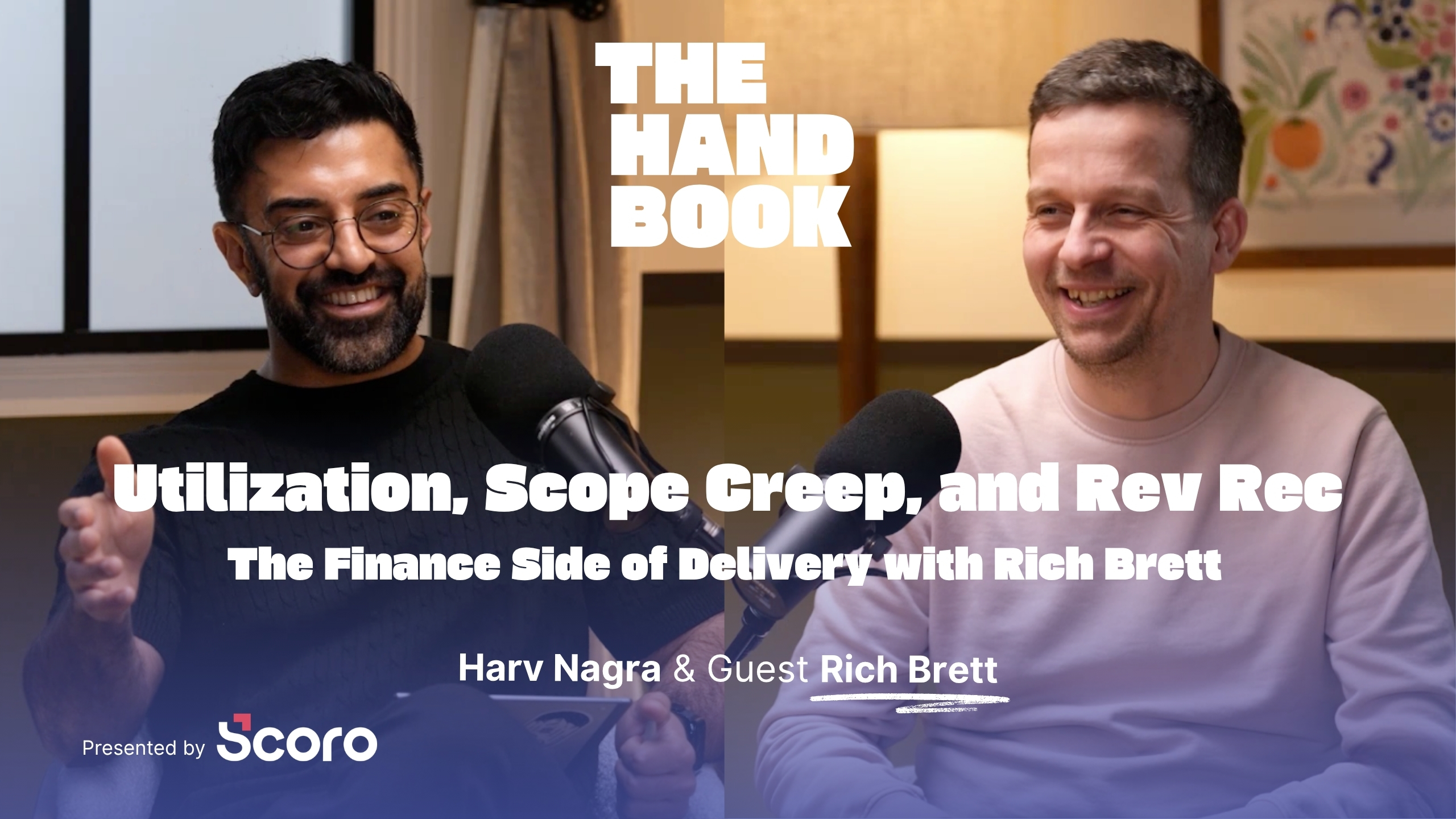
In this episode of The Handbook, Harv Nagra sits down with fractional CFO and Trimline founder Michael Wark to unpack why so many service businesses hit revenue ceilings, run on thin margins, and stay stuck in that exhausting cycle of over-servicing.
If you’ve ever wondered why more clients and more staff don’t automatically create more profit, this one’s for you.
Here’s what we get into:
- The hidden math behind low profitability – and why over-servicing is usually the real culprit
- Why headcount growth can become an ego metric (and why hiring your way out of inefficiency rarely works)
- How to diagnose your true unit economics and reset your pricing based on reality, not optimism
- The operational signals your business is running harder in place rather than growing
- What healthy, scalable service businesses measure – and the benchmarks Michael looks for in top-performing firms
Whether you’re firefighting day to day or thinking seriously about scaling, Michael brings a clear, practical lens to understanding your numbers and building a healthier business.
Listen to the full episode to hear the data, the patterns, and the playbook that can help you break the cycle. 🎧
Additional Resources:
👉🏽 Follow Michael on LinkedIn.
💰 Check out Trimline.
📺 Check out Michael’s Youtube channel.
👨🏽 Follow Harv on LinkedIn.
📈 Measure your business maturity and find out how to get to the next level: https://bit.ly/assess-business-maturity
📬 Stay up to date with regular ops insights. Subscribe to The Handbook: The Operations Newsletter
Transcript
Harv Nagra: [00:00:00] Harv Nagra: Hi all. Welcome back to the Handbook. I’m Harv Nagra. I’ve got a friend that works in the service business. In this case, it’s an agency that’s run, well, let’s just say not run very well. Okay? They underprice everything. Essentially making up a budget That’s a fraction of what the competition charges.
Overheads are not considered. So margins never make it into the equation. Naturally, projects are under quoted, hours balloon, and no one tracks time consistently enough to know where it’s all going. It’s a wonder they’re still in business. You might be shocked to know that they’re over 10 years old.
Talk about being stuck in the chaotic era. But this isn’t an isolated story. Across agencies and consultancies, the same themes crop up: over servicing, scope creep, utilization blind spots, and confusing busyness with real growth.
That’s what today’s conversation is about when you’re scaling effort, not results. Our guest today is Michael Wark, fractional CFO Chartered Accountant and founder of Trimline, a Fractional CFO firm. He recently ran a survey into the state of independent agencies in Australia, and the results shine a light on these exact challenges.
And while the survey may have looked at agencies down under, you’ll find relevance to all kinds of service businesses, and you’ll hear similar patterns all over the world. From slim profit margins to the hidden costs of overservicing to why you shouldn’t confuse headcount with progress. Michael’s gonna tell us what to look for if you wanna build true sustainable growth. Let’s get into it.
Thanks for listening to The Handbook: The Operations Podcast. This podcast is brought to you by Scoro.
If you’re running an agency or consulting firm, you might live inside tools like Asana, Trello, or Jira. They’re great for tasks and collaboration, but they’re not built to run your business. So you bolt on more stuff and end up with a patchwork of a dozen tools. Everything’s out of sync, and there’s no single source of truth.
Scoro is different. It’s a modern PSA that combines the power of an all-in-one platform with a modern ux. From pipeline to projects, to billing to reporting. You get one place to plan, deliver, and track your business. Leaders get the dashboards they need. Delivery folks see the work and numbers that matter. And specialists just get a clean view of their tasks and time. Go to scoro.com/demo to arrange a call and learn how Scoro can help take your business to the next level of maturity. And for the VIP treatment, tell them Harv sent you. Now let’s get to the podcast.
Michael, welcome to the podcast. We’re gonna be covering a few different topics today, but before we dive in, what prompted you to run this survey of Aussie agencies and what surprised you most about the result?
Michael Wark: The motivation was that I wanted real data based on the people that I serve day to day. a lot of the, the people in the agency space who are thought leaders are often, North American based or European based.
And I’m like, I wanna know what our local market’s doing, which is a useful contrast when comparing to the US and the uk just to see how we stack up. So that was the main motivation. and yeah, it was really interesting to, to do the results. That was our first year of doing it and I’m gonna try and do it every year moving forward now to see how the data changes over time.
Harv Nagra: I was flipping through the results. I, I think it’s super useful to have localized data, but at the same time, challenges tend to be universal, right? We’re, we’re all having trouble with, similar kind of challenges anyway. one of the standout stats that shocked me, okay, 37% of independent agencies are running under 10% profit. Why do you think profitability is such an ongoing challenge?
Michael Wark: I, I, I think it’s timing a little bit. So half of it’s kind of business model. coming out of COVID where wages boomed, inflation went nuts around the world, interest rates were super low, and so the price of everything went up. And people, like there was, there was staffing shortages, trying to find good talent.
so, so the payroll or the, the wage cost went up. but at the same time the market’s gotten tougher and the people that agencies are selling to are price sensitive and that, you know, everyone’s starting to tighten their belt and so there’s not a lot of wiggle room with increasing the prices.
So they kind of had to eat that margin of higher wage costs, higher rent overhead, and all those kind of things, while still not being able to pass it on to their, to their customers. So that was one big part. But I think as you mentioned, the universal nature of challenges for service businesses.
The second is that I think just over-servicing is endemic across all my clients I see, everyone I speak to. and I think that’s another key component of this is that, it’s endemic. ’cause it, it’s a beast that grows over time. It like, it’s, it’s like a mold grows and constantly and each, each month it compounds.
and that’s another key challenge of it.
Harv Nagra: We’re gonna be getting into more of that in a few moments, but I, I just wondered if you can run us through any other interesting stats that might have come up in that research.
Michael Wark: The second stat that was super interesting was num, the headline. As you mentioned, 37% are less than 10% net profit, but also 69% of respondents were still planning to grow their team and hire. And that was really something that scared me a little bit.
They’re not profitable enough to actually grow the team. They’re not keeping enough cash in their business, so they’re flying really close to the sun and risking a lot, probably not even knowing that they’re risking it. But that was the other really, scary stat that I found that people are looking to grow the team regardless, even though they’re probably not in the right shape to be doing that.
Harv Nagra: Mm-hmm. you know, I, I was reading something that you said, I think it was in the report that you said, you don’t fix a sinking ship by adding more crew. Can you, can you explain that a bit?
Michael Wark: If you’re unprofitable, adding more staff will make you less profitable. And I know that sounds obvious, but the, the actual challenge I see is that
people are in a tricky spot and they’re like, you know what? We need to sell like crazy to add more revenue to solve a cash crunch to solve a problem that we’ve got in the business. So we need more revenue and cash. So they sell new clients, but then the staff are already at capacity and burnt out and screaming for help.
So then they’re forced to make another hire. So it’s just the endless jump between new client. New person, new client, new person, and they can’t ever decouple those two things through efficiency. And so they’re not profitable enough, but they’re still adding people.
Harv Nagra: Yeah, that’s really interesting. I, I think we had a recent guest, she was a CFO as well, a fractional CFO, and, and she was saying that when you’re running an inefficient business, you always feel like you need more people. But the reality is that if you are running in a really tight way, in control of your business, you would realize that you probably have too many, but, but you’re just not resourcing and working as optimally as you could.
Michael Wark: Yeah, absolutely. And we see it, I’m sure as like fractional CFOs. I’ve got up to 20 clients at one time, right? So I’ve got a visibility over a wide snapshot of people and like I see the efficient ones and then I see the inefficient ones who just get started with me and they’re living in a different reality.
Like the staff are like, we couldn’t possibly add more clients to this list. And I’m like, the numbers are telling me that you have to add more clients and you need to find efficiencies. But that, that path between those two extremes is tough, it’s hard, involves a lot of investment, a lot of training, which is why it’s, it’s hard to do.
Right. And that’s, that’s why so many agencies are struggling. ’cause not easy.
Harv Nagra: Absolutely.
sometimes we associate headcount growth As a sign of growth in the business,
Michael Wark: mm.
Harv Nagra: you think that’s a, a fallacy?
Michael Wark: I dunno if it’s a fallacy, but it’s, headcount is often an ego metric for founders. it’s one of the most common things that someone will ask you at a business networking event is like, oh, how big’s your team? or it’s nice to, to, to throw that number out at dinner parties to show that you are a big company.
so I think there’s a, a certain incentive to have a bigger team. and, and that sometimes gets wrapped up in it. A little bit of that, that kind of ego. It’s not the main, it’s not the only driver. But I think that’s a little bit part of it, of why people might wanna carry more than they need to.
Harv Nagra: Absolutely. So Michael, when a, agency consultancy feels underwater, you know, things that you might feel, the, the stretched team you’ve got the over-servicing, you’ve got the thin margins. if that’s the case, where should leaders focus first instead of defaulting to hire to try to create more capacity, like we were just describing a moment ago?
What would you say to somebody that’s, facing those challenges?
Michael Wark: Look like many challenges in life, one must look inward first, right? So. I would start with the unit economics of your business and the unit economics of your retainers and your projects. Boil it down to understanding what you’re actually charging clients, what you’re delivering. Are those things in balance?
You charge out rates properly, what are the hours you’re doing? And get an understanding of, of the, the base building block of your entire business. And if that’s broken, then you’re building your house on sand and everything else will be hard. You’ll be, pushing shit uphill. There’s an expression we have here in Australia, you’ll be struggling from the get go.
so I’d start with the unit economics of those things. And then in terms of actioning it, I would increase the prices on any clients who aren’t paying that proper rate that you should be. So people are often overservicing or underpricing, a combination of one or the other. So you need to hike the prices on those, you know, your bottom five clients as a starting point.
Harv Nagra: Mm-hmm.
Michael Wark: they don’t like that price, often they don’t because they’re just rusted on. You need to have enough clients in the pipeline to fill them and do a one in one out. Boot the worst five, bring in five more that are super profitable, that have clear scope that you’re gonna make some money on. And then start building your way out of that as well.
And obviously increasing the, the overall retainer number as well through efficiencies. So it is kind of a multi-pronged approach through increasing your prices on existing clients, increasing your prices on new clients that you sell in, whilst getting more efficient.
Harv Nagra: That’s a really good point. I, I think over time, as we grow and mature as well, we, we tend to hang on to clients ’cause that’s always a metric as well, right? You want the repeat business
Michael Wark: Mm
Harv Nagra: but we tend to hang on to clients that come from a previous stage of our growth and stuff like that and they, they struggle with the price rises
Michael Wark: mm.
Harv Nagra: stick to their kind of legacy pricing
Michael Wark: Yeah.
Harv Nagra: of working.
So it’s always a challenge. So I, I think Being okay with letting them go, as you described, is, is probably a really good shout.
Michael Wark: And that’s why people bring in a fractional CFO because we’re the adults in the room that have to give them this, this bad news, and then it’s not on them. It’s like, I’m telling you, you have to, so you know, we, we need,
Harv Nagra: yeah.
Michael Wark: and when I show them the math of it, it’s like, you are volunteering, you are subsidizing your services.
You, you, you are paying wages and not collecting enough money for those wages you’re paying. Like it’s, it’s money that should be in the founder’s pocket. And once they truly see that, they’re like, yeah, okay, we need to, we need to change this.
Harv Nagra: Mm-hmm. Alright, so, another thing that your survey found was that almost half of agencies don’t track utilization at all. So tell us about that. Why does flying blind on utilization, what does that do to the business?
Michael Wark: I, I think the scariest part is that they don’t know when they’re going off track. Like you, you don’t have that little blinking red light on your dashboard saying, warning, warning, we’re going off track here and we need to adjust. Especially on projects where there’s big dollars amount and you need to deliver over a long period of time, that needs to be monitored regularly to make sure that the end result isn’t too far off.
’cause you can, you can have massive losses that way. so I think that’s probably the scariest part is, is not knowing when things are gonna go wrong. and often founders will have like a rule of thumb. That they’ve kind of, or a gut instinct that they’ve worked by that’s got them this far, but it doesn’t scale and it doesn’t, you, you can’t grow a business to 10 million beyond through that gut instinct.
I think it’s it works at a certain level, but it doesn’t work the bigger you get.
Harv Nagra: Why is there a reluctance to kind of embrace time tracking , do you think?
Michael Wark: Cultural I think part of it, like Big Brother tracking me, like I started as an auditor at Ernst and Young. I used to hate doing it every 15 minute increments. End of the day I had to say what I’d done. So there’s just. inertia of another task people have to do throughout the day, which is a bit of a pain.
I also don’t think people educate their team. As to why it’s important. They think that they’re being tracked personally because they are not trusted. So it’s a messaging thing too. when I help clients implement it, it’s always about protecting them from burnout and making sure that our clients aren’t taking advantage of it.
So I always look at it through the lens of client profitability. How many dollars are our clients giving us? How many hours are we spending on it? What’s that average billable rate? Does that make sense? At a really basic level? But the pitch to staff, which is genuine, is, well, if you wanna work a four day work week or you want to, take time off, you want to be more efficient and get rewarded, we need to know where your time’s going, and we need to have a metric to work out.
Yes, you can do that because everything lines up. But otherwise it’s just a black box of unknowns.
Harv Nagra: Absolutely at the end of the day, you wanna make sure the projects you’re selling are, are profitable. Right. And, I, I think that’s a really important thing to say to people. It’s not about tracking you, it’s making sure that we’re pricing things right and
Michael Wark: Mm.
Harv Nagra: delivering things within
Michael Wark: Yeah.
Harv Nagra: because everyone feels burnt out, when stuff goes over serviced.
Mm.
and, the team will be expressing their frustration. And the only way for us to do anything about it is if we’re tracking.
Michael Wark: And, and, and the other thing I see at the end of the year when they’re like, you know what, that was a terrible year. I worked so hard. They’re like, Hey, can I have a pay rise or a bonus? Because I worked so hard this year, and the founder’s like, we literally don’t have the money for it. Like, we’re not even profitable enough.
We’re sorry. So it’s like there was, there was no even upside for it, So that that’s when it, you really need to fix it.
Harv Nagra: And there’s like a lots of new and interesting, I shouldn’t say new and interesting, but like there’s a variety of ways. You can track time as well now, right? It can be calendar based, it can be the timer and the manual time
Michael Wark: Mm
Harv Nagra: stuff like that. But there’s a lot of like, apps and stuff like you can use that allow people to track time in a way that works for them.
So there’s just really no excuse. I, I think you just have to get your team on board
Michael Wark: mm
Harv Nagra: communicating the reasons, like you
Michael Wark: Yeah.
Harv Nagra: is the way to get about it.
Michael Wark: What are your favorites for in the time tracking world?
Harv Nagra: For, for what I do for myself, I do it calendar based. So
Michael Wark: Yeah.
Harv Nagra: literally block out things that I’m gonna be working on and then retroactively go and add things that I did work on and then tag it. I, I use Scoro obviously,
Michael Wark: Yep.
Harv Nagra: I tag it to the project and stuff like
Michael Wark: Yeah.
Harv Nagra: when I, worked in my agency, what I loved is that we would, Resource our teams, our our designers and developers for example. And by doing that, it was effectively that their time sheets were automatically completed ’cause this is what they were meant to be working
Michael Wark: Yeah. Yep.
Harv Nagra: days. And all they had to do was validate that this is what I worked on. or it took an extra 30 minutes or whatever.
So, so that was really useful for them ’cause they didn’t have to do any of the manual stuff as
Michael Wark: Yeah, I think that’s, that’s it. The devil’s in the detail. Make it as easy as possible for people.
Harv Nagra: Absolutely. So scope creep came up again and again in your survey and the thing about scope creep is that you only see the impact if you’re tracking time, like we just said. Right. And even then, you have to be inclined to do something about it. because I’ve been in that situation, my past agency where you track everything, but then it gets a bit muddled in terms of what you’re doing when stuff is over serviced. ’cause then people start making excuses saying, oh yeah, that was our fault. And,
Michael Wark: Mm
Harv Nagra: it is, and other times it’s just like, oh, well we can’t ask the client for more budget.
Michael Wark: mm.
Harv Nagra: who have you seen really in control of this? Or how have you seen, getting really in control of this?
Michael Wark: I think it’s always learned the hard way. So, it’s a trick for young players to deal with it. And then you’ve gotta work out a system that works for you. And, and the, the best clients I’ve seen have super clear processes. They have them documented, they’ve trained the team on them, like it’s doing the basics right.
But it’s also really hard to make the team follow that process and stick to it and get them to know when it’s in and out of scope. so having that piece connected between not just having an SOP that gathers dust in a G drive, actually have a workflow management system where people are looking at the tasks, critically thinking, are we on track or off track?
Is that out? And having a process for escalating it to suggest an upsell cross sell a bonus pack of extra hours, whatever way they wanna deal with it. yeah, that’s a really important part of, how the good players operate and, and try and protect against it.
And also the best ones I’ve seen have a second level person that, that it escalates to and they have that conversation, like the technician doing the work wants to keep the client happy, which is natural. And so it’s really awkward for them to be saying yes to them all day and trying to keep them happy.
But then also have that awkward conversation. So having a another channel that comes in over the top for those conversations can help make it a little bit less awkward.but one of my favorite clients says that service businesses is just the art of expectation management. And as long as you’ve set the expectations upfront, properly, clearly.
Then when you remind them of those expectations later on, it shouldn’t be a big deal. ’cause everyone was clear on what was in, what was out from the get go.
Harv Nagra: Good client onboarding. Right.
so something that you, you’ve said is that you’re not undercharging, you’re over servicing, theme of the day.
do you mean by that?
Michael Wark: that was born from a, a data point we pulled about the, the charge out rates. So here in Australia, the charge out rates were pretty good for industry standard, like around 200 ish, between 180 to 250 Australian dollars.which was, should be a fairly profitable business, but 37% were less than 10% net profit, so that there was something broken.
Their charge rate looked okay, but the, the, but the net profit number said that something was broken. and then the only other thing that could really move the, the needle there is the amount of hours that they’re throwing at each of those things. And so what I was trying to say with, if you’re not, you’re not under charging, you’re over servicing.
Maybe your retainer is priced correctly. It’s 200 bucks an hour times X number of hours, and that’s the retainer. But if you are throwing twice the number of hours at it, your actual charge out rate in reality becomes a hundred bucks. And so it’s like your price looks okay, but you just didn’t actually stick to the estimated hours.
So that’s, it’s just a pretty simple, hours time price. And if one of them goes way over budget it throws all the math out.
Harv Nagra: If we talk about kind of signals, what are signals that a business is running harder in place rather than actually moving forward, what, what kinds of things would you say are red flags?
Michael Wark: I mean the, the literally the most obvious is that they hit revenue ceilings and they’re like, they come to me and they’re like, oh, just can’t, we just can’t push. We keep knocking on the door of three mil and then something happens and we break, and we’ve been doing this for years. So like an actual glass ceiling of revenue is one. and that’s generally because something in delivery or the process breaks and clients leave and client churn brings them back to earth and then they make another run at it. other ones are low profitability. cash runway less than a month. They’ve got debts that they’re struggling to keep up with, which is a bit of a drain on their cash flow.
we already mentioned one, which is adding a new client means you have to hire to fill a gap for that client. You can’t just scale clients. And keep the same team. You don’t have any leverage, you haven’t found any leverage or efficiency with your existing team. and that’s connected to the team, pushing back, being burnt out, like, team churn or client churn.
Obviously two key big ones too, where people are spinning their wheels and that, you know, I’ve had some clients where they had a horror year and they had like 30% churn over the year, and they were literally sprinting on the treadmill on sales. But at the end of the year, they’re exhausted and in the same spot.
So those are probably the, the key ones from a CFO lens that come to mind. yeah. Do you see ’em any in, in your world as well? What have you seen?
Harv Nagra: I mean, they all trigger me, everything you’ve said, but the, the cash runway less than a
Michael Wark: Yeah.
Harv Nagra: Fills me with dread. I remember a couple years ago the UK was Really struggling
Michael Wark: Mm
Harv Nagra: and yeah, I remember, I remember those kind of conversations where it was just like, we need to make decisions on headcount if this, if these sales don’t come through, or these invoices don’t get
Michael Wark: mm.
Harv Nagra: it’s just so uncomfortable. So,
Michael Wark: It is and, and that’s, I didn’t mention it at the top about why everyone’s struggling in profitability. But that’s another key behavioral problem that’s not spoken about enough, is that people are too slow to fire. ’cause firing is hard. It’s like getting efficient in operations. It’s actually really hard.
It takes a lot of work and a lot of investment. And firing people, it sucks. It hurts you as a human. It’s the every founder’s worst day at work. and people don’t do it quick enough. And so even though the numbers are telling them we need to, there’s the human element where they pause doing it, and that erodes their cash flow and their profit for too long.
Harv Nagra: I think that’s something that I had to learn, as well, is that that does take a lot of maturity, I think, that you do have to make those decisions for the business rather than letting emotions cloud or slow you down.
and you were saying that earlier that sometimes bringing in that outside voice can be really valuable, like, like yourself a fractional CFO and I think that is really valuable. And what you can learn from that,
’cause often this out outside expert doesn’t have the relationships with these people and can just look at the facts. But the point is, even in-house, we have to learn those skills ’cause we’re here to run a profitable business and not doing so means that we might be, collapsing
Michael Wark: Yeah.
Harv Nagra: lack of a better
Michael Wark: Absolutely. Look, I’ll give you a bit of my hidden ip. Here’s how I pitch it to founders, right? When we are in that situation, I come in, the first one I tell them is, Hey, it’s better having 25 people employed rather than holding onto this one extra person and the whole business goes broke, and then no one has a job because you held on too long for one or two key people.
So it’s, let’s keep the ship afloat and moving along, becausethe opposite is obviously worse for everybody. And then I don’t see firing as like a negative thing. You’re just releasing them back into the market to find a better suited job and they will go onto new opportunities and new things.
It’s never literally anyone’s last job. And so it always usually works out in the end. So they need to take that approach.
Harv Nagra: Mm-hmm. Mm-hmm. Really, really good advice. so we’ve been talking about the red flags, but I wanted to ask you on the flip side, what are the kind of metrics or proof points that show that you are healthy, you’re running things really well, and that you can scale?
Michael Wark: Yeah. Okay. So there’s a few, and I look at them in unison. There’s no one metric to rule them all, and I’ve got into lots of arguments on LinkedIn about this, but. The, the key basic one is your total wage bill is taking up less than 50% of your revenue. and I ideally 45%, but honestly, generally 50% is, is a good target.
45% I would say is elite. I don’t have seen many clients in that range. obviously your net profit’s about 20% as well. That’s great. That’s probably a good place where you can still invest in a team member and your profit will only drop back down to, 18%, 15%. So you’re still, you’re not, you’re operating from a profitable place.
They’ve got more than three months of cash runway, so they’ve got working capital in the business that they’re not using for other things. So they’ve got a bit of a, a war chest to sustain some storms as we invest in scaling and growing and, they’ve got, they can invest in a website, they can invest in marketing.
They’ve got the cash to do that. From a, billable rate perspective.my rough rule of thumb there is whatever the person’s hourly cost is, you should be marking it up three and a half times to four times to get their charge out rate, so you’re building in enough margin.
So that’s another really important one. obviously utilization on most team members is, 75% ideally or above. and then across the whole team it will drop a little bit ’cause you’ve got management who aren’t as billable. so those are some, some key ones that I look at regularly to, to know if this business is, is ready to scale.
Do they have enough cash, are they profitable enough? and then the other ones in terms of more sales focused, like if we’re thinking scaling is like, what’s your pipeline like? Can we make hires in advance? ’cause we know you’ve got a pipeline coming and that helps us make bolder decisions when we know they’ve got a, a clear look at what’s coming ahead.
and, and then we can get a bit more bold.
Harv Nagra: Mm-hmm. Good examples there. You know, something that kind of made me laugh to myself when you were just talking about that is that you’re talking about kind of the healthy rates and that kind of stuff. Right. I’ve got an example in the intro I was talking about a friend of mine that works at this, like really chaotic level one maturity business and when they told me, when he told me what their hourly rates were, I was shocked because it was like double what my previous agency was charging. Yet these guys charge a fraction of the time that all the competition does.
Michael Wark: Mm.
Harv Nagra: is like ridiculously over service. So that’s just a really weird vanity thing they’re doing by saying, oh, our hourly rates are like super high. Like, I, I don’t know
Michael Wark: Yeah.
Harv Nagra: benefit that’s for when they’re charging like five hours to do everything. And, and, and then, panicking about profitability.
Michael Wark: Yeah. I mean, and we’re talking about staff previously you’re just setting your staff up to lose, aren’t you? You’re like, oh, you’re over a budget again. You know, a lot of these profitability issues are won or lost on the pricing and quoting. And that’s why I said, if you’re trying to get someone out of a sticky spot, go to your unit economics, unpack it, make sure that’s locked in.
And with realistic time estimates based on time tracking from previous clients. So you literally know actually in reality what it takes and then you’re setting yourself clear goals because yeah, I, I think there’s a lot of challenges in business that pop up from ego. Things like our high charge out rate or our big head count, or our NICE office or the founders leased European car going through the business.
All types of things that sometimes sneak in. And as a CFO, that’s my job to call ’em out.
Harv Nagra: absolutely. So Michael, you gave some really good examples of healthy proof points that your business is doing really well, right? But I was just wondering if you do come across businesses that are doing all those things well. Like, why, how did they get there? did they, did they bring in outside help or the founders having like a really good, financial background and stuff like that?
Is there, is there any interesting patterns there?
Michael Wark: I think it’s, it’s often on the founder, of course, most businesses success is and it’s the founders, if I think am my stable over the past six years have been doing this full time helping as a fractional CFO for agencies, founders have a growth mindset. They learn, they invest in consultants or specialists to help them improve their workflows and things like that.
So yeah, that always learning, always growing approach. they attract good talent as well, which then further compounds this positive flywheel. and I think those are the two anchor points of, of. What the successful businesses do, and they learn their lessons, they don’t keep repeating their lessons.
They’re self-aware enough to know their weak spots. And they invest in those weak spots to get better bit by bit. and often they have a good strategic view of what’s gonna move the needle and they focus on the right things. They don’t just focus on the stuff that’s maybe fun, but actually isn’t gonna get ’em the outcome they want.
Harv Nagra: The sad thing is that I think self-awareness comes with a bit of maturity and time and pain,
Michael Wark: Mm.
Harv Nagra: Before you get to that point. But like, if, if a business isn’t doing that well, then they, they might struggle with the outside expertise as well. What would you say to somebody that’s in that situation? It’s like, we’re already struggling. Can we really afford to bring in somebody from outside?
Michael Wark: , In those situations, like some, like in my instance, if, if a business, because I, this happens often, like people will reach out ’cause they’re like, we need cash, we’re struggling. You’re A CFO, you know how to do it. Often I’ll do a short term project, right? We’ll do a one or two month to get started and I’ll just give them the playbook or I’ll give them the first three months of the playbook and say, run this, come knock on my door Once you’ve done it.
And then the founders who are really serious about taking that decisive action will do it and come back, and then we can take that next step. but often it’s overwhelmed when people are struggling, they’re panicked, they’re making decisions based out of fear. And so, I guess that’s, that’s really hard to help someone who’s in that mindset.
And I’ve gotten better at saying no to those kind of clients because I get sucked into the vortex and I feel bad, I’ve had situations where you’re trying to help them, but it’s, the momentum was already swinging one way. And,I’m not a miracle worker. I can’t just magically find 50 K of sales in my back pocket.
So, yeah, it’s it is a tricky spot, but I try and simplify it down to the key things they need to do in the next steps to help them and, and try and, and, and try and let them loose.
Harv Nagra: Yep, that’s a good point that the project can be short term, to just get some of those skills or, or some of those plans in action.
Michael Wark: Absolutely. And the, I think the evolution of my, coaching over the past six years, often when I first started, I was too focused on the one spreadsheet that would solve all their problems or the model that would prove that this would work or this fancy forecast.
But I wasn’t truly just focusing enough on diagnosing the real problem. And then focusing on what the key step is to improve the outcome. so I’ll give you an example. someone’s cash strapped and struggling, they don’t have time to do a full client profitability analysis. Get the time, look at retainers, see how it’s trending over time.
I’ll just say, who are the pain in the ass bottom three clients. And ask your team. And, and they’ll know. They’ll know who the painful clients are. They’ll know who the ones who are demanding. And they’re over servicing. I’m like, we already know who your bad eggs are. We literally don’t need to run the data.
Ask your team and reflect. Take action on them first. Fix them first, increase their prices or swap them out. And so it’s in those tricky situations, it’s just like, what’s the outcome we would take if we ran all the fancy modeling and data that we could do? And then just focus on that outcome and the simple next step for that outcome.
Harv Nagra: Really, really good advice.
So Michael, from a finance and ops perspective, what do the best run service businesses do differently when it comes to balancing growth and profitability?
Michael Wark: So if we’re combining finance and ops, and that’s where the magic happens, really. They have a clear picture of their future pipeline if we’re thinking about growth. So they’ve got a clear view of future revenue dollars, but they’ve also got a clear picture of the people they need to deliver that revenue.
And so they’ve got a way of working or reverse engineering their resourcing needs to plan the org chart as we grow and as we stair step it out. And that’s based on data. And they can rely on that data ’cause the team aren’t over servicing. So it’s, it’s a more measured and structured approach because they have those two key data points.
And that was off the back of things we already spoke about, like clear processes for people to follow. They’re looking at their data regularly, both time and finances. And they’re changing and adjusting as needed, but, but they’re looking at those kind of future based things and then being able to make decisions with a bit of clarity.
So I think those are the ones who make it up, the scaling curve ’cause they’ve got those tools at their disposal.
Harv Nagra: Excellent . So we, we are coming up towards the end of the, the conversation. If you could give our listeners one piece of advice, whether it’s from your research or your experience, something to act on tomorrow, what would it be?
Michael Wark: Well to summarize this pod, Fire your painful clients who you know are costing you money. So that’s probably the first one. Or at least bring it up and have a look at your client profitability. and that might help with your team burnout and team happiness and have a lot of positive flow on effects.
but like holistically, if we’re thinking about like, my takeaways from our research, I would say, especially in the operations world, embrace the boring ’cause what you do drive so much profit in the business. So like the processes, the workflows, the systems, get ’em world class and get your team to follow them.
But don’t over egg the sauce, keep them as simple as possible, break it down to the core tasks they need to do so people will actually follow them.
Strip it back to the basics and and, and that’s gonna drive the efficiency in your business. ’cause you can train people. Staff turnover isn’t as big a deal ’cause you can train up the next person quicker and you’ve got those processes. And if you don’t track time, obviously start, whatever way you do it, that would be a key, key thing to action.
Harv Nagra: So, Michael, where should people find you and connect with you?
Michael Wark: I’m most active on LinkedIn, so, Michael Walk, WARK on LinkedIn. Feel free to add me. And I try and post three times a week there in the occasional video. and I’m just trying to grow my YouTube channel, which has been a long-term project. I’ve got an embarrassingly low number of followers, but, Michael Walk fractional CFO on YouTube as well.
Or if you just wanna see what Trimline does, you can go to Trimline, T-R-I-M-L-I-N-E. Co trimline.co and you can check out what we offer there in terms of the CFO services.
Harv Nagra: Amazing. And you’ve got a couple of really good resources on your website as well, eBooks, and stuff like that.
Michael Wark: Yeah, absolutely. In the resources section that you can even download the report we’ve been talking about, and there’s a, a book on scaling to 10 mil. Everything I’ve learn, so there’s a few things there.
Harv Nagra: Excellent. We’ll put a link to your YouTube, first of all, and everything else in the episode notes as well. Michael, it’s been absolute pleasure having you on the podcast. Thank you so much for joining us.
Michael Wark: Thanks for having me. Really enjoyed it.
Harv Nagra: What I loved about this conversation with Michael was how practical it was. One of my favorite lines of his is what we started off with. You don’t fix a sinking ship by adding more crew. And Michael pointed out that headcount growth can be an ego metric and how hiring your way out of inefficiency is usually the wrong move.
When we moved into pricing and quoting, he highlighted something that I think everyone in a professional services business can relate to. On paper, the hourly rates or the day rates look fine, but there’s a lot of delusion or optimism around how long things are gonna actually take to deliver. As a result of that, a huge amount of over-servicing happens. Anyone who’s felt pressure on pricing will recognize that pattern.
We also dug into kind of the boring but essential stuff. You know, tracking your time properly, knowing which clients are actually costing you money, having the courage to either reprice them or let them go, and understanding your unit economics.
By the way, for anyone unclear unit economics in this context means looking at what you charge for a project versus what it genuinely costs you to deliver once all the real hours are counted. It’s the clearest way to see whether each piece of work is actually profitable.
And finally, I really like Michael’s point that great operations and finance aren’t about heroics. They’re about simple, clear processes that people actually follow.
So guys, one ask for me as we wrap up. Think of one agency or consultancy leader you know, who’s struggling with the numbers or worrying about profit across a project, across their team, or across the whole business. Someone in your organization or a friend at another firm. Send them this episode and tell them to subscribe to The Handbook so they’ve got company while they get their house in order.
I’ll be back with the next episode soon. Thank you so much for listening.