







The work we produce gets all the attention.
But the real question is: what’s happening behind the scenes that makes that work possible?
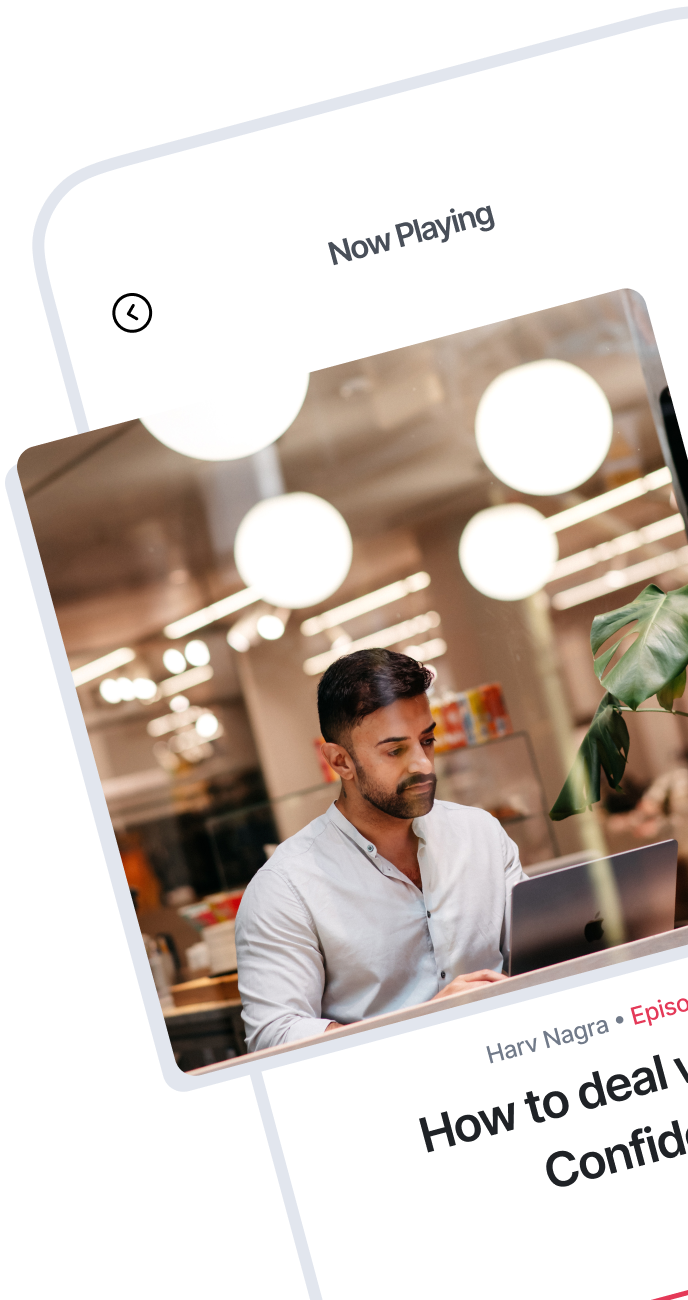
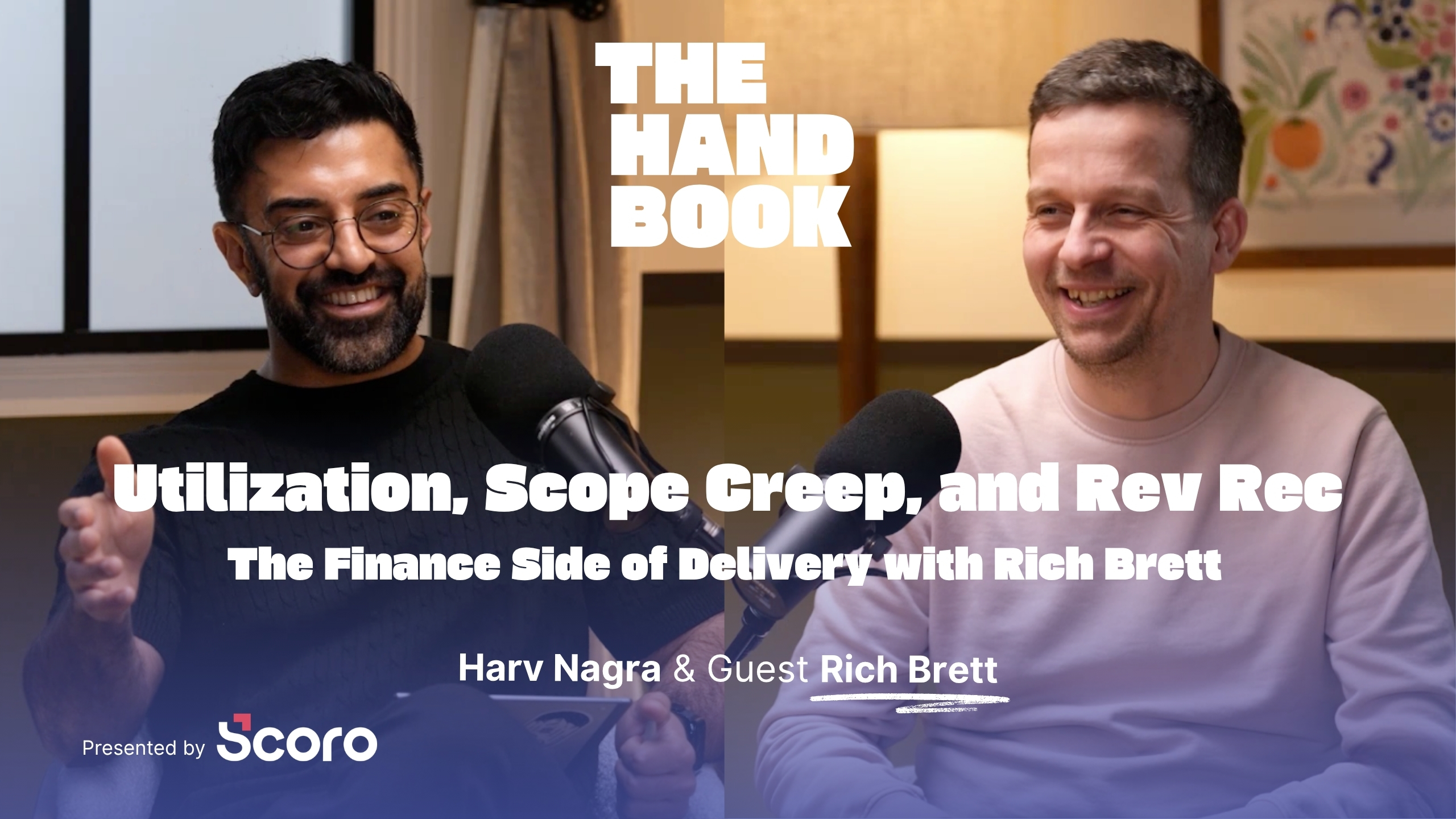
In this episode of The Handbook, Harv sits down with creative operations expert Nicky Russell, co-founder of WDC, We Deliver Change, and chair of the Creative Operations Summit in London. Together they explore the discipline of creative ops – the systems, culture, and leadership required to help creative teams do their best work.
What starts as a conversation about creative teams quickly expands into something bigger: how operations leaders create the environment where great work can actually happen.
Here’s what we dive into:
- What creative operations actually is – and why it’s becoming a strategic role inside agencies, brands, and consultancies
- Why ops is fundamentally about culture – not just processes, workflows, and systems
- Why happiness and psychological safety matter more than most leaders realise when it comes to producing great work
- How creative ops and business ops are converging as technology and AI reshape how work gets done
- How learning to speak the language of different stakeholders is often the key to unlocking real influence.
Whether you work in a creative environment or not, the themes in this conversation will resonate with any ops leader trying to build a healthier, more effective organisation.
Additional Resources:
👉🏽 Follow Nicky on LinkedIn
🌐 In-House Agency Leaders Club
🗓️ Henry Stewart Creative Ops Summit London, 19th March 2026
👨🏽 Follow Harv on LinkedIn.
📈 Measure your business maturity and find out how to get to the next level
📬 Stay up to date with regular ops insights. Subscribe to The Handbook: The Operations Newsletter.
Transcript
[00:00:00] Harv Nagra: Hi all. Welcome back to the Handbook the Operations Podcast. I’m Harv Nagra. On this podcast, we cover operations across the full spectrum from how you structure a team to how you manage delivery, to how you think about growth. But one area we haven’t explored yet is creative operations. It’s a discipline that sits inside agencies, in-house creative teams and even some consultancies, and it’s concerned with how creative output actually gets made.
The workflows, the resourcing, the processes that sit behind the work. But it’s also, and this is where it gets interesting, about the culture and environment that people need to do their best work. That’s what we’re getting into today.
Our guest today is Nicky Russell. She’s the co-founder and managing partner of WDC, We Deliver Change, a change management agency specialising in creative and marketing operations. She chairs Henry Stewart’s Creative Operations Summit in London, widely recognised as Europe’s leading authority in the space. And she’s co-founder of the in-House Agency Leaders Club, or IHALC , which champions the in-house creative community.
Whether you work in a creative agency or not, the questions she’s asking are about how ops leaders build culture, earned strategic influence, and create environments where people actually thrive. Those aren’t creative industry questions. Those are questions every ops leader is grappling with.
I’m really excited for you to hear this conversation and we’ll get into it in just a moment.
Thanks for listening to The Handbook: The Operations Podcast. This podcast is brought to you by Scoro.
If you’re running any kind of professional services firm, you might already have a legacy PSA in place. On paper it does everything: quoting projects, invoicing, reporting. But it feels like it was designed 20 years ago. The interface is hideous, it’s clunky and unintuitive, and your team hates using it.
Adoption ends up being low. Data quality suffers, and you lose the very visibility you brought the system in for the first place.
Scoro is different. It’s a modern PSA that combines the power of an all-in-one platform with a modern ux. From pipeline to projects, to billing to reporting. You get one place to plan, deliver, and track your business. Leaders get the dashboards they need. Delivery folks see the work and numbers that matter. And specialists just get a clean view of their tasks and time.
Go to scoro.com/demo to arrange a call and learn how Scoro can help take your business to the next level of maturity. And for the VIP treatment, tell them Harv sent you. Now let’s get to the podcast.
Nicky, welcome to the podcast. Pleasure to have you with us today. I wanted to start off with hearing about how you got into ops and turned that into a career path. I know you have a really interesting story.
[00:02:44] Nicky Russell: I know it’s really random. I used to be called the football girl for so long, ’cause I was in football actually. I used to run a football up in my twenties. It’s really random. And, um, it’s gonna make me sound way, like bigger than it is, but I, I actually owned the football
[00:03:00] Harv Nagra: Wow.
[00:03:01] Nicky Russell: like a, know, but it’s not, everyone thinks of Steve Parish and it’s like, they used to call me the poor man’s Karen
Brady.
was there, it wasn’t, it wasn’t all of that, I was so used to running my own businesses. That when I sold that, I think I was about 31, 32. And, I didn’t know what I wanted to do next. I generally thought I was unemployable. So, uh, my best friend was working at Grey at the time. She said, why don’t you just come do a bit of work experience? And I did. I went in for six weeks work experience just as Neils Leonard and Chris Hurst
had joined.
Um, and for me it was like. I can’t believe you not get paid to do this. Like it’s insane. I just fell in love with the industry. They offered me a job. They said, where do you wanna
go?
And I have to say, I was looking at project management at the time and I just thought, God, these guys are everywhere.
They see everything. Like I wanna be in that team. and that’s where I started and it, I was there I think four years. And then I realised, oh, I, if I wanna, I can’t just keep mooching along. Having the best time ever getting paid to make brilliant
work.
I couldn’t help it. I bought my operational brain from running a business to that role. I had no kind of legacy point of view on how to run that role, but I could bring all that experience maturity to it
it. Couldn’t see anyone that was doing that role, and so I, yeah, I created it myself.
[00:04:20] Harv Nagra: So they didn’t have an in-house ops person at all?
[00:04:22] Nicky Russell: I, they had project management and they had a studio. The thing that for me, that I couldn’t understand was, is that when people are your product. You know, why are you not thinking about operations in the round? Why are you not thinking about it commercially? Because if you’re thinking about creativity, you had obviously amazing finance. I mean, we had Janet Marwick, excellent. Uh, she’s a consultant now and
she’s brilliant.
But you know, she was running the business.
You had a CEO who was interested in new business. Yeah, everyone was not siloed, but I just thought, I can’t believe that you haven’t got anyone looking at the running of this business and thinking about the bottom line and, the intricacies of how this business works.
And so I just couldn’t understand it. I generally was a bit, I just assumed that would be the case, but there
wasn’t. So I was lucky in the sense that the CSO there at the time had just started his own company, brought me in to run their studio and creative. operations and he kind of said, look, you can just do it as you want.
And I did. I set the template and, and then went from there and then obviously become more senior as time went.
[00:05:26] Harv Nagra: Right. You eventually got into a COO role,you chair of course Creative Ops London, And now you’re the co-founder and MD of a creative agency that works in operations.
I love hearing that like, um, so much of your career has focused on the space and evolving it into new and more interesting ways.
So Nicky, on the podcast, we talk about business maturity a lot, and we obviously talk about operations from all different angles.
What we haven’t spoke about before is creative operations. So for those of us that might be listening and saying, I dunno what that actually even means. Tell us what that means and what does a creative leader do?
[00:06:06] Nicky Russell: So everyone has a different version of what they think creative ops is, and that, I think just goes to show how the, um, the industry at the moment is at different levels of maturity. When you look at a creative business, but particularly in my area at the minute, which is advertising
and marketing,
It’s managing everybody that’s within that, creative ecosystem. So if it’s an agency, it’s the agency and generally all the creatives in there. And then also the production departments that normally sit alongside it. If you’re in a brand, and this is where the role is really evolving, that what you are doing is you are looking at that entire ecosystem of that
brand.
So if you think of any above, like any kind of chunky brand, like a Sainsbury’s, anything
like that.
who are the partners that we should be working
with? What model should we be building? Who should we be buying from? there’s, it’s quite an intricate system actually. and it’s a shame that the ecosystem. The buzzword is getting smashed about a bit, but ’cause it is a perfect example of the fact that there’s a lot of interdependencies and everyone has a role to
play.
But when it comes to what is the role, how do they
work together?
how do you continually optimise how you work? That’s down to the creative operations team. So in the past operations was very much in service to whatever we were get was being made, whatever the creative
wanted.
But when
you look
at. How people are engaging with media today, how people are engaging with brands. What does creativity stand for? creative operations is having a much more strategic role in terms of how, a business should be behaving, who they should be working with, and what kind of talent they need.
[00:07:39] Harv Nagra: Hmm. Do you think there’s a certain kind of head count size where an agency gets to or in-house team maybe gets to where this becomes more critical in terms of the necessity for this role. I’m just wondering if there’s a, there’s a point in kind of a, perhaps a smaller agency where a creative director or somebody like that might just take responsibility for some of this stuff.
What, what are your thoughts on that?
[00:08:03] Nicky Russell: I, I have thought I have thoughts on that because a lot of the time, a creative is the leader in that space. They are the leader in that space because it is their creative vision that you are servicing. Right. the problem is, is I think where creativity is going now, it needs to have the tension of operations. Creative operations is creative in itself. You know, it’s a, it’s a different way of thinking about producing, about putting different people together. And I think, you know, the worst thing that you can do is bombard a creative leader with the, the, the operations of how their team operate. Their brains don’t work like that. Like, uh, it’s, to me, it’s like a left brain, right
brain kind of thing.
Um, and I think it’s very different skill sets. And I think this is the thing, if you’re a CMO these days, or you’re a a, a senior
creative,
you want that next to you to turn around and go, this is my vision. How are we gonna make
work.
So I think when you’re in an agency or an in-house agency. There tends to be, there’s an evolution of the role of how we are coming
up.
There is a head of operations and that tends to be about 40, 40
people.
That is very much about how do I problem solve, how do I, um, you know, manage all of the different resources in the business.
[00:09:17] Harv Nagra: Mm
[00:09:17] Nicky Russell: There’s the bit that when you start getting more senior, and I think it, you know. It depends. Sometimes it’s a headcount thing,
[00:09:25] Harv Nagra: hmm.
[00:09:26] Nicky Russell: But also I think it’s how fast the business is moving and also what kind of role technology is gonna start playing moving forward. And I think then that role starts becoming a lot more value driven. It’s about how you can speak to the business strategically about where you wanna move going forward, but also how you can start quantifying some of the choices that you make. So it’s a language thing as well.
[00:09:47] Harv Nagra: Sure. I, I think you’ve started to touch on it there, but where does creative ops end and where does business ops begin? And do those two roles live in tandem or does like in an organisation where you need this kind of role, does one kind of subsume the other?
[00:10:02] Nicky Russell: It is, you know, a fascinating question. Let’s take a brand in-house to start
with.
Typically you’d have market operations, which is the business operations, and then you’d have the creative
operations.
historically they could be quite
separate.
Today they are becoming one and the same thing. Technology is forcing the coming together of these two roles. because so much about running a business at the moment… how do we want to integrate technology? What might that look like? When do we bring people in? When do we bring creativity in? the skillset of creative operations is definitely evolving to match business objectives rather than I think business leaders and business operations coming down and trying to learn it the other way
around.
Cuz
It’s quite difficult to do that unless you come from creative operations background.
[00:10:50] Harv Nagra: Hmm. That makes sense. So if we think about a creative ops function that’s working really well, what, what does that actually look like? You know, how is that structured? What do you measure? How do, how does it talk to the rest of the team? All that kind of stuff.
[00:11:04] Nicky Russell: Yeah. When a creative ops team is working
well
they’ve got data.
and most creative ops teams, it’s so hard to get hold of the
data
and have good data so that they can quantify the value that they’re
bringing
um, show that the work that they’re doing is
effective.
That they, when you get to, a lot of, in-house agencies or agencies, they’ve got a lot of people to keep happy.
Lots of people are measuring them on different
things.
a lot of the time it’s about how efficient are you being, ’cause obviously you’re in operations, so you need to have some value or some framework to be able to show the value that you’re bringing
there.
In marketing, they’re gonna care about how effective are you being, HR are gonna care about, have we got happy
people?
know what I mean? So creative is gonna care about the work. So I think have a way of being able to
measure
the impact that you are bringing as a business because it’s so important not only to protect
yourself
but also to be able to show where you need areas of growth.
[00:12:03] Harv Nagra: Right.
[00:12:04] Nicky Russell: And I think it also shows the level of creative ops maturity because I think when you can capture that data and go back to the business and say, in order to grow, I need X, and this is the value that I’m gonna bring
[00:12:14] Harv Nagra: Yeah,
[00:12:15] Nicky Russell: That’s really, really important.
[00:12:16] Harv Nagra: can, can you just get into that a little bit? What kinds of things are you suggesting measuring then?
[00:12:21] Nicky Russell: Yeah. So for us, we always say to, to measure,
effectiveness,
efficiencies, excellence. if you’ve got the data to show that the work that you are producing is being
effective,
let’s measure
that.
[00:12:34] Harv Nagra: does that mean hitting the client’s objectives? What do you mean by that?
[00:12:36] Nicky Russell: yeah, so this is the thing. Effectiveness means different things to different
people.
but genuinely, it’s like the effectiveness of the work. So the work that I’m making is it doing the job that it’s meant to do? What’s quite hard about that from a client perspective is it’s quite hard to get the data to see what is and isn’t
working.
So you have to be quite sophisticated in terms of what are the assets that you are testing to be able to really be able to turn around and go. We know that asset has thoroughly worked, but I think. Every client should be looking and building into their operating system and their ways of working, a way of being able to measure that work. because, it’s quite, it’s funny,we work with some clients where you might have a banner ad that might come through, which actually on paper doesn’t look that important. But the reality is that banner, a campaign for Christmas for an online sales retailer might have an X uptick in sales. Where a brand brief might come down, which they’re gonna spend time and money and effort on, which has a brand metric that they can’t
measure.
So So when you’re talking about prioritisation, that’s when you have to be able to turn around and go look to help us prioritise. To help us know that we are delivering for you. Let’s measure what is effective. But you have to come up with what those metrics are first and you need the ability to have the data.
[00:13:53] Harv Nagra: Makes sense.
[00:13:54] Nicky Russell: The efficiency piece always to show that the good operate.
’cause the thing about operations, it can feel invisible. You know the amount of times that people have said, oh, the operations is fine, we ain’t got a process. And it’s like, if you can’t feel it, it’s
working.
That doesn’t mean it’s not there, and it doesn’t mean it doesn’t need investment. So measure the efficiencies that you are
bringing.
And then of course the work, are you happy with the creative work that you
doing.
That’s where the excellence piece comes in. The other piece that I think is really important to measure, and this is where I think the role is evolving, and moved into culture is, let’s talk about the impact that it’s having on the
people.
Like, how, how are the
people feeling?
Do they feel protected or do they feel thrown under the bus?
[00:14:35] Harv Nagra: Hmm.
[00:14:35] Nicky Russell: You know, how is feedback given? What does that look like? and are you creating your best work? I think all of that stuff is really important to measure.
[00:14:42] Harv Nagra: Right. that takes us really nicely into our next question, which is something I’ve read that you’ve said that the role of ops is all about culture. that’s not, normally I’d say how most people pitch operations, right? We think about processes and workflows and procedures. Why do you see culture so central to operations?
[00:15:02] Nicky Russell: I get challenged a lot, particularly online, and people are going, Hmm, you know, creative operations is about value. It’s about efficiencies. It’s about commercial realities. Yeah, it, of course it is. But actually, when you think about
creativity.
Right.
Creativity is storytelling. creativity is about my human experience that I’m bringing to that brief, to hit that commercial objective or whatever that business objective is, so order for people to be able to feel like they can be creative, it’s that you, the, the, the expertise is being able to manage the discipline and the vulnerability at the same
time.
in order to provide, an environment where people feel like
it’s that I’m gonna get this wrong 10 times because the one thing I’m gonna say is gonna be
amazing.
Or, I can be vulnerable with this work that I’m doing because I know that the feedback is gonna be constructive rather than destructive. You know, all of this stuff. And no matter how much technology we move to in the future, how much everyone’s banging on about the
AI drum.
It’s still human beings that are managing this process and involved in this process. So of course it’s culture and I think we have to con cultivate that more
[00:16:15] Harv Nagra: Mm-hmm.
[00:16:15] Nicky Russell: particularly as you start getting people coming in and just going tech, ai, money all the time,
[00:16:20] Harv Nagra: Right?
[00:16:21] Nicky Russell: have to protect that, those people
[00:16:22] Harv Nagra: Mm-hmm. You get the best outta people when they’re supported, don’t you? So that’s absolutely critical. It makes sense.
[00:16:28] Nicky Russell: Exactly.
[00:16:29] Harv Nagra: you’ve also mentioned that creative teams are often more neurodiverse, like how does that change the way that you think about building an operating mould model or a culture really?
[00:16:38] Nicky Russell: Yeah. I think it’s so important because we want these amazing brains when we want them around a creative brief, but what we’re gonna try and do is we’re gonna try and shoehorn you into a HR system, right, that isn’t fit for neurodivergent people. So I know when in, and actually when you work from an agency
side,
The reason why it’s such an attractive, or has been in the past, quite an attractive business to be in is because, the culture is so relaxed.
You can be who you wanna be. that’s a part of you bringing yourself and a part of your creativity to the
table.
If you want to, as an in-house or a big brand, wanna build an in-house agency. I’m just picking one up the air. But let’s say BT for example, they’ve got thousands and thousands of people that they’re trying to
manage.
they have to have a certain way of hiring their psychometric tests. that which might not be compatible with the creative person. And I think you just have to be aware of that and aware that when it comes to hiring people and how you manage them,I know some of the best people that I’ve worked with, they’re on the autism scale. and again, you put them on a brief and the work is insane. You put too much pressure on them. they freak out. So it’s like, okay, what do you need in order to be your best self? I take that very
personally.
and I feel like it’s the greatest joy of my job when I do it well is to be able to protect all those different in individuals in that
space.
So again, that’s why I think creative operations is so important, because who else
is gonna do that, you know?
[00:18:19] Harv Nagra: And definitely an area that all of us could be paying more attention to and making sure, like ev everyone’s supported. So somewhat related, I suppose, if you had to pick one metric or signal that tells you like the creative ops function is really healthy in an organisation, not just efficient, we’ve talked about that, um, what would that be?
[00:18:38] Nicky Russell: Do you know what happiness. I think happiness is, it encompasses so much
stuff.
because, this industry, when you are making good work, there is nothing, there’s no better feeling than that. And I think there is coming into work every day and being happy because you like your colleagues and you like the environment and you like your job,
So if you walk into a creative environment and everyone’s happy, you know they’re doing good work, you know they’re treating each other well, and they’re supported by the
business, whatever business that might be. So I know it’s not a a metric that the CFO wants
hear.
But actually that’s how I measure a good
place
and of course, like I say, that’s why it’s important to quantify what that
means
’cause if you can sort of somehow try and measure what that happiness target
is,
then you’ll be able to turn around and go, and that’s why we are getting an uptick in this.
We’re getting more work, we’re getting better work, whatever it might be. I think it’s important to try and get that data.
[00:19:34] Harv Nagra: Yep. Really good point,
[00:19:36] Nicky Russell: I wanted to like just step back for a moment and just talk about the operations role in general.
[00:19:41] Harv Nagra: given your experience, I’m sure you’ve got some advice you can share if someone’s kind of new into the role or in the role for a couple of years and feeling like they, they’re doing the job, but not really having the influence or the impact that they wanted. Does anything come to mind that you’d recommend for them to kind of focus on or start doing?
Really?
[00:19:59] Nicky Russell: Yeah. And look, I’ve been there, I think, um, when, whenever you’re on that journey and that evolution in your career, you’ve in those places where, you know what’s happening. You can see, I mean, I’m gonna say the car crash, but many a time as an ops person because you are problem solving. I find, and it’s quite hard sometimes for us to articulate what we want to say with real clarity because we are so used to doing and we are so used to just fixing, we are not used to taking people
on that journey.
And it was a, my biggest step actually from kind of being in one evolution of my skillset, if you like, to the other, when I learn how to be able to turn around and go, ah, I’m gonna have to say this in a way in which I might say one thing to you, but I’m gonna completely change it for
you.
because you have different understanding of what I’m gonna
say
And also you care about different things.
[00:20:56] Harv Nagra: Absolutely.
[00:20:56] Nicky Russell: and I, we really resisted it After a while. I was like, I’m not managing up. Oh, they should listen to me. They, you know, I know what I’m talking about. that was me by the way. I’m not saying that’s anybody else, but that was my
experience.
But then I started realising that actually if I genuinely wanna move the dial, how can I build closer relationships, but also how can I talk in
in their language.
and again, you might be saying the same thing, but you might say it in three different ways because you’ve got to influence three different people and they all care
different stuff.
So once we move from doing and fixing to managing and, and playing back, here’s the problem, this is my solution for it, and by the way, this is the impact that it’s gonna
have.
It’s very hard for the business to then turn and go, you can save me money, but oh, I’m not gonna
bother.
Most people don’t wanna put themselves on the line once they know that there’s, you know, how are you gonna justify that to someone when the CEO says, oh, you didn’t wanna make that investment because of
that.
[00:21:49] Harv Nagra: That is, really good advice and they’re all our stakeholders in this role. So it’s absolutely critical that we learn how to communicate with each party with the messages that make sense, right? So really, really excellent advice.
What are you most excited about now in terms of maybe what you’re working on or what’s coming up next? what are you most, looking forward to?
[00:22:08] Nicky Russell: I think it’s an interesting time. I think we are at a bit of a crux period whereby we are hopefully gonna step into our, our potential, because there’s a lot of tech conversations that are going on at the
moment
and there is a lot of pressure on our clients, on CMOs specifically and agencies about how they can start integrating
technology
into their workflows.
Now, where we are at today, if we’ve been really honest about stuff, it takes a lot of investment to get it
working.
You know, there’s upskilling that needs to be done. Some of the tools aren’t quite there yet. we can help tell that story. And I think we can really help educate everyone in this space to turn around, go look, technology and human beings, how do we work together?
What does that look
like?
And, we have to step up into that role because otherwise. I worry that the education isn’t there. The right conversations aren’t happening in the right room. I think this is our sort of time to come in and go, by the way, if you do that, just need to know that the interdependencies are
X
and this is what we need in order to make that work.
But they’re brilliant conversations to be in. They’re strategic conversations to
be in
and I think we can really grow into it. that’s what I’m excited about.
[00:23:30] Harv Nagra: Excellent.
if anybody listening wants to reach out to you and, and speak to you, get some advice or,reach out to WDC, where do they find you?
[00:23:37] Nicky Russell: It’s uh, www.wdc-london.com. and the IHALC community. So if you’re an in-house agency leader, um, it’s ihalc.com. But yeah, they’re the kind of that, that’s where you’ll find us. but also Henry Stewart is on the, I think it’s the 20th
of March.
It’s Friday, whatever one that one is.
[00:23:56] Harv Nagra: Yeah.
[00:23:57] Nicky Russell: Um, and we’d love to see you then. Brilliant day. It has nearly 500 creative operations professionals. the agenda is some amazing speakers. And also the thing is it’s not often we get to be in one
room
amongst our
peers
actually talking. And what I’ve noticed now is year on year it’s growing, but the same people are coming back.
It’s like, it’s a real kind of family. um, so yeah, if you come down on that date, then uh, then I’ll see you then as well.
[00:24:24] Harv Nagra: Amazing.
Nicky, it’s been an absolute pleasure having you on the podcast today. Thank you so much for being with us.
[00:24:30] Nicky Russell: Honestly, I’ve loved
[00:24:31] Harv Nagra: Thank you.
[00:24:32] Nicky Russell: Thank you.
[00:24:33] Harv Nagra: All right. There’s a few things I’m taking away from this conversation. The first is that reframe on what operations actually is. Nicky’s argument, the ops is fundamentally about culture, not just process, might feel like a creative industry idea at first, but Whatever kind of organisation you’re in, if your people don’t feel protected, supported, and able to do their best work, no amount of process will fix that. Our job as ops leaders isn’t just to make the machine run, it’s to make sure that the people inside it can thrive.
The second is the point about moving from doing and fixing, to influencing. Nicky was super honest about the fact that she resisted this herself for a long time. The “they should just listen to me” frustration that I think most of us have been through. The shift she described: learning to say the same thing, three different ways for three different stakeholders, each of who cares about something completely different. That’s not politics, that’s leadership, and it’s one of the most practical things you can do if you feel like you’re doing good work but not getting traction.
The third takeaway for me is the idea of measuring what actually matters. WDC’s four Es, effectiveness, excellence, efficiency, and economies. It gives you a framework that goes beyond the usual metrics we talk about. Maybe it’s something to think about. Do you need an in-house set of metrics to track that you’re delivering to your standards?
And one other thing I wanted to touch on is the upcoming conference nicky is chairing in London, the Creative Operations Summit, taking place on Friday 20th March. This year’s theme is Dare to Be Different, and the idea is an important one. That a lot of systems, processes, and frameworks that creative ops teams work within today were built with good intentions.
But over time, these legacy ways of working have starting to constrain the creativity they were meant to protect. So the event, as I understand it, is effectively a call to arms to have the courage to question whether the processes that have been inherited deserve to be preserved.
I think all of us, regardless of whether we work in a creative space or not, can understand the relevance of that to all of our workplaces. Henry Stewart Conferences runs the Creative Ops Summit in cities around the world with events in London, New York, LA, Sydney, and Melbourne.
So if you work in the creative field, do check out when there’s gonna be one coming to a city near you.
Lastly, if this episode resonated with you, please share it with an ops leader in your network. I’ll be back soon with the next episode.
Thanks so much for listening.