





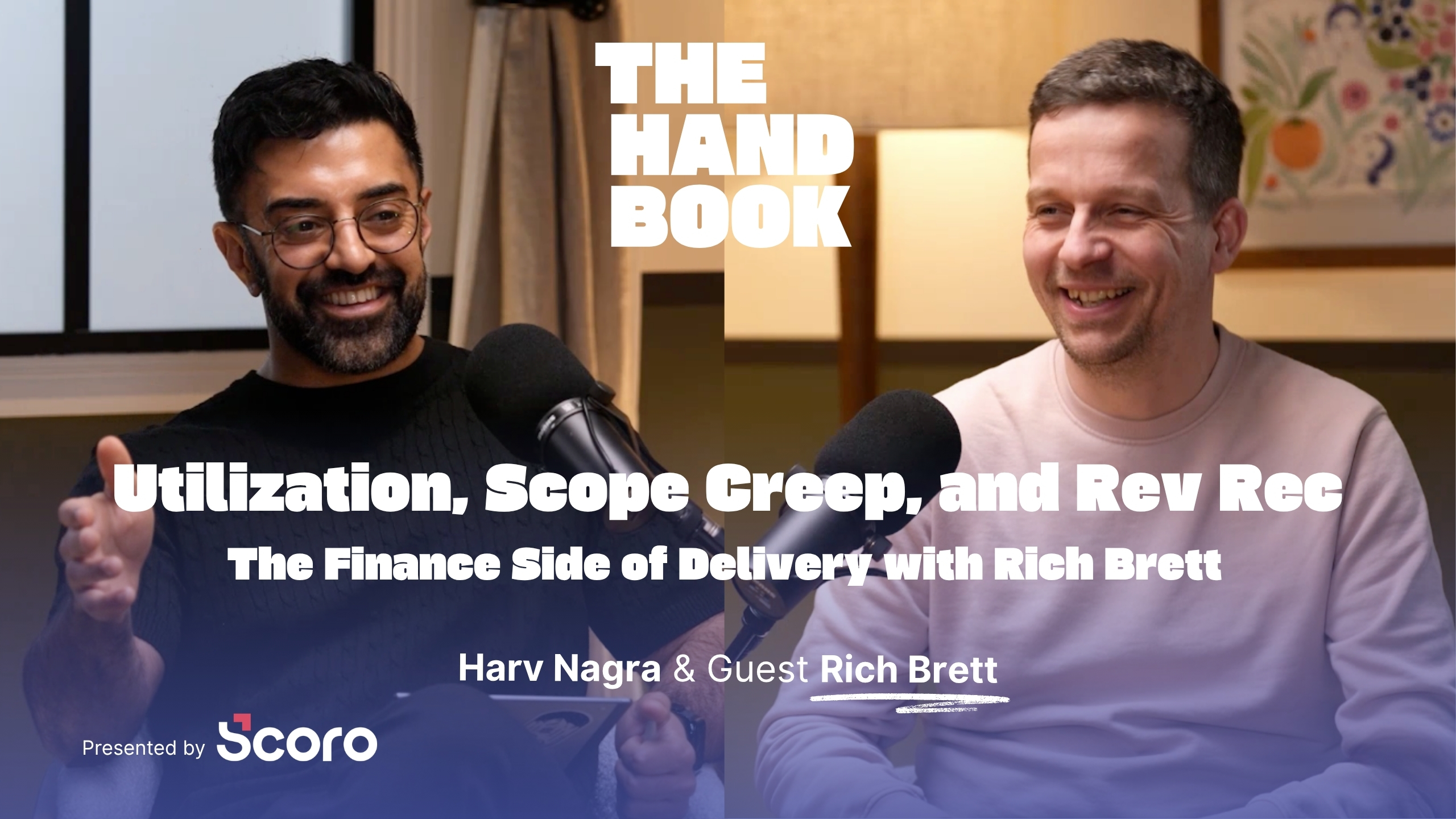

Growing a professional services business often starts the same way: scrappy teams, generalists wearing multiple hats, and a lot of momentum driven by energy rather than structure.
In this episode of The Handbook, Harv sits down with Alex Bodini, CEO of Spin Brands, to unpack how Spin evolved from a grassroots social media shop into a multi-entity group of 100+ people. Rather than waiting for a crisis to force change, Alex and his co-founder made a conscious decision to professionalize the business so they could attract bigger clients, better talent, and more ambitious opportunities.
They walk through the operational shifts that helped Spin move from “proper scrappy” to a more mature organization – and the cultural tensions that inevitably come with that transition.
Here’s what we dive into:
- Why bringing in a proper finance director changed far more than reporting – from pricing and scoping to forecasting and recovery
- The role HR played in moving from informal “touchy-feely” people management to structured career paths, policies, and development
- How hiring experienced specialists elevated the quality of work – even if not every senior hire worked out
- Why investing in senior-level marketing helped Spin build credibility and compete for bigger clients
- What a chairman can bring to a founder-led business – accountability, perspective, and bigger strategic thinking
- The trade-offs between the fun, chaotic “old Spin” culture and the more structured, scalable “new Spin”
Alex is refreshingly honest about the reality of transformation. Some hires didn’t work out. Cultural change created tension. And the journey took far longer than expected.
But the result is a business with stronger foundations – one that’s now scaling through acquisitions and positioning itself for the next stage of growth.
If you’re navigating that transition from scrappy startup to grown-up, mature organisation, there’s a lot in Alex’s story that will feel very familiar.
Additional Resources:
👉🏽 Follow Alex on LinkedIn
👨🏽 Follow Harv on LinkedIn.
📈 Measure your business maturity and find out how to get to the next level
📬 Stay up to date with regular ops insights. Subscribe to The Handbook: The Operations Newsletter.
Transcript
[00:00:00] Harv Nagra: Hi all. Welcome back to the Handbook the Operations podcast. I’m Harv Nagra. Let’s start with a story today. There was a point in a former workplace where I was digital director and operations was stuff I was doing off the side of my desk. The business at the time had one internal facing person.
The group finance manager. Literally everyone else was client facing. Everyone. Across three entities in three countries. So things like hiring, performance reviews, onboarding, marketing, processes, tech, all of it, all these things were side jobs for me and the other senior team members.
Meanwhile, we were also working on pitches, managing our teams, and overseeing or managing client work ourselves. It was genuinely heroics that were keeping things ticking behind the scenes. And so inevitably there did come a point where we were burning out and recognizing there was no way this could scale. A few of us on the leadership team sat down with the co-founders and told them, this can’t go on much longer.
It was an uncomfortable wake up call for them, but thankfully they listened. An interim cOO was brought in a few months later and our transformation journey began. In 18 months so much changed the management structure, the market positioning, processes, documentation, the tech stack, that’s where we brought in Scoro, by the way. Everything changed in that year and a half.
today we’re gonna be speaking to someone who has a similar story to tell, and in his case, a lot of it centers around people. That person is Alex Bodini, cEO of Spin Brands. What started as a scrappy social media agency a decade ago is now a multi-entity group employing over a hundred people,
that’s grown rapidly over the past few years. We’re gonna be talking to Alex about what their business looked like before, why he felt things needed to change, what they changed, and the impact of all of the above. What I love about Alex’s story is that this wasn’t crisis led. It was proactive, a conscious decision to build a more mature business. I think you’re gonna love this conversation. I’ll introduce you to Alex in just a moment.
Thanks for listening to The Handbook: The Operations Podcast. This podcast is brought to you by Scoro.
If you’re running an agency or consulting firm, you might live inside tools like Asana, Trello, or Jira. They’re great for tasks and collaboration, but they’re not built to run your business. So you bolt on more stuff and end up with a patchwork of a dozen tools. Everything’s out of sync, and there’s no single source of truth.
Scoro is different. It’s a modern PSA that combines the power of an all-in-one platform with a modern ux. From pipeline to projects, to billing to reporting. You get one place to plan, deliver, and track your business. Leaders get the dashboards they need. Delivery folks see the work and numbers that matter. And specialists just get a clean view of their tasks and time. Go to scoro.com/demo to arrange a call and learn how Scoro can help take your business to the next level of maturity. And for the VIP treatment, tell them Harv sent you. Now let’s get to the podcast.
Alex, welcome to the Handbook. Thank you so much for being here
[00:03:10] Alex Bodini: It is a pleasure. I’m excited.
[00:03:11] Harv Nagra: I met you last year at an event about this time, of the year, and I, I knew I had to have you on the podcast ’cause your story was just so interesting. And before we dive into kind of what you did to transform your business, let’s start with some context.
I’ve heard you describe Spin’s journey as moving from proper scrappy to still scrappy, to growing up. in your own words, what did each of those stages actually look like inside the business?
[00:03:37] Alex Bodini: Yeah, it’s a good question and I guess it’s key to our, our story. essentially. unlike some agencies, we very much started from what we call like the grassroots level, and by that I basically mean myself and Max, my business partner. We were not experienced agency people. We hadn’t worked in some agency and got a lot of experience in terms of big clients and big opportunities.
We also didn’t have any funding. Like we were very much like bootstrapped independent, and we didn’t start with any kind of marquee client or any kind of big, big brand. So really we did start off, from that, that grassroots level. And really what that meant was working with a lot of like really local, independent businesses.
Everything from cafes to apps to local services. and yeah, as a result, kind of we’re, we’re just about sort of 10 years in now, but we really feel like there’s been quite a few different phases in that story. and yeah, the first three years were proper scrappy. And, and by that I mean it was genuinely myself and Max jumping in the car and driving two hours to go and meet a random business to hopefully sign up a 300 pounds a retainer.
And that’s where we started. And and you know what kind of, in some ways I, I sometimes look back and I wish we Maybe raise some funding to shortcut a few of the stages, or maybe we try to work our way towards those kinda like bigger clients, bigger opportunities early on. But realistically, I know it’s kind of so cool to our story now that kind of going from really, really, really simple, relying on pure energy, pure talent, pure good people to actually bit by bit going through these different stages and eventually getting to where we are now. So I’ve kind of enjoyed that evolution and it’s very much ingrained into like our, our culture and our ways of doing things now, for better and for worse sometimes.
[00:05:22] Harv Nagra: Sometimes I, I, I think back to those years when I’ve worked in businesses like that, and it’s very much make it up as you
[00:05:27] Alex Bodini: Yeah.
it, it can be quite chaotic and really,I tell a bit of a story in the introduction of this episode, like really, relying on the heroics of individuals to pull things through and make it happen just ’cause of their passion. and, and you do need to grow out of that at some point. For sure. Like we for so long built the agency on just having a handful, and by a handful I may mean 10, 12 people who are they were straight out of, maybe some of ’em went to university and college, some of them didn’t. But either way, it was often their first job.
But they came straight into spin and we just hired them very much with the whole idea of hire the attitude, train the skill, and they were trained up on the spin way of doing things. And they were people who wore many different hats and had a whole load of different roles, and they did amazingly well.
And some of those people are still with us coming to this day. Whereas you look at us now and everything’s hyper specialized. Everybody’s got loads of experience, everybody’s knows exactly what their role is and works in much bigger teams and things like that. And it’s, I kind of like, I like both models, but I definitely do think talent and energy goes a huge way in terms of like doing a good job fundamentally for people.
[00:06:33] Harv Nagra: Absolutely. talk a bit more about that kind of maturity journey you went on. I’ve heard you say that you needed to grow up in order to grow. what were the kind of warning signs that made you feel like that was necessary?
was there a specific moment or, or something that was happening where you thought that, if we don’t sort this stuff out, the wheels are gonna come off?
[00:06:52] Alex Bodini: Yes and no. I suppose there was definitely a few times where we, maybe we got an opportunity that came to our door that was a little bit further ahead of where we were and. Look, I, I never think we’ve done a terrible job of anything, but we probably didn’t, we didn’t seize the opportunity quite as well as we could have.
’cause we just, we lacked, we always lacked something, whether it’s like we lacked the creative process or we lacked the invoicing, like financial stability or we wouldn’t scope it properly, price it properly, whatever it might be, we would do something wrong and therefore fumbled, to an extent.
Opportunities. So there was lots of different moments like that, but there was also a moment of kind of reflection for myself and Max about five years in where we’re like, we’ve got to this point, we’ve got, maybe by that point, let’s call it a team of twenty five, thirty people, but we had a huge amount of clients.
We had maybe a hundred and 120 clients on a retainer, and we were at that point, we decided like, right, do we want to continue down this route I, in the last possible way, stack ’em high and sell ’em cheap, get a huge amount of clients through the door that we’ll just try and manage and we’ll, we’ll win three clients a month and we’ll lose one client a month and we’ll grow that way and whatever.
Or do we want to grow? in terms of like, do we wanna work with bigger clients? Do we wanna work with brands that we’ve heard of, do work that we are really proud of? Open up our business to international scale, and attract really great talent. And in the end, we, we decided on the latter, we decided that we, it’s, it’s a perfectly viable business model to have a thousand clients.
and I’ve seen it quite a lot, especially in the states. But we decided we didn’t wanna do that. We wanted to go for that kind of, like that blue chip, journey for, for a reason. And we were quite intentional about trying to climb up to that level.
[00:08:32] Harv Nagra: it’s really great that you, I, I think, had that first of all, recognition that you wanted to transform in order to attract that talent, get those kind of bigger clients, and, and that kind of thing. ‘Cause we see businesses often fumble along way too long before kind of having those conversations and having a lot more stumbles along the way before they recognize that this is not working any
[00:08:51] Alex Bodini: Yeah, exactly, exactly. You just have these inflection points. And I think for us it was the fact that we, we, we got relatively far down the line with the potential sale of the business. At that point, we weren’t for sale, but we, we took a conversation, it became quite serious and, it didn’t go anywhere in the end.
because we kinda just realized, what are we doing? Like we’ve got so much, so much more energy to give. We’re in such a good position. Let’s, so at least, at least it was a trigger point and it made us think about things.
[00:09:15] Harv Nagra: Absolutely. We’re, we’re gonna dive into kind of the six areas you looked at in order to become this grownup business. So let’s go through it one by one. first one of the big shifts was bringing in, a proper finance director. who was there before? What were the issues? And what changed when this person was put in place?
[00:09:34] Alex Bodini: Yeah, this is probably the, the most meaningful change that we saw across the business. up until that point, I suppose myself and Max have always been quite close to the numbers, so we always felt quite comfortable in terms of we were always numbers first, commercially driven. we weren’t creatives who found ourselves in a agency and it was all about the work.
We always knew we wanted to build a good business, so we felt quite comfortable and we had, Kind of external accountants, basically, who would always do a bit of, bit of monthly reporting. They’d make sure all our returns went at the same time and things like that. And we implemented various,resourcing systems and things like that.
But fundamentally it was, it was quite basic. but good enough. And then we hired a, hired the FD, who had about 10 years or so experience at we are social, like one of the leading agencies in our kind of space. and what, what I always say is I used to think finance basically meant p&L doing your VAT return, managing cash flow.
That’s kinda like where I thought it started and stopped. And then I’ve come to realize it’s just, it touches everything. And once the FD kinda got into things, I’m like, wow. Kind of really it’s, um, financial operations are so much broader and is everything from obviously your rate cards, but like then you’ve got your
proper scoping sheets to your proper pricing, to your proper resourcing, to your reconciliations. And we were introduced to words like recovery. Like we knew about utilization, but we started to understand recovery and we started to understand,
[00:10:58] Harv Nagra: Yeah.
[00:10:59] Alex Bodini: kinda how things worked. And that was the biggest, journey to growing up, was having this proper FD and who basically just brought in a lot of what he knew, but also.
I was willing to adapt to basically the stage that we are at. I we are on this growth stage rather than kinda like the real finished deal, if that makes sense.
[00:11:18] Harv Nagra: It’s such a huge part of a maturity journey, that kind of financial transformation. how did the team react to that transition? Because I, I suppose a lot of things changed in the way they were working before and after.
[00:11:29] Alex Bodini: Yeah. It’s honestly mixed, but mixed positive. I guess if I, if I start with the negatives, there was a little bit of Oh, this is, a new way of doing things and it feels a bit more rigid and naturally people will say, oh, well, this is slower or this is like, um, I don’t know, they might call it more bureaucratic, whatever it might be.
And we’re very careful. It’s not become bureaucratic, but people kinda like put up the normal signals you’d think they would have. so it’s a little bit, a tiny bit of pushback, but that was definitely over overwrote, overridden by the fact that everybody’s went, oh, it’s so nice to have a proper finance person involved.
and it’s so nice to know that. Invoices going out and they’re correct all the time. That we don’t have to worry about this, we don’t have to worry about that. There’s a system for this, system for that. And it’s, it felt like there’s just like a grownup in the room when it comes to financials.
’cause myself and Max, like we’re kind of sort of founder energy. and actually to have the grownup behind the scenes is making things tick and making things work. Made a big difference.
[00:12:24] Harv Nagra: I think a lot of people react really positively to that
[00:12:27] Alex Bodini: Yeah.
[00:12:27] Harv Nagra: Like exactly what you’re saying. And sometimes I, I think there are, maybe there are some people that like that really scrappy kind of environment. But I, I think, maybe part of that is that if it’s no longer a fit for you. If the business is becoming more mature in the way it operates, then then, we, we need to part ways or, or whatever it may be. and, and that happens
[00:12:47] Alex Bodini: Exactly. Yeah, we could have strained to something slightly different, but like in terms of like values, we became a bit more, like a bit more intentional about our values. And by that I basically mean we started rather than just saying things which were like generically positive, we actually started saying some things which people might not like and they might scare off the wrong people.
Like for us it was like we said. Keep up or get out. Like we, we basically said spin moves really, really fast. Social moves really, really fast. Agencies are a whirlwind. And if that’s not you, if you’d rather work in a big agency with one client, and if you’d rather have the time to be booked into a project for three weeks and get deep into that, that’s great.
But we are not that like we move all the time and it so we started We started jarring with certain people and that’s, that’s okay. Then we had like just honest human conversations about those things.
[00:13:37] Harv Nagra: Mm-hmm. That’s a really nice transition to our second area that you transformed, which was bringing in a HR manager. tell us
[00:13:44] Alex Bodini: I.
[00:13:44] Harv Nagra: of why that was necessary, how you were handling HR previously and what changed once, that person was in place.
[00:13:50] Alex Bodini: Yeah, so we, we had probably what a lot of agencies have, which is like a person who handles a whole bunch of stuff. They are office manager, they’re hr, they’re recruitment. They are social secretary. They do like social, social events within the business. They basically do a whole lot of stuff and that was great and.
The per the person we had for that was a brilliant part of our culture. Like I would not for a second look to denigrate her and the impact that she had across the business. Like it was really, really positive. But as we grew and the expectations kinda grew, you kinda come to realize that, okay, we can’t expect to have really clear.
Progression pathways or really clear policies, or really clear, kind of like, I dunno, development systems, learning and development budgets. We can’t expect those things to be really well put together when this person hasn’t fundamentally done that before. and so we we decided we needed a, a kind of a proper HR manager and it, it probably had a similar impact to the FD in terms of Yes, the, the slightly more touchy feely stuff probably went away, but it was backed up by, okay, let’s do a proper review of our perks and benefits. Let’s do a, let’s, actually let’s use data in our hiring. Let’s use data in our kind of, how we’re, working on our progression pathways and. The HR manager, again, just just helped us to make it feel a bit more grown up.
which again, has, its, has, its, has its pros and cons. Sometimes when things are a bit more grown up, people do get a little bit more kind of arms length and people maybe negotiate a bit harder or they’re willing to kind of like complete a bit more, whatever it might be. But that’s is there for that.
And it means that people feel like they’ve got a place to go and there’s somebody just looking after everything from wellbeing to onboarding now.
[00:15:29] Harv Nagra: I mean, I, I found it interesting that you mentioned that some of the touchy feely stuff went away a little bit and you, you know, it’ll be interesting to hear what you meant by that. But I remember like, uh, at one point in a place I worked, like the whole performance review process was just so lacking any structure.
it, it was very much about just everyone’s feelings rather than anything like concrete that anyone was being assessed on. And, and it either ended up feeling like a bit of a, a waste of time or a bit of a joke, or you could get away with, a. negotiating really hard because, the other party, like your, your line managers were completely unprepared and had no structure. I remember going in once with like slides to say, like, all this wonderful stuff I’d done, which was true. but it, it just meant they were not as prepared to participate in that conversation other than be like, oh yeah, you, you have done a lot. in, in your point of view, touchy feely stuff, what did you mean by that?
[00:16:21] Alex Bodini: Yeah, it is interesting ’cause I, I think as you said, like it’s, it’s it’s data, it’s relationships. I think like on a similar point to what you were saying just then, like when we used to ask how busy someone was or try to figure out capacity across the team, it would basically say, how busy are you?
And everybody always, everybody always says busy. And then therefore we go, okay, we need to hire more people. And it’s things like that, like if it becomes highly subjective, you lose any objectivity around how you make those decisions. So again, it’s similar to the, to the things that we are making, I think.
what do I mean by touchy feely stuff? basically, I suppose by having these more layers, myself and Max become more removed from the team, it feel felt like for the first number of years, hopefully, without sounding egotistical, people really wanted to work for me and Max, like it was part of the journey.
They were close to us, they were in the room with us. They, they saw our energy and our passion or whatever it might be, and they enjoy working in that kind of place. And once you kind of do bring in that structure, you a, you, you create that distance very slightly. Secondly, I suppose we, I dunno, we just maybe some of the slightly, we probably replaced some of the bit more like fun perks, like everything from going to the pub to doing something silly, to little treats, to like spontaneous, I don’t know, afternoons off or whatever it might be. We removed that and we went, let’s get professional healthcare, and let’s get a really good parental leave policy and let’s make sure that our, disciplinary process is well documented.
And it’s fine, but it doesn’t. But it means that, things are a little bit,more removed. And, and the final one I’d say is in terms of like promotion and opportunity. I’ve, and I still am like this, I always believe in. I don’t, I, I, I like, I like the idea of seeing someone who’s highly talented doing a really good job and giving them an opportunity well above their station.
So it might be an account manager who comes in and I’m just like, I think this person’s brilliant. Like, why don’t we put them on a, put ’em on a pitch, put them,give them a strategy brief and see what they can do, whatever it might be. And it completely goes around the progression pathways.
’cause there’s all these, there’s all these tiers and all these salary bands, all these different things. And, but sometimes people just like move outside their lane a little bit, whereas now it feels like that happens a lot less. So I’d say, I actually would say progression within the business is slower and it’s probably does make sense in most cases, but I do miss the ability to like move talent fast.
and sometimes we do bypass it when we really see an opportunity.
[00:18:46] Harv Nagra: makes sense. let’s move into the third area. and, and again, a nice transition because we’re talking about kind of promotions and that kind of thing. You said that you shifted towards hiring more senior leaders with external experience and that kind of made me wonder what kind of expertise were you missing before and what kinds of roles did you bring in? of course, what
[00:19:06] Alex Bodini: Yeah. Um, so. As I sort of half mentioned before, like we hired a lot of people who are essentially, we had a social team and a paid team, and they were they were the two roles that we had really. but everyone was quite raw in terms of talent and kind of, if you were in the social team, you did everything from, you did strategy, you did ideation, you did copywriting, you did social media management, you did client management, you did a bit of measurement, whatever it might be.
and. That was fine and it got us to a certain point, but we basically realized that to be really, really effective at social, to use the example, you need a brilliant strategist. You need a brilliant creative, you need a brilliant producer, you need a brilliant community manager, you need a brilliant, kind of measurement executive.
You need a brilliant client services person. And those are quite different skills. And asking somebody to do all those skills, like it’s just not gonna work out that well. So, um, we basically, so started looking for Specialists in those spaces, we start to say, okay, our creative team actually, let’s hire people who have done creative work, either in big agencies, small agencies, social agencies, and basically brought those expertise in.
So that was the first thing. The second thing was. We did just feel like sometimes as much as like energy and vibes got us to a certain place with grownup clients, we needed grownup people and the world is quite transparent now and everybody can look up anybody on LinkedIn and if we won some big exciting blue chip client and we said, here’s your strategist, it’s very possible that client looks up that person and says, but they left university a year ago and they were accounting executive up until last year. And even though I’m saying, yeah, they’re really, really talented, it doesn’t look right or feel right. so we basically had to we had to, but also wanted to bring in that external expertise, to sort of see, see the impact both on ourselves but also on our clients.
And
[00:21:00] Harv Nagra: I’d say speaking honestly, and I guess that’s what podcasts are meant to be for, um. There’s a very mixed bag. A lot of the time we paid significantly more salary for someone who was quite what I would just say in the nicest sort of way, mediocre. They came in, they’d been, they were maybe they’d had 10 years experience and they were just okay.
[00:21:22] Alex Bodini: They weren’t bad, but they weren’t, they weren’t quick, they weren’t sharp, they weren’t moving with the times, whatever it might be, and we’re often like God our junior who’s been in it for two years is significantly better. So there was a little bit of that, but there’s also a whole bunch of examples where we’re like, okay, that does really make sense.
That’s actually, they’re able to produce things fast and quickly, whatever it might be. So I’d say the risk in terms of getting it wrong, increases. But the kind of, the quality of the work. In the end, we, we do look around at our, like our team now, and to use a slightly lazy footprint analogy, like when teams get promoted through a division, and let’s say they go from the championship into the premier, premier League, You want kinda that balance of you want the people who got you there, you want that kinda like core people, but you also do have to bring in some of the superstars, some of the people who’ve been there and done it at that level, whatever it might be. And we do like to, we now can look at the team and be like, okay, actually bringing on that, that expertise has been net beneficial and the quality of the room is always higher now, and therefore in the end, the quality of the output will end up being higher.
[00:22:24] Harv Nagra: A couple of things, uh, just really quickly to comment on what you said. I completely agree. Like, you know, in that very scrappy early stage , we do tend to have a lot of generalist kind of folks in the team that can do a lot of stuff and help us just get stuff done right. but there does come a point where you need that kind of specialist skill. The other thing I really loved is just you being really honest about kind of some of those folks not working out at that kind of senior level, which is something that happens sometimes it just might not be a culture fit or, sometimes you just can’t screen perfectly in an interview and, things slip by. So as long as you’re recognizing that, and I guess parting ways or, or whatever it
[00:23:02] Alex Bodini: And you also
[00:23:03] Harv Nagra: that’s the
[00:23:03] Alex Bodini: what you’re hiring for as well. It’s that the slightly trickier thing when you’re like, okay, we wanna get a brilliant strategist. It is okay, but nobody really in the room is a brilliant strategist at the moment. So what are we, what are we looking for? Are we looking for the names on the cv?
Like how do we, we always try to do some sort of, for senior roles, we try and do some sort of case studies, some sort of exercise, and it’s like, but how do we know if this works really good or not? Like we kind of, we kind of have to guess in the end. And like, as you say, like it’s just being, being honest with ourselves when it’s, and also being like looking in the mirror and saying, actually sometimes people don’t work out with us.
A, it means our hiring process is wrong and b, sometimes we’re the problem, like sometimes they’re the problem. Sometimes we’re both the problem, but sometimes we’re the problem. Sometimes, I don’t know, we’re too scrappy or me and Max are still too involved or sometimes they came expecting to have these tools and we don’t have those tools, whatever it might be.
So there’s a bunch of different reasons that kind of why it can work or not work.
[00:23:54] Harv Nagra: Mm-hmm. Good examples. Alex, we’re, we’re gonna move into our fourth area, which is you hired a marketing director who was handling marketing before, and why did you feel like this was a necessary hire?
[00:24:06] Alex Bodini: this is one that’s been full of hits and misses, to be honest with you. I think we’re in a good point now where our marketing, our marketing has really improved over the last two years. but probably it took us two years after deciding to get more seriously to actually see any kind of,momentum with it.
we have always been lucky whereby whatever reason we maybe, maybe we’ve. It’ll give reputation. Maybe we’ve just ridden the right wave in terms of social. Maybe we are just quite good at building relationships. I’m not sure, but we’ve always had a decent amount of inbound kind of opportunities and the size and nature of those inbound opportunities has grown as we’ve grown.
However, we did look at ourselves and we’re like, actually, if we want to compete at that kind of top tier of independent social agencies, we looked at our competitors and. Let’s say for an example, born social who are a few years older than us, a fair bit bigger than us. Were like they, like we can’t compare ourselves to them in terms of how we look and feel at the moment.
They’ve got. They’ve got a great website, got great case studies, they’ve won a bunch of awards. They do really good webinars. They do nice events. They, their socials are better, their, whatever it might be. And we’re just like, no, we just, we lack those like credibility hallmarks. Like our website looks quite amateurish.
Our case studies aren’t updated. we haven’t won any kind of major awards, et cetera, et cetera. So we just, we. We speak about being worthy, like worthy of the big clients, and, and they, yes, you can sometimes stumble into a really good contract just by doing great work or having a good one-to-one relationship, but a lot of the time.
Kind of people who are looking for new agencies and looking to switch agencies, they’re, they’re gonna scour the market and we have to look the part and, and feel credible. and now we’re in a, a spot where actually, like, of course it’s not perfect, but we’re in a much better position now. Like our website looks good, our proposition looks good, our kind of communication is clear.
Our socials are good. We’ve got a good newsletter. We’ve won some good awards. we host some really good monthly events that we’ve got a lot of stuff happening now that basically just makes spin look like it fits at that level essentially.
[00:26:09] Harv Nagra: It’s great that, that, that story you’ve told, like how that, that worked and the impact that had. often I see when people are hiring for that marketing role, they’re going from like really poor, marketing in-house,
done off the side of people’s desks. and so the kind of idea is that we’re gonna hire a marketing assistant to just help us get by. But I like that you went the other way and said, actually no, we need a marketing director who’s really gonna sort this out and not just start from the bottom and, and iterate on kind of the, the effort that we’re already putting
[00:26:38] Alex Bodini: Exactly. It is, it is that kind of age old thing whereby like a lot of the time we will speak about. Like we can sometimes a slightly kind of cheesy phrase where we’re like, we’re on a mission to prove that social isn’t just the cherry on top, it’s the whole damn cake is like the idea. So like we are basically, so we’re trying to say social is this like big grownup opportunities, big grownup channel and the thing that kind of like it used to be like a big phrase back in 20 16, 20 17 when we started is oh, I’ll just give it to the intern. And like, if you’re just gonna give the social to the intern and hope something’s gonna happen, then of course you’re gonna be in like, we’re, we’re the counter argument to why you take social seriously.
And therefore, if we just hired someone respectfully on an entry level salary and just said, can you make us just look a bit better? Is this gonna take more management of that person than that then, then is, then it’s worth it. It just doesn’t make, it doesn’t really make any sense. Whereas if we want to look grown up and look the real deal, it’s worth going senior in that regard and have somebody who knows the industry and knows how,
[00:27:35] Harv Nagra: I’m
[00:27:36] Alex Bodini: how agencies grow and knows how clients assess agencies and things like that.
[00:27:41] Harv Nagra: And the impact just so much, so much stronger
[00:27:43] Alex Bodini: Exactly.
[00:27:44] Harv Nagra: we’re, we’re moving to our fifth area of six. you brought in a chairman. what prompted that?
[00:27:50] Alex Bodini: this kind of came from the fact that like we’ve always had good advice as a business kind of along the way. Whether it’s like sometimes family advice, sometimes like we had some kind of like early stage advisors, whatever it might be. But then
[00:28:01] Harv Nagra: Hmm.
[00:28:01] Alex Bodini: gotta to the point where it was just me and Max.
and yes, we had we started building a senior leadership team around us, but we, um. We, I don’t know, we talk a lot about what we could do and we definitely got a little bit of kinda shiny object syndrome in terms of we could go here, we could try this, we could try that, and that’s, that’s quite nice for a bit.
But essentially we wanted to understand how businesses go from like where we. Were to basically like really kind scale up and really become like a key part of the industry and do something really exciting. and we basically just, we wanted some accountability and we wanted just like people who could be removed from the day-to-day who could help us think a little bit bigger.
we got introduced to our, our chairman who’s a chap called John John Smith, of all names, and he’s basically based out in LA so a British guy who moved out to LA maybe I think maybe 15, 20 years ago, something like that. And his whole thing, and I’m going to do a visual representation, but I’ll, I’ll explain it for anyone who’s listening is he likes to take things that are this small.
I like putting his hands very close together and help them get this big, and essentially he’s, his whole thing is most people just think too small. Most people think I’m in this industry. I do this one service. The only way I can grow is by doing more. More of what we do to more clients. And he was like, he basically believes there’s four or five key levers.
Through acquisition, through, internationalization, through what he calls like adjacencies. I, for us, that basically means rather than think ourselves as purely an agency services provider, how can we actually, like, how can we provide those services but in a different way? Can we create our own ip?
Can we have our own content? Can we have our own channels? And he just basically challenges us all the time. His kind of, what he always wants to do is antagonize us, and in a, in a really like nice way. But he wants to basically like Ask questions that make us get a little bit like, ooh, like, well, that’s a good point.
I didn’t really think about that. And just basically make us get outta any kind of comfort zone. and it’s been really good. It’s been really, really nice to have that kind of person who’s that bit removed, both geographically, but also from the day to day who can just help us, help us think bigger.
And we have started taking slightly bigger swings as a result.
[00:30:14] Harv Nagra: I love that. just out of interest, was this just you, you were introduced and it was just, you, you felt it was the right fit? Or did you go through any kind of process to kind of identify who you might want to find?
[00:30:25] Alex Bodini: He, we did speak to a couple of different people for sure. We decided we wanted advice and we spoke to a few different people and we kind of like assessed. ’cause there’s a lot of, and I mean this respectfully, there’s a lot of NEDs, like non-executive directors around, there’s a lot of advisory companies around and If I looked in my LinkedIn, I’ve probably got 300 people who basically said, Hey, I’d like to work with you guys on whatever it might be. we we knew a few that we had always liked. but John in particular, he had been chairman at a similar business who’d been through that kind of scale and private equity sale and things like that.
And he. Came across us and asked for an introduction to us. So he actually, he, someone who we already knew, said, Hey, look, this guy John, we’d love to talk to you guys about this, that, the other. And we jumped on a kind of couple of calls and had really good chemistry and, and decided to start working together.
yeah, it was a, it was, it was an introduction, but we were looking for something and he basically, he ticked all the boxes in the end.
[00:31:18] Harv Nagra: Alright, Alex, onto the sixth. and this one’s not about people. You made a long-term commitment to a physical office space. were you fully remote before? And, why was this important?
[00:31:30] Alex Bodini: Yeah, and it’s, it’s something I still think about, about whether or not it’s a hundred percent right, a hundred percent wrong. It’s, it’s probably neither. we always had an office. We, we started in southwest London. So that’s kinda where me and Max were base at the time. And we quite quickly realized that we didn’t want to stay in southwest London because it meant our talent pool was very limited ’cause only people who live in southwest London want to work in southwest London.
So we had to move out and that was definitely a really good decision. and then basically we during the lead up early years and then obviously the COVID years and then the post COVID year, we basically jumped around a lot and we went from having kind of a. Our own small private office to a, co-working space.
Then we sublet a bit of an office, then we went back to a co-working space and kinda like we bounced around and we always we always under invested in it. ’cause we always felt like there is a deal. There’s, there’s always a deal for an office. There’s always someone who’s got some spare space.
There’s always an office, which is, Due to be demolished in two years time and therefore there’s some really cheap rates available. There’s always someone who needs to get outta their lease and therefore you can get it cheaper. So we kind of like, I hated the idea of paying market rates for any sort of office because I just knew there was stuff out there.
Hmm.
But then, basically we come, came to realize that if we’re gonna take ourselves seriously, if we’re gonna work with attract good talent, if we’re gonna work with really exciting clients, we need an office that looked and felt our own for culture reasons, for work reasons, for whatever it might be.
and at the time we liked to kind of like London Bridge area. so we decided to commit to basically a 5,000 square foot office, split over two floors on a five year, five year lease. And and yeah, it’s overall been very, very good to us. Like we’ve got a space that feels like our own. I am sure there’s been a bunch of unseen benefits.
I’m sure we maybe, maybe we can convinced candidates to join us when they might not have done. I’m sure clients might have liked our vibe. I’m sure it’s kept people in the business for longer ’cause they had a nice relationship with their client, um, with their colleagues, but. It is expensive. Like it’s not only the rent, it’s the rent, it’s the rates, it’s the service charge, it’s the, the office manager.
It’s the toilets got blocked. It’s the supplies, it’s the coffees, it’s the, parties. It’s uh, it really does add up. And it’s and. We were up until COVID like five days a week in the office. Now we’re minimum of two days a week in the office. So on a Tuesday and a Thursday, I look around, I’m like, this is great ’cause everybody’s here and there’s a nice atmosphere.
And I like seeing the creative team and the paid team and the influencer team and it’s all kinda like, flows nicely. Whereas, on other days it can be. Nine people in the office and it’s oh, this feels pretty painful to be paying whatever we offer for rent for nine people in the office. so it’s it’s still a pro and a con at the same time, but for us it’s been, it’s been a good thing.
And I think I do, I do think people care more about their work when they have a physical place to kinda go and be with each other. The kind of slightly lazy analogy I always use is that Being a barista is quite an appealing job overall for a lot of people. And being part of a barista is you you are in a cool, trendy coffee shop.
You’re surrounded by people. It’s hopefully, it’s clean, it’s fun. There’s a nice smell of kind of coffee around. There’s pastries, there’s colleagues, like it’s quite a fun, fast moving kind of thing, and there’s latte art, whatever it might be.
[00:34:53] Harv Nagra: Mm-hmm.
[00:34:54] Alex Bodini: ask that same person to make coffees at their at home all day long in a kind of in their sage coffee machine, it’s gonna be a very, very different job.
It’s not, they’re not there for the love of making coffees. They’re there ’cause they like being in the environment. And equally if you ask a creative or a strategist, whoever it might be, to purely do it from home, I just feel like that kind of connection to the team and the wider purpose that you’re kind of doing, the client connection, the work connection.
Just kind of phase. And yes, like remote work is really powerful and we are increasingly, our direction of travel is more to remote friendly, I’d say. But I still believe having where possible core people in an office together as often as possible really does work.
[00:35:37] Harv Nagra: Absolutely with you on, on, on some of those points that you’re raising. I, I think that kinda shared mission and the passion definitely, struggles when, when you’re not seeing people face to face. and, and I think as adults anyway, the, the easiest and best place to make friendships, is through work.
And if you’re not doing that and coming in completely remotely, that can be quite a challenge, to, to
[00:35:59] Alex Bodini: I totally
[00:35:59] Harv Nagra: If, if
[00:36:00] Alex Bodini: a hundred percent. so many people like their kind of their core, there’s a lot of people join SPIN and they maybe came from overseas or they’d like, they just moved to London from like somewhere else in the uk and their core friendship groups are, is from spin and there’s a huge amount of spin relationships which are still going ’cause they’re like, and it’s like that stuff does matter for sure.
[00:36:18] Harv Nagra: absolutely. Small tangent. Do you
[00:36:20] Alex Bodini: I.
[00:36:20] Harv Nagra: like in terms of recruitment, then you’re, you’re forced to stick to London and there might be candidates that want to work for you from further afield that you have to say no to, and that’s just the way it is.
[00:36:32] Alex Bodini: This is why we’re starting to be a bit more remote friendly and we are try, we’re starting to be clear around, okay, which roles really do need to be in London and for us, that is typically like client leadership or like client services. We do want those people in London. We like any sort of production kind of people who basically need to come down a, arrange a shoot and arrange various different people.
We would always prefer those to be in London. however, things like post-production video editing things like to an extent, sometimes like strategists, we are open to those people being a little bit more removed now, ideally still commutable to London. So ideally the strategist can still come in for either a pitch or whatever it might be.
But we are increasingly a bit more open-minded and we will make sure that for the right roles, we are considering the wider talent pool. ’cause we want to just fundamentally, we want the best person for the job and it’s, Yeah, it’s it. It is. It’s a tough one to balance though, for sure.
[00:37:26] Harv Nagra: That makes sense. Alex, we, we, we’ve been talking about your transformation story. A lot of it had to do
with people and I, I can’t not comment on this. I was looking at your about page on your website and there was no ops person there, so I was just like, what gives.
[00:37:39] Alex Bodini: That’s a good question. I mean, basically Ops fundamentally falls under, falls under our FD and that’s kind of like, so like we actually have quite a big ops team now. So like we’re, we’re a group structure now where we’ve got Spin Group and we’ve got three agencies within the group now. Spin, the social agency, Be a Bear, the YouTube agency, and then Tiny Studios, the production agency.
The second two we, we acquired last year. And then we have a central ops function, which is basically our FD. and that’s kinda why I kinda mentioned before, like I think finance can be, like, it can be so much bigger than purely kind of like finance. So LEE the FD is basicallyour essentially head of business ops as well.
we then have Another finance manager. We have a recruiter, we have a HR manager, we have a studio manager, and we have an office manager. So those six people are essentially like our ops function, and they all, they all report into Lee the fd. So you could say that Lee kind of like. I suppose different terminology for similar things, but you can almost say he’s a bit more of a COO style role as opposed to a CFO style role.
but obviously really the finance function falls under him as well. So we do have quite a decent investment in the ops layer to make sure that the whole agency flows.
[00:38:51] Harv Nagra: Okay. Forgiven. Um, uh, so you, you mentioned the kind of multi-entity setup and you’ve started growing the group through acquisition. maybe that was slightly influenced by the chairman that you’d brought in. when thinking about operations, are there things that come to mind about being multi-entity that you hadn’t appreciated, previously, like complexities or, or things you just maybe were surprised by or, or didn’t have to worry about?
[00:39:16] Alex Bodini: Yeah, so when we think about kinda like an integration side of things, essentially there’s four tracks that we focus on, finance.
[00:39:22] Harv Nagra: Mm-hmm.
[00:39:24] Alex Bodini: Hr, sales and marketing and delivery of the work. So delivery of the work is probably a separate thing. And maybe we can come back to that a little bit. But finance wise, we basically wanted everything to run in a similar way.
And by that I mean scoping and pricing and rate cards all look and feel the same. there’s obviously maybe slightly nuances in terms of the, the rate cards, but that’s not done in the same way forecasting is done in the same way. So we’re we’re really clear about kind like. How we, how we weight opportunities, like how we do a budgeting perspective.
And every, every rolling forecast looks the same, has the same lines within the forecast, and we’re able to compare those kind of forecasts. So transitioning to that overall was quite, that’s been quite smooth. The only thing I would say is like Spin is typically a more of a retainer agency, whereas, like Tiny Studios does, for example, is more of a kind of project agency.
And just realizing that comes to like, there’s so many more third party costs when it comes to. Projects and production and things like that. So how do you account for those? obviously the visibility on the revenue for spin and be a bear is much clearer than tiny. Tiny, you like when you’re forecasting, it’s much more guesswork involved ’cause you just, projects will come, you just don dunno how big they will be, how many they’ll be, whatever it might be.
Right.
HR, again is We we have our like default policies and then basically each entity has had to adjust their policies, whether it’s the working hours, like for example, we finish at four o’clock, spin finishes at four o’clock on a Friday. However, for be a bear, a huge amount of their key, their key hours.
Our four till six on a Friday, because a huge amount of uploading needs to be done ahead of the weekend for YouTube content and things like that. So for them, just shutting off at four o’clock simply wasn’t an option. So we’re like, how do we make that, how do we make that fair? So there’s, there’s a, there’s always like different things like that in terms of policies that need a little tweak.
but that’s worked quite well. Sales and marketing has pulled together really nicely. That’s been a really positive experience. So there’s been, there’s been nuance, but I’d say typically. Because we, we’ve become quite advanced in terms of our ops thinking and our structure that actually some, a lot of the time they’re quite happy to kinda like adopt our frameworks ’cause it feels that they can just get on the railing straight away and not have to stress too much about it.
[00:41:37] Harv Nagra: Right. I had a question about kind of the overall transformation, as well. we’ve talked about a lot today in terms of kind of everything you did in place to become this kind of grownup agency. how long did that transformation take? And I’m just wondering like in terms of you making all these changes, hiring all these kind of very senior leaders to lead these disciplines in your business.
Did you do them one at a time or, or was it done in, in tandem?
[00:42:02] Alex Bodini: We did quite a lot, all at the same time, to be fair. So I think there was basically a, there was a slightly naive, probably three year plan. So we basically planned most of this stuff in 20 21, early 2022. And then we’re like, we basically thought 20 22, 20 23, 20 24. By three years time, everything will be like, we’ll be done and we’ll be flying.
We’ll, we’ll be able to bear all the fruits from that. we made a lot of the changes, we implemented a lot of the changes during 2022, so most, the, most of the people were in situ by the end of 2022. and yeah, there was quite a lot of, also quite a lot of cost involved. like certainly our chairman still said, it’s actually very impressive you’ve been able to do this purely off your own kind of balance sheet, because we didn’t raise any money to do it.
And we also did these acquisitions. And look, we are an independent agency. We’ve, we’ve always been profitable, we’ve always done well, but we’re not sitting on 3 million quid of cash in the bank like it that we always have to manage cash throughout every process. And. It was a lot of cost. and as I said, we got some things right.
Like for example, like Lee, the fd, he joined and he’s been a brilliant part of the business for two and a half years now. Other people were invested and they had to, they had to leave after six months
for any number of different reasons. And, and that kind of. What we did realize is hiring, getting the hiring decision wrong costs you a huge amount of time.
’cause you spend maybe three months hiring, then you wait three to four months for a notice period. Then they join. Then you wanna give them at least, at least six months really to see if like they gonna work out. If they don’t work out, you then gotta often pay their notice period, whatever it might be.
Hire again. So you don’t lose three months, you actually lose about a year if you make the hiring decision wrong. So that was tricky. But yeah, overall it definitely took much longer than we expected. It definitely there was more resistance internally than we mentioned a bit of that before than we, than we probably expected, just like changing of the culture.
And to be honest with you, right now, we’re still navigating some of the, the transition to being like a true kind of top tier agency. we’ve still got some gaps. We still fall short in some areas. And, it’s definitely not like a clean, smooth process where we go, wow, wasn’t, that wasn’t that tough, but I’m glad we did it.
It’s like a, it’s an ongoing thing.
[00:44:18] Harv Nagra: Clearly listening to your story, like there, there’s been a huge amount of change and a lot of it, most of it probably really positive. What was the hardest part?
[00:44:26] Alex Bodini: The hardest thing I’d say was this kind of, this mentality that came within the business of. Old spin and new spin and kind of, and learning to be okay with that. ’cause old spin and some people hate us talking about old spin. I don’t, and I don’t mean to kind of like trigger them, but there was old spin, first five years of spin whereby it was way more fun.
We were way, there was way more hustle, there was way more like hunger to win the work, keep the work people, and rightly or wrongly worked longer hours. People felt like they cared more. there was a huge amount of like camaraderie that kind of came with that. As we professionalized it is a bit more, like a bit more arms length.
People do their work, people are committed. People still work hard, but there’s a, yeah, there’s, there’s, there’s some cultural changes. There’s this slight, there’s a lack of accountability, whereas before it was your own client. You worked on that client and you were, you were dedicated towards kinda keeping it.
Whereas now, like working on a big client, there might be eight of you who touch it in a different way. And that’s kind of like, that’s complicated. the culture changes. People have massive rose tinted spectacles and look, maybe I do sometimes where I go, oh God, we used to do this. And it was so much fun.
I remember back then there was all these other challenges, like whereas for example, like now, like pay structures are really clear. People get paid well as really good benefits of really good development plans and learning and development side of things. that’s all kind of working forward. And PE and people used to just moan about pay the whole time and like, so there was always something that kind of bothered people and like it’s agency life.
But it’s definitely, um, seeing it change and accepting that change is probably the hardest thing
[00:46:00] Harv Nagra: Hmm. appreciate you pointing that out because, none of this is easy. So we’re coming towards the end. Alex, the question I wanted to ask you is you have a new project, operational project that you’re tackling now after all this work?
[00:46:11] Alex Bodini: The biggest thing that we’re looking at the moment is, scoping was the buzzword for the last six months. Like kinda keeping, getting scoping, right? ’cause getting scoping right is basically critical. However, how do you, how do you scope but also be flexible? And how do you scope, but also make sure that you are competitive?
So scoping is something we were focused on, and then the off the back of scoping comes resourcing. And at the moment we have a, I mentioned we had a, we have a resourcing manager, studio manager and that’s great, but it’s still, I would say what I would call reactive mode rather than proactive mode.
and we don’t have like a ERP type system at the moment, so we need to, basically, we are looking at some and we’re gonna embed something like that. And I do think. Slightly better resourcing, slightly more proactive resourcing will help us get into a better space. And it’s, it doesn’t sound sexy, but it’s really, really critical.
And I think the efficiencies to be gained are, are gonna be very clear.
[00:47:04] Harv Nagra: Good project to take on. Alex, if You were kind of advising somebody, listening to somebody in an agency or a consultancy, what is, based on your experience, like one grownup investment you’d tell them that they should make sooner than later in terms of the way they’re running or the people they have in place?
[00:47:22] Alex Bodini: Oh, good question. And there’s a couple of different angles I could go with it. and also I would say, I actually think we invested in a lot of the right things at roughly the right time. For example, like I could say, oh, bring in a really expensive, like really expensive, really experienced finance person when you’re 10 people.
I actually don’t think that’s, it might be the right advice for some. I don’t wish we had Lee, when we were three years old or four years old because
it might’ve
been too much too I don’t know, like I might be wrong, but I just feel like actually him joining when we were like professionalizing when we were at a certain size, when we were maybe like 40 people felt like the right way of doing things.
So I don’t wish we did that earlier. I suppose I wish, I do wish we invested in our sales and marketing earlier. ’cause fundamentally I have always believed that revenue in at the top helps you deal with all other problems much better. So if you’re fundamentally able to attract great work, pitch for great work, win great work, then that gives you the operational headroom to invest in your staff to do pay rises, to hire ahead of the curve, to invest in systems, to have an office manager to make it a nice place to work.
All those things. So I think it all starts with sales, basically. So therefore, I would basically be thinking about sales and marketing as early as possible.
[00:48:39] Harv Nagra: Mm. Mm-hmm. I think, um, l like you guys did,recognizing your gaps and then picking which one is the most critical in your organization I is the key thing. everyone’s gonna have a slightly different challenge. such an amazing story, alex.
If somebody wants to contact you and, and hear more or learn more about spin, where can they go?
[00:48:59] Alex Bodini: The best thing is probably just LinkedIn to be honest. yes, I’m Alex Bodini, B-O-D-I-N-I on LinkedIn.always happy to connect. Always happy to chat and yeah, people can feel free to reach out.
[00:49:08] Harv Nagra: Thank you so
[00:49:09] Alex Bodini: Pleasure. Thanks for having me.
[00:49:10] Harv Nagra: Well, there was a lot to take away from that. What I really appreciated about Alex’s story is that this wasn’t a turnaround. It wasn’t crisis management. It was a conscious decision to build a business that was worthy of bigger clients, better talent, and long-term growth. A few things really stood out for me.
First, the finance or even FinOps hire, if you will, with their finance director, they shifted from being decent at the finance fundamentals to finance touches everything, pricing, scoping, forecasting, recovery,
that transition towards becoming data led is a huge part of a business’s maturity journey. You could hear how bringing in a proper finance director didn’t just improve their reporting, it changed how the whole business worked and how they thought.
Second, acquisitions don’t automatically multiply success. Because SPIN already had professionalized their finance, their forecasting, their ops, hr, and marketing, the new entities can plug into something structured. If your own house isn’t in order, adding another entity just amplifies the cracks.
And third culture, the tension between the old spin and the new spin, the fun, chaotic, everyone does everything phase, versus a more structured, accountable, grownup environment. That’s something a lot of founders and early employees struggle with.
But you don’t get to scale without bringing in more structure. You gain stability, clarity, and better foundations.
Now, if you know someone who’s at this stage and would appreciate hearing Alex’s story, please share this episode with them.
That’s it for me this week. Thanks very much for listening.