










Most businesses will go through some kind of change management challenge – a new tool, a restructure, a rebrand. But what does it look like when you’re doing that across eight acquired businesses, each with their own people, systems, culture, and way of doing things?
Jonathan Healey is Group Technology Director at IDHL, a 500-person UK digital agency group that has grown through eight acquisitions. He’s been at the center of every integration – aligning systems, consolidating brands, and figuring out what actually has to happen, and in what order, before any of it can work.
This is a conversation about what M&A integration really looks like on the ground – and why, at its core, it’s a change management problem more than a technology one.
Here’s what we get into:
- Why the back office has to move first – and what happens when it doesn’t
- The “us vs them” dynamic that can derail an integration before it starts
- How to decide what to standardize and what to leave alone
- Why process is poison – and what good process actually looks like
- Build vs buy: when in-house systems become a liability
- AI adoption as a change management challenge – and the federated model IDHL is using to scale it
Whether you’re navigating an acquisition, thinking about one, or just trying to get a new way of working to stick across your team – this one’s got something for you.
Additional Resources:
👉🏽 Follow Jonathan on LinkedIn: https://www.linkedin.com/in/jonathanhealey1/
👨🏽 Follow Harv on LinkedIn: https://www.linkedin.com/in/harvnagra/
➡️ This podcast is brought to you by Scoro, where you can manage your projects, resources and finances in a single system. Sign up for a free trial or a demo at https://scoro.com/demo – and for the VIP treatment, tell them Harv sent you.
Transcript
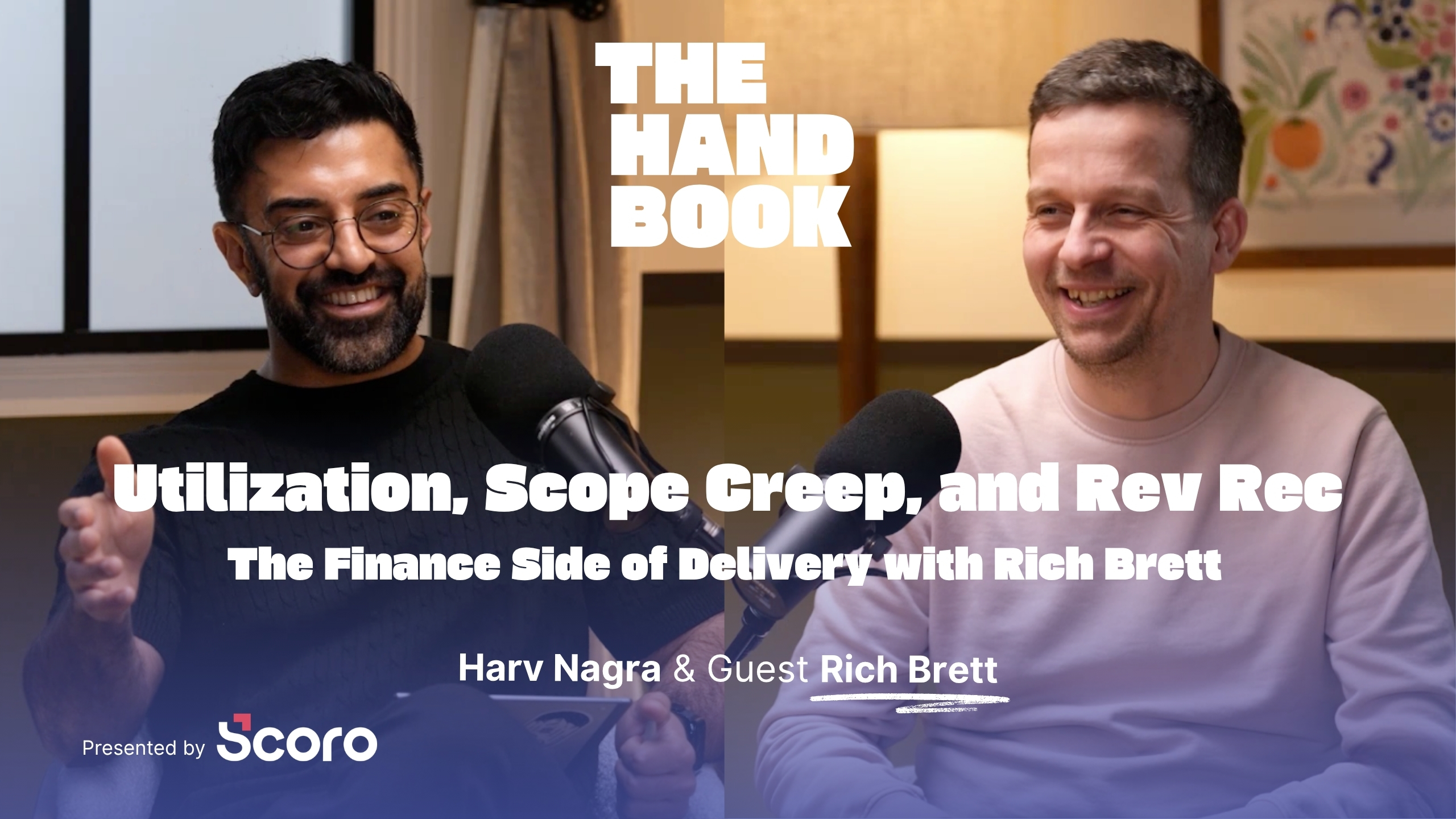
[00:00:00] Harv Nagra: Hi all. Welcome back to the Handbook, the Operations podcast. I’m Harv Nagra. Getting people to adopt a new way of working, a new process, a new tool even inside a single business where everyone shares the same culture and the same history is a real challenge.
So I’ve always wondered, what does that actually look like when you’re bringing in an entirely new business through an acquisition one that has its own way of doing things, its own tools, its own people who didn’t sign up to work for you? today’s guest has been through that process more times than most.
Jonathan Healey is group technology director at IDHL, a UK based digital agency group that has grown through eight acquisitions over the years and incubated a couple of internal startups as well. Jonathan has been at the centre of integrating those businesses, aligning systems, standardising ways of working, and figuring out what you actually have to get right before any of that can happen.
He’s got strong views on why implementations fail, why process isn’t what most people think it is, and what the real sequencing should look like when you’re trying to bring in a newly acquired business into the fold. Whether you’re a single entity, you’re running a group or thinking about an M&A process, I think you’re gonna find this one really useful.
We’re gonna get into it in just a moment.
Jonathan, welcome to the podcast. Thank you so much for being here today.
[00:02:35] Jonathan Healey: thanks. It’s really great to, be on board to the discussion.
[00:02:39] Harv Nagra: You started out as a developer, you became a dev manager, then a MD where you were often focused on business ops, and now you’re the group tech director of a 500 person group. So first of all, why didn’t you stay in development and what was pulling you towards the operational or structural side of things?
[00:02:58] Jonathan Healey: I think, at the stage in my career when I was a developer, a lot of the thinking was that in order to progress you had to become a project manager. And so, uh, given the opportunity to become a project manager, it’s one that I took. And so that obviously, means a slightly different kind of career path. I didn’t stay a project manager for very long. I am an outstanding project manager for about two weeks, then I start to lose interest. it also fall apart. And I think I realised that quite quickly, and ended up back in that dev management role. But I think there was enough in there, that, the business I was in at the time, I think partly through need, obviously saw something in me that they thought was more interesting. and,I started to get dragged into to all sorts of things. I’ve been customer facing for a fair while as a developer. but suddenly involved in, pitching for new business and the sales process, I found myself around a, a management table. I was being invited into board meetings to feedback on various things to the board.
[00:03:55] Harv Nagra: Yep.
[00:03:55] Jonathan Healey: and I think what I started to realise is that I was seeing the kind of the overall system as a whole, not just as a technical solution. and so I think the problem solver in me wants to go broader than just servers and code, but to understand good looks like, what great looks like from end to end.
And I’m, even today I’m firmly of the belief that great development starts with the very first conversation that a salesperson has with a client
[00:04:23] Harv Nagra: Right.
[00:04:24] Jonathan Healey: long before you’ve even started to think about the code that you write. And so being able to see that system through end to end was, I think a really interesting aspect of my career and one that I gravitated towards quite quickly.
[00:04:35] Harv Nagra: Mm-hmm. so I, I understand that IDHL has made eight acquisitions over the years, I think, and you’ve been involved in integrating a lot of them, or perhaps all of them. I have personally never gone through that process. really keen to pick your brain on this today. Can you, can you help us understand what that actually looks like on the ground when a new business joins the group?
What’s the first thing you try to do and what’s the first thing that usually goes wrong?
Yeah, so I, I think what the first thing that you tend to start with is the behind the scenes stuff. So things that don’t directly impact, the clients Yep.
[00:05:12] Jonathan Healey: or the clients of us as a business, the things that, don’t necessarily impact the majority of staff. And so for most of our acquisitions,we would say on day one, nothing will change for most people. And I think that is true, at least on, on day one. And then over time that may, adapt. So I wanna talk about back office, you’re talking about things like your kind of financial reporting systems, um,
being
able to understand as a group exactly the financial position rather than having to a, a bunch of, siloed accounts together and add them all together and hope that you don’t make an error along the way, becomes important.
[00:05:47] Harv Nagra: Yeah.
[00:05:48] Jonathan Healey: but then often things like our recruiting capability, our legal capability, our IT capability, all start to come to bear and add some of the behind the scenes side of things. one of the things we, we try and tackle, early on if we can, is alignment of employment contracts. often that’s been a really easy discussion because, we are, we have a lot of great benefits that we’re able to offer. And so often for colleagues coming into the business that’s ultimately seen as a benefit rather than, something that they are being forced to do and they’re not forced to do it.
We go through a proper consultation
[00:06:21] Harv Nagra: Right.
[00:06:21] Jonathan Healey: and all those things, but the aspiration being to align.
When it comes down to it though, it’s it’s the kind of the old trifecta of people processes and IT.
[00:06:31] Harv Nagra: Right.
[00:06:32] Jonathan Healey: and I think often when people think integration, they either create an org structure and, right, we’re integrated or we put everybody on the same IT systems, right, we’re integrated. I think those three things have to go hand in hand throughout. In some situations one takes the lead and the others follow,
[00:06:48] Harv Nagra: You. Mm-hmm.
[00:06:49] Jonathan Healey: and vice versa.
[00:06:50] Harv Nagra: Mm-hmm.
[00:06:51] Jonathan Healey: In terms of things that kind of go wrong, I think the first barrier that you hit when it comes to any integration: a business that feels it is somehow losing its identity or its culture.
[00:07:05] Harv Nagra: Mm-hmm.
[00:07:05] Jonathan Healey: as a result of now being part of something that’s typically much larger it was.
And if that’s not handled correctly, that can very much lead to an us versus them type of mentality.
[00:07:15] Harv Nagra: Okay.
[00:07:15] Jonathan Healey: and so I’d say that’s probably the single biggest watch out in any of these things because the moment you create unhelpful friction within an organisation,that can really damage the process.
So we work a really hard, as much as we can to try and prevent that from happening.
[00:07:31] Harv Nagra: mm. Um, lots of really interesting things there and in, in the coming questions. I think we’re gonna dig more into this. but you know, I, I’ve heard people say that you can wrecka good business pretty quickly if expectations aren’t set up front, as an example,or the integration is a handled right.
And you’ve given us some examples there. have you seen that happen and can you tell us like,what that looks like?
[00:07:52] Jonathan Healey: Yeah, I think the success of the integration has quite a lot to do with how bought in the leadership is of the business that you’ve
acquired.
and also what their capacity is to handle that integration. often, People are looking to sell or to move on their business or to be acquired because they’re looking for some sort of support because they’re really thinly stretched.
And if we suddenly come in and on day one, throw a load of additional responsibilities on top of a founder who’s already incredibly busy, that can be quite damaging to them. And then to the business and then to the to, to the integration. And that can lead to that sort of sense of us versus them that you start to get and that’s obviously not very helpful.
So we’ve certainly seen it before where we’ve started to go down that route and then had to back off,
[00:08:37] Harv Nagra: Yeah.
[00:08:37] Jonathan Healey: and to leave space for certain things to grow slightly more naturally there. I think one of the things we try and do these days when we’re talking through an acquisition as well is to understand what the non-negotiables are from both sides.
[00:08:51] Harv Nagra: Hmm.
[00:08:51] Jonathan Healey: Um, we’ve certainly seen it in the marketplace where one agency is acquired and had absolutely no idea what was expected of them. Or sometimes even the acquiring agency had no idea what to do with them.
[00:09:03] Harv Nagra: Oh wow.
and very quickly that can go. wrong because Yeah.
[00:09:07] Jonathan Healey: immediately got misaligned expectations.
understanding that and working on that before you sign on the dotted line can
be absolutely critical. You know, if, if, if we are looking to, I don’t know, rename an agency through the
acquisition process, but actually that name is a core part of who they are and their reputation and how they attract staff and things like that, we probably wouldn’t do that if that was the case, but to them
[00:09:28] Harv Nagra: Yeah.
[00:09:29] Jonathan Healey: a really important matter.
and if, if you’re not aware of that on day one. It’s,it can be a, a dealbreaker, a deal breaker down the line.
[00:09:37] Harv Nagra: Mm-hmm. Essentially. So just making sure everyone’s on the same page in terms of what’s gonna change and when, when that time comes.
[00:09:44] Jonathan Healey: Yeah, I think you’ve just kind of nailed some of the change management thing there.
Harv is, a huge amount of it is expectation alignment, rather than do
[00:09:51] Harv Nagra: Yeah.
[00:09:52] Jonathan Healey: actual change.
[00:09:53] Harv Nagra: Yep. Absolutely. there, there was something that you said to me previously that I thought was quite interesting, that you’ve sometimes set those expectations clearly with the founders so they know what’s gonna happen, but it doesn’t necessarily trickle down to their teams. and after you’ve lived through that and learned that lesson, what do you try to do to mitigate that from happening?
[00:10:11] Jonathan Healey: Yeah, I mean, I guess that cuts both ways, right? Um, we’ve got one or two on our side that aren’t trickling down to the management team on the IDHL side, that can have the same, effect. So, there, there’s always a degree of sensitivity when you’re going through the acquisition process and there’s always a degree of sensibility about
when you have which discussion.
There are certain things that need to happen. side of the dotted line. Certain things have happened the other side,
but probably what we’ve got slightly better at is bringing on board some more stakeholders from both sides when the time is right as we were moving up to and post deal.
And so just ensuring that not just say a founder, but also some of their key management team
are aware
of what’s happening, and what may come down the pipeline that may affect them, can be hugely helpful.
And again, the same from the IDHL side.
understanding who from the IDHL side is going to be responsible for what aspects of, an integration or post acquisition, uh, activities that we may choose to do.
[00:11:14] Harv Nagra: Right. Have you, Jonathan ever seen anybody or a team really digging their heels and resist, just wondering if that happens and you know how you’ve handled that?
[00:11:23] Jonathan Healey: Yeah, I, I mean, you can get it in pockets
[00:11:27] Harv Nagra: and I think it, it comes particularly where people feel their identity. is being eroded. we, over time we acquired a number of brands.
Right.
[00:11:37] Jonathan Healey: you know, you can have a look at the timeline on our website, but we, we had brand one, brand two, brand three, brand four.
We were going to market as, I think at one stage about eight or nine different brands. We took the decision to consolidate that all into, uh, you know, a single brand just to make the story for our customers easier to understand and our go to market. Easier to understand.
[00:11:57] Harv Nagra: Mm-hmm.
[00:11:58] Jonathan Healey: And what was really interesting to me is that some of our longest standing acquisitions were the ones that pushed back hardest against that.
[00:12:05] Harv Nagra: Mm.
[00:12:06] Jonathan Healey: Um, which is, which is really intriguing, in terms of a real sense of identity that carried its way through.
[00:12:13] Harv Nagra: Yeah.
[00:12:14] Jonathan Healey: know, and in one situation we’re talking sort of eight or nine years that identity had kind of carried through with a set of individuals in the, in, in the business.
[00:12:22] Harv Nagra: Mm-hmm.
[00:12:23] Jonathan Healey: so yeah,you can get that.
ultimately that wasn’t a particularly big one and I think they all knew it had been coming for years anyway, and soon got over it. but yes, I think it’s that when you touch on somebody’s identity, that’s when you get the biggest pushback and heels digging in.
[00:12:39] Harv Nagra: Yeah, that, that’s a good point. And I guess to some degree understandable as well. so I am wondering, just in terms of visualising how that structure works, then you consider all these acquisitions separate entities at the moment. Can you just paint a picture of that for us?
[00:12:52] Jonathan Healey: Yeah, so we made, we’ve made a number of acquisitions over time. Typically, when we acquire a business, we don’t integrate it as an entity straight away.
[00:13:00] Harv Nagra: Okay.
[00:13:01] Jonathan Healey: in terms of some of the process that we went through, we’d acquired five, web build businesses, over a period of time for example, and, we were going to market as those five web build businesses for some time, even though behind the scenes were operating a single profit and loss account. And we were offer operating by and large, 100% integrated kind of back office processes. In fact, very often the same, some of the same staff working on the same systems.
[00:13:30] Harv Nagra: Okay.
[00:13:30] Jonathan Healey: in that scenario, the very last thing that we integrated, if you like, was the brand name.
we may not always do it that way. we’ve made two acquisitions in the last, uh, 18 months or so. they still standalone. they’re still separate legal entities. They still have their own, uh, profit and loss accounts. and the way in which we are approaching both of those integrations is fundamentally different. partly due to the nature of who they are and what they do and, and, and how they operate in their own marketplaces.
[00:13:59] Harv Nagra: Okay. Okay.
[00:14:00] Jonathan Healey: so over time we went from, about eight entities to a single legal entity.
[00:14:04] Harv Nagra: Right.
[00:14:05] Jonathan Healey: it gets more complicated when you go abroad. and we, so we have a,a decent offering now in, in the US um, tracking upwards of 10% of our revenue is coming from, from that market. and so obviously there you at a very different, differently and you need separate legal entities in order to do that effectively.
[00:14:22] Harv Nagra: Mm-hmm. Mm-hmm. And just to, sorry if I’ve confused myself. how many total entities do you have then at the moment?
[00:14:31] Jonathan Healey: At the
[00:14:31] Harv Nagra: Because
[00:14:31] Jonathan Healey: Four.
[00:14:32] Harv Nagra: spoke about
[00:14:33] Jonathan Healey: Four
[00:14:33] Harv Nagra: eight acquisition. Okay? Okay. Yep.
[00:14:36] Jonathan Healey: and actually the one, two of those would be our US versus uk,
[00:14:40] Harv Nagra: Right.
[00:14:41] Jonathan Healey: So really in terms of go to market, it’s three entities.
[00:14:44] Harv Nagra: Okay. Okay. So coming back to our questions, Jonathan, that given that you’ve gone through this acquisition and integration process several times now, do you get better at it or does each come with Its completely different set of challenges.
[00:14:58] Jonathan Healey: I think the answer to both of those is yes.
[00:15:00] Harv Nagra: Okay. Okay. You get better at it
[00:15:03] Jonathan Healey: Yes, we get better at it, but equally, I think. When we were first going on this journey, you’re acquiring a, we were a smaller business and you’re acquiring a different type of agency to the type of agency or business that we’re acquiring now.
[00:15:16] Harv Nagra: Uhhuh.
[00:15:17] Jonathan Healey: And what a, when you acquire a founder led business, what they need from an acquiring company and the support that they need in the integration requirements for those very different, for example, to one that’s led by a management team.
or perhaps a much larger agency where the management team are no longer even significant shareholders or stakeholders in the business. You might call ’em a professional management team, if you like, rather than a management led business, again, that is slightly different. They’re likely to have their own systems and processes and structures and legal departments and, and things like that you need to consider. So as you scale, each one becomes different and the reasons you buy each is also different and that affects how you integrate them.
For
quite a long time, we essentially had platform bolt-ons that,
that we were moving into the business. So although the businesses perhaps operated in certain, or looked from the outside, like they were in a similar space, they operated in completely different markets and so could be kept quite separate.
[00:16:15] Harv Nagra: Okay.
[00:16:16] Jonathan Healey: As a standalone specialist function.
as you start to acquire larger entities, they tend to do more things and have more services and more products, and then you start to get something more of an overlap with existing products and services that you offer. And so that means that, you’ve got a slightly different set of complexities that you’re dealing with when it comes to integration.
[00:16:37] Harv Nagra: Right. Right. That makes sense. And that was gonna be my next question, is that, is there a certain kind of business that’s harder to integrate? But maybe that’s an example is where you have that overlap, you need to figure out what you’re gonna do about it.
[00:16:48] Jonathan Healey: I think so when, when we were acquiring essentially different channels to add to our business,
[00:16:54] Harv Nagra: Yeah.
[00:16:55] Jonathan Healey: didn’t necessarily matter so much if they had a completely different process.
[00:16:59] Harv Nagra: Right.
[00:17:00] Jonathan Healey: because we could look at that and we could re-engineer it over time. But I think when you’re offering the same product in a slightly different way to the same set of customers, that certainly changes the dynamic. and I think also you’re dealing with,again, depending on the size of the business, different integration needs. if we head out and we acquire a much larger business, it inevitably comes with its own time sheet software and potentially with its own PSA and definitely an accounting system and
[00:17:30] Harv Nagra: Yeah.
[00:17:31] Jonathan Healey: an HR manager
[00:17:33] Harv Nagra: Mm-hmm.
[00:17:33] Jonathan Healey: all of those things that, with a much smaller business they wouldn’t have and they would just gratefully take whatever we had to offer as their
default
without even questioning it.
[00:17:41] Harv Nagra: Mm-hmm.
[00:17:41] Jonathan Healey: so the conversations become very different when you’re dealing with a business of scale.
[00:17:46] Harv Nagra: Right. That makes sense. Um, you know, you, you were, pointing out that it comes down to people, process, technology, is I think how you put it a few minutes ago, so let’s go back to that kind of order things need to happen. structuring roles, integrating processes, technology reporting and all of that.
How do you decide what needs to come first and why that order?
[00:18:05] Jonathan Healey: Yeah, so I think just from a purely practical point of view these days, because so much happens in an online space, some of
the IT considerations
are, are straight up front.
[00:18:16] Harv Nagra: Okay.
[00:18:16] Jonathan Healey: just simply to be able to collaborate as teams having access to the same systems becomes vitally important.
[00:18:22] Harv Nagra: Sure.
[00:18:23] Jonathan Healey: So that’s not necessarily to say that we’re going to, overnight transform and integrate, big document repositories and things like that, that, that requires a little bit more consideration and thinking, but just simply making sure everybody is on the IDHL network and can access the IDHL systems. is your starting point.
[00:18:42] Harv Nagra: Yep.
[00:18:43] Jonathan Healey: that even comes through as, as far as, we have an HR system that requires, you to be on our network in order to access it for security reasons, et cetera.
[00:18:51] Harv Nagra: and so in order for us to align contracts that I spoke about before,
[00:18:56] Jonathan Healey: the IT thing has to happen. and so that’s a typical path that we would go through is it access? we would typically look at that sort of staff contract alignment. and then it’s into the other back office things. So often we would look at how contracts are structured. we’re lucky enough to have an in-house legal team, and so being able to make sure that we’re able to offer clients a single consolidated set of terms and conditions. Is a huge advantage in terms of their engagement with us,
[00:19:27] Harv Nagra: Right.
[00:19:28] Jonathan Healey: our ability to easily understand what our commitments are to each customer
[00:19:32] Harv Nagra: Mm-hmm.
[00:19:33] Jonathan Healey: and to speak a common language. it’s often things like contracts,I’ve mentioned accounting and finance systems before. Very often we will leave an acquisition through the current financial year that they’re in and the moment we start the next financial year, it’s into our, systems so that, we’re not trying to do that. we are doing that across a year end rather than in, in the middle of the year.
[00:19:54] Harv Nagra: Makes sense.
[00:19:55] Jonathan Healey: And, yeah. And then I think it’s a question of deciding whether or not you align or whether or not you directly integrate.
and I think I would probably draw a distinction between those.
[00:20:07] Harv Nagra: Mm-hmm.
[00:20:08] Jonathan Healey: things, because where integration is hard, often the first thing that you’re trying to do is to think about, okay, how could we align these two things
slightly
so that in the future we are able to integrate them more effectively?
[00:20:20] Harv Nagra: can you just, um, explain that a bit? I am not quite sure I’m on, I understand what you mean by align. What, what, what would that mean?
[00:20:26] Jonathan Healey: Yeah, so a good example of this is if you’ve got,a workflow that is done by two very similar teams in, in, in the two different businesses. So, um, uh, we, we went through quite a lot of this when we did our kind of web division integration. we had agencies who, even some of them used the same software platform to manage their work, had completely different workflow stages for tasks running through their Kanban boards.
[00:20:51] Harv Nagra: Mm-hmm.
[00:20:51] Jonathan Healey: So one of the first things you can do is say, okay, well how can we align these two processes so that they both are familiar? Sometimes that can literally come down to labelling.
[00:21:00] Harv Nagra: Right.
[00:21:01] Jonathan Healey: Sometimes that’s okay. You have the same process, but we’re gonna label it the same now. really nothing’s changed, but the name of things has changed.
And over time, that makes it easier for people to say, okay, we can now use one platform instead of two.
[00:21:13] Harv Nagra: Yeah. Makes sense. Um, there, there’s also the element of roles, right? And whether there’s redundancy due to them becoming part of the group. I, and is that something that you, you, you try to address early on?
[00:21:26] Jonathan Healey: I don’t think we’ve ever made an acquisition where the intention on day one was to make anybody redundant.
[00:21:33] Harv Nagra: Right. Mm-hmm.
[00:21:35] Jonathan Healey: sometimes what happens in the natural order of things is people might come to the conclusion that actually this isn’t a path that they wanted to go down as part of their, kind of career progression.
or over time it may emerge that a particular role becomes, redundant. but it’s never something we’ve set out to do. And one of the things that we’ve. not done yet. And it’s not to say we wouldn’t do it in the future, it is to take two teams and try and put them together on day one of the acquisition. so generally speaking, we’ve allowed teams to operate as they have been for a period of time before making any active intervention.
[00:22:09] Harv Nagra: Right. Okay. Um, you know, we’re talking about integration here and there’s this tension, I think sometimes about, bringing somebody in and wanting the standardisation. you’ve talked about common systems, common reporting, common ways of doing things, and maybe then, also not wanting to ruin what made it a good business in the first place.
Right. So you’ve talked about that integration piece and what you would do, but. How do you, you know, is there a line that you can draw or how do you distinguish what you standardise and what you leave alone?
[00:22:40] Jonathan Healey: Yeah, it’s, it’s really, it’s really hard is the short answer, and it’s different for every business.
[00:22:45] Harv Nagra: Mm-hmm.
[00:22:47] Jonathan Healey: and that’s because what every business adds to us is different. and, yeah, so I, I wouldn’t say that there’s a standard approach that we can to that. what I would say as an observation is that I think over time the acquisitions that we’ve brought in have changed us as a business.
[00:23:01] Harv Nagra: Mm-hmm.
[00:23:02] Jonathan Healey: And obviously they,and that’s maybe a bit that people don’t talk about is if we hadn’t brought that business in as an acquisition, it would have changed anyway.
[00:23:10] Harv Nagra: Right.
[00:23:11] Jonathan Healey: Because it was a business that was going places and had aspirations to grow and had aspirations to change by default.
[00:23:17] Harv Nagra: Mm-hmm.
[00:23:17] Jonathan Healey: The only thing that’s fundamentally different is that they have handed over some of the decision making on that change to somebody who wasn’t them.
[00:23:27] Harv Nagra: Right,
[00:23:28] Jonathan Healey: And so would say o over time, perhaps it’s impossible to leave an agency exactly as it was.
[00:23:38] Harv Nagra: right.
[00:23:39] Jonathan Healey: Because, again, as I said, they would change. We would change, we would move closer to where they are in a position. They would move
closer to where we are in a position. Ultimately, those lines are gonna become more and more blurred
Until
nothing is left. I was gonna say disintegrated. That sounds terrible. Unintegrated.
[00:23:56] Harv Nagra: Right, right. No, that makes sense. and it’s a, it’s an important thing that you’ve pointed out, that we are in a state of constant flux and evolution, especially if we want to be,Successful in the current climate, you have to keep changing. Right. so it’s just maybe certain things accelerate or go down a slightly different path than originally intended, but
[00:24:16] Jonathan Healey: are perhaps slightly different as
[00:24:17] Harv Nagra: Right.
[00:24:17] Jonathan Healey: Yeah.
and that kind of yeah, makes,
[00:24:20] Harv Nagra: Yeah,
[00:24:21] Jonathan Healey: too.
[00:24:21] Harv Nagra: absolutely makes sense. I have heard you say something before process is poison and as an ops person, it pains me to hear that. It upsets me. What do you actually mean by that and how does it change the way you approach rolling out a new way of working? tell us about that.
[00:24:37] Jonathan Healey: Yeah, I, I knew you were gonna raise that. It’s,
[00:24:39] Harv Nagra: How dare you.
[00:24:40] Jonathan Healey: yeah, no, but it’s an important point because, and I do, I believe a certain type of process is poison. And
[00:24:47] Harv Nagra: Okay.
[00:24:47] Jonathan Healey: go as far as saying that it’s what t people typically refer to as process. And so
what you often observe in any organisation is that something goes wrong. Somebody decides that if certain steps had been carried out,
it wouldn’t have gone wrong.
[00:25:04] Harv Nagra: Right.
[00:25:05] Jonathan Healey: Documents those steps, emails it around and says, this is our new process.
[00:25:09] Harv Nagra: Mm-hmm.
[00:25:10] Jonathan Healey: and then something else goes wrong or perhaps even the same thing goes wrong and somebody does the same thing again. And before you know it, you have got large aspects of your. your business, that now has a process that not everybody is up to speed with that. Not everybody has remembered Not
even everybody is certain of, and it can lead to the sense that, oh, there are so many steps that we have to go through to do anything around here. And almost everybody adopts their own process.
[00:25:37] Harv Nagra: that regime. And then there is a tendency to lay a process on top of process, on top of process, on top of process.
Mm-hmm.
[00:25:43] Jonathan Healey: I think that’s where we get to this kind of slow strangulation effect. The process can have,
on a business. I think we all get the sense sometimes that many of our kind of, sector organisations have a tendency towards this type of behaviour, especially in highly politicised organisations where there is a, people are perhaps more strongly incentivized to cover their ass rather than to be proactive on things.
[00:26:08] Harv Nagra: Right,
[00:26:08] Jonathan Healey: So anything we can do to simplify things makes process more effective.
[00:26:16] Harv Nagra: right.
[00:26:16] Jonathan Healey: what I sometimes like to talk about in our business is how can we make it so that what we want people to do is the genuine route of least resistance. ’cause people always find a path that is the path of convenience. And if we can make the path, we want ’em to take the path of convenience, they will always stick to the process.
[00:26:38] Harv Nagra: I love that. Mm-hmm.
[00:26:39] Jonathan Healey: And so when you look at it that way, process should do one of two things. It should either remove friction, which is the majority of what process should do,
[00:26:49] Harv Nagra: Mm-hmm.
[00:26:50] Jonathan Healey: or it should introduce a very intentional friction point,
[00:26:54] Harv Nagra: Hmm
[00:26:55] Jonathan Healey: that point where you say, no, stop, intervene, observe. And I’ve got a great example of this from, a process that we run in our business every single week.
that relies on, a project manager critically evaluating a piece of information, summarising it, and putting it into another document form.
[00:27:11] Harv Nagra: Okay.
[00:27:12] Jonathan Healey: it’s a manual process and it would be very easy to automate. We could automate it in 25 minutes with a simple Excel formula.
[00:27:20] Harv Nagra: Okay.
[00:27:21] Jonathan Healey: And over the years, every time a new project manager would join, they would say, Hey, I’ve got an idea.
We can automate this. And
every time I would say, no, I refuse to automate that.
Because the value in that is you stopping and critically evaluating the information, not just passing it from one source to another.
[00:27:36] Harv Nagra: Right.
[00:27:37] Jonathan Healey: mean by friction.
[00:27:38] Harv Nagra: Often it’s the human in the loop piece is
Yep.
[00:27:41] Jonathan Healey: to add friction.
The same is true of AI systems today. We want to introduce friction into the process because you won’t want the AI hallucinating and making a decision on behalf of the business. Sometimes you want a human in the loop that’s a friction point in the system. So process should either remove friction and that’s what it should aim to do the majority of the time, or it
should introduce a very intentional but clearly defined friction point.
[00:28:04] Harv Nagra: really good advice. we’re gonna kind of change tracks now and talk about, systems you have at IDHL built a lot of internal platforms rather than buying off the shelf tools. These days, like with platforms like lovable, replit and so on, you can build things with a series of prompts as well.
But having built an in-house platform in the past, I’m aware of the work that can be required to build and maintain and innovate on,something that you’re building in-house. So tell us about that decision and where’s the threshold where you know that, okay, this has worked until now, but now it’s becoming a burden, rather than an advantage for the business.
[00:28:42] Jonathan Healey: Yeah, I think, the majority of the systems that we built in the early days were business operation systems, and the reason we built them is because there were no good alternatives
available. We’re a longstanding business. Some of those systems date back more than 20 years.
[00:28:55] Harv Nagra: Right.
[00:28:56] Jonathan Healey: Um, they’re not 20 years old. We’ve continued to invest in them and modernise them and update them over time. but of course what happened over time is that we built up kind of an ecosystem of systems that
meant in some parts of, in fact, in large parts of our business, the entire process of systematised literally from the first conversation that we have with a prospect through to the final invoice out the door, including
[00:29:17] Harv Nagra: Okay.
[00:29:17] Jonathan Healey: back into our delivery and operational teams.
So
[00:29:20] Harv Nagra: Hmm.
[00:29:20] Jonathan Healey: we feel that that’s a huge, huge part of who we are as a business. and replacing those with off the shelf systems when you’ve got something that’s really highly customised to you,
[00:29:31] Harv Nagra: Mm-hmm.
[00:29:32] Jonathan Healey: a, is a challenge. Now, that’s not to say that we haven’t done that.
[00:29:35] Harv Nagra: Mm-hmm.
[00:29:36] Jonathan Healey: example, I think CRM systems have matured significantly in the last decade. and a short while ago we made a significant investment in removing the CRM that we had built ourselves and replacing it with an off the shelf alternative.
[00:29:48] Harv Nagra: Right.
[00:29:49] Jonathan Healey: it still plugs into our entire business process end to end, and I think that’s the kind of the core value that, that we would maintain.
And so over time I can see us replacing some of our other systems.
but it does also mean that we are reallocating some of our resource and capability elsewhere. And, we don’t use. replit lovable, but we, we do have agentic coding capabilities,
[00:30:10] Harv Nagra: Right.
[00:30:11] Jonathan Healey: that we have invested in and we are building tools to help our team service our customers more effectively
[00:30:17] Harv Nagra: Mm-hmm.
[00:30:17] Jonathan Healey: as kind of our primary internal development function now, rather than tools to manage our business process.
Partly
[00:30:24] Harv Nagra: Right.
[00:30:25] Jonathan Healey: ’cause we have most of those, but partly because actually the greater value is in being able to service clients better
through
the rapid development that we can now do.
[00:30:34] Harv Nagra: And how do you, how do you know that it’s time to replace something then that example of the CRM, then where did that as an example, that decision come from?
[00:30:45] Jonathan Healey: of that was an integration exercise. coming back to this acquisition side of things, we would acquire an agency and they would say, right, we’ve got either Pipedrive, got HubSpot. And before we knew it, we had I think two instances of HubSpot and five instances of Pipedrive in our business
[00:30:59] Harv Nagra: Hmm.
[00:31:00] Jonathan Healey: alongside an internal CRM.
[00:31:02] Harv Nagra: Okay.
[00:31:03] Jonathan Healey: once you started to look at that and you say, okay, how do we integrate this? you’ve now got some scenarios is, you know, do you, do you put everything in HubSpot? Do you put everything in Pipedrive?
Do you put everything in our internal CRM or do we go and test the market and see what’s available?
And
so we tested the market, we saw what’s, what’s, what’s available.
[00:31:20] Harv Nagra: Yeah.
[00:31:20] Jonathan Healey: and ultimately we, we selected,Salesforce, which is, um, you know, probably the most successful SaaS platform on the planet.
[00:31:28] Harv Nagra: Mm-hmm.
[00:31:29] Jonathan Healey: and use that to replace seven or so systems that we had with one single consolidated system.
[00:31:35] Harv Nagra: Sure. Sure. now, I, one more question on this kind of theme is the technical investment. there, there’s the balance of having your resources working on billable projects for clients and I’m just going back to that kind of example of myself. in, in a past workplace where we’d built this system, um, the, the, the challenges we run into was like the client work comes first, and
you know, not having a team focused on iterating and developing this becomes a bit of a liability and frustration. Like, you, you build something that works for today rather than for tomorrow. So how do you guys manage that?
[00:32:13] Jonathan Healey: I mean, you, the only way you can do it is to ringfence the resource to, to do it.
[00:32:18] Harv Nagra: And I think we’re lucky enough that we’re now at a scale where we can do that. Right.
[00:32:22] Jonathan Healey: we have an internal development team that, that is not responsible for any revenue whatsoever.
[00:32:28] Harv Nagra: Yeah.
[00:32:29] Jonathan Healey: we do have, some of our revenue generating team will from time to time work on, on, on sort of special projects, if you like,
normally, to provide benefit back into their division.
And some of our aspiration there is to take those products into our internal team for maintenance on an ongoing basis because you’re absolutely right, overlook the cost of maintaining a piece of software,
which
is. Oftentimes just as expensive as building it.
[00:32:57] Harv Nagra: Right, right. And with the change of kind of pace in the market and stuff like that, you need to de dedicate that resource to make sure that you’re
up
with.
[00:33:05] Jonathan Healey: A hundred percent. And it’s very easy to throw together a vibe coded application today, but ultimately software still needs to be maintained.
And I think it takes just as much effort to maintain a vibe coded application as it does a traditional software
application. That side of things is not going away.
[00:33:22] Harv Nagra: Mm-hmm.
[00:33:23] Jonathan Healey: So, um, yes, you might be able to throw somebody onto a project for a few hours and build something that’s useful.
[00:33:29] Harv Nagra: Yep.
[00:33:30] Jonathan Healey: but whether or not you can keep on doing that on an ongoing basis every week, in week out, year in, year out as a business is a, I think a challenge that it often comes as an afterthought.
[00:33:41] Harv Nagra: Absolutely. And that’s something you should probably be thinking about clearly upfront,
[00:33:44] Jonathan Healey: Yeah.
[00:33:45] Harv Nagra: when you make those decisions. Um, sorry, were you about to say something?
[00:33:49] Jonathan Healey: I was just going to say, I think, coming back to your original question about that sort of build versus buy, I think if we were starting the business fresh from scratch today, we probably would’ve bought more than we’ve built.
[00:34:00] Harv Nagra: Mm-hmm.
[00:34:01] Jonathan Healey: Um, I said for all the advantages given us, and it’s a huge advantage.
but we’ve already got that advantage,
[00:34:07] Harv Nagra: Right.
[00:34:07] Jonathan Healey: to think about it. But yes, absolutely, I think, I would going to market to buy more than I would be trying to build internally.
Certainly for business
operations related
software.
[00:34:20] Harv Nagra: we’re gonna switch gears again, Jonathan, you mentioned, to me that you work very closely with the ops director at IDHL on the change management side of these integrations, you know, comm strategies, engagement plans, training, and all that kind of structured stuff.
two questions. does it change approach that those of us that haven’t gone through an M&A. does that process differ from the the way you would handle it in an acquisition? Um, maybe I’ll leave it there first.
[00:34:49] Jonathan Healey: Yeah, I think the short answer is yes,
[00:34:51] Harv Nagra: Hmm.
[00:34:52] Jonathan Healey: but predominantly because the stakeholders don’t know each other as well.
[00:34:55] Harv Nagra: Right.
[00:34:57] Jonathan Healey: And so a little bit more handholding needs to take place. I think people within IDHL used to a certain kind of approach to change management that we’ve tried to model over the years,
and so they, they sort of understand the way that we do things around here,
[00:35:12] Harv Nagra: Yep.
[00:35:13] Jonathan Healey: acquisition coming in doesn’t, and so they need to be handheld a little bit more closely through that process.
But fundamentally, the change principles are exactly the same.
[00:35:25] Harv Nagra: Right. and on that note, what advice would you have for us in general on, in terms of successful change management from your experience?
[00:35:33] Jonathan Healey: Yeah, I think there’s probably to recognise two things is that one, the change only starts when you announce the change is done.
[00:35:42] Harv Nagra: Hmm.
[00:35:43] Jonathan Healey: And, and I think,we’ve drawn on, in, in our BU business o over the years, the Bridges transition model. I dunno if that’s one that you’ve come across before, but the
sort of this, notion that for those of us who are directly working in the change and insti instigating
[00:35:57] Harv Nagra: Yep.
[00:35:59] Jonathan Healey: for us, when we announce it to the business, it’s great. Pat’s on the back, everything’s done off we go. For those receiving the change, it’s
brand new to them
and they still have to go through the transition process with that change. I think a lot of change management fails because we don’t recognise that
bit that comes after we launch the change.
[00:36:18] Harv Nagra: Right.
[00:36:19] Jonathan Healey: and maybe the second part that comes with that, that I’ve learned is that nobody’s reading your announcement. So people are really busy. People have a lot of communications coming across their desk all the day. What you are announcing to them may not be the most important thing that they deal with that month.
They may come back to it weeks and weeks later when it’s no
[00:36:37] Harv Nagra: Yeah.
[00:36:37] Jonathan Healey: relevant or something like that. So I think the importance of how you communicate cannot change, cannot be, overstated.
[00:36:47] Harv Nagra: Right.
[00:36:48] Jonathan Healey: we try and telegraph change before it happens. We try and ensure that there are announcements leading up to it.
We make sure that it’s properly announced on the day. We do follow up announcements to it confirming that it’s in place. Every one of those announcements is written for multiple audiences. Every announcement always has A-T-L-D-R at the top of it.
So for those who are hard pressed, who may not read the whole thing, at least the TLDR tells them whether or not they really should read the whole thing or not.
[00:37:14] Harv Nagra: right.
[00:37:15] Jonathan Healey: and so we try and work really hard on those things. but that being said, I think what I’ve learned is that most people are still not reading those announcements, and you have to walk them through that transition
step by step over a period of time.
[00:37:26] Harv Nagra: Mm-hmm. Mm-hmm. Despite all those comms, you still have to think, there’s always another opportunity to
[00:37:33] Jonathan Healey: A
[00:37:33] Harv Nagra: the message,
[00:37:34] Jonathan Healey: Yeah.
[00:37:35] Harv Nagra: Yeah. Excellent. so let’s talk briefly about ai. in, in our prior call you were saying that, the barrier to AI effectiveness is a people problem, not a technology problem.
What does that mean and, what are you actually doing about it at IDHL.
[00:37:51] Jonathan Healey: Yeah, so first of all, this isn’t an all people problem. We have practitioners in our business that, are super enthusiastic about AI are over every tool, over too many tools. doing really impressive things, and really leading the charge when it comes to that. but with any change, with anything that’s new, there is always a degree of reticence from people to embrace it, and I think that’s even harder when there is an undertone in the marketplace of, and it could take your job,
[00:38:19] Harv Nagra: Yeah.
[00:38:20] Jonathan Healey: which I don’t believe in for a moment.
I’m a firm believer that AI is coming for your tasks, not your role.
[00:38:26] Harv Nagra: Hmm.
[00:38:27] Jonathan Healey: Um,
[00:38:28] Harv Nagra: Mm-hmm.
[00:38:28] Jonathan Healey: and we do see that more and more, but again, it becomes a change management challenge to take people on that journey. And for us, we’ve tried to, as we’ve launched AI capabilities to the wider business, we’ve tried and take everybody through a training programme.
[00:38:44] Harv Nagra: Okay.
[00:38:45] Jonathan Healey: to ensure that people are trained in how to use AI safely.
[00:38:48] Harv Nagra: Hmm.
[00:38:49] Jonathan Healey: Um, in what the risks are in using ai. we’ve tried to ensure that everybody is, aware of our policies and what their state with regards to use of AI and the fact that there always needs to be a human in the loop
[00:39:00] Harv Nagra: Mm-hmm.
[00:39:01] Jonathan Healey: Mm-hmm.
we’ve tried to ensure that, people understand that when they take AI generated content and pass it over to a colleague or to a customer, it is no longer AI generated is their content and they take ownership of it.
[00:39:14] Harv Nagra: Yep.
[00:39:14] Jonathan Healey: I think really important,to make sure that is the case so we don’t abdicate responsibility to a machine.
[00:39:20] Harv Nagra: Yeah.
[00:39:20] Jonathan Healey: which is the last thing we want. all of those training things be, become an issue. And I think one of the things that we also see right now, and maybe this is a tech problem, is that the maturity of the tools is such that it’s really quite difficult from within the tools to share best practise with people. We see a lot of evidence of solopreneurs popping up and saying they can now do all the things because they have an ai. and the reality is they’re probably doing all of the things to 60 or 70% of the capability that a human would do. Then we probably have all of those roles in our business. so how does the AI really act in that context is a big question. The other question becomes, okay, I, as an individual have done something very cool using the AI capabilities that I’ve got. How do I share that with my colleagues?
[00:40:13] Harv Nagra: Yeah.
[00:40:14] Jonathan Healey: And so a huge amount of my emphasis at the moment inside IDHL has moved on from, okay, everybody’s got AI tooling now that’s, just a given, but how do we get the most out of that?
And a lot of the getting the most out of it is how do we leverage our teams and the champions within those teams to cascade their knowledge and their learning wider across the organisation? And that’s why it’s a human problem, not a technology problem
[00:40:38] Harv Nagra: Yeah. No, that’s fair. really helpful examples there as well. I, my question is that there’s just so many tools out there as well in, in every type of niche and dozens of kind of competitors, for each of them. So do you have strict control in your organisation, in your group about what tools people are allowed to use?
First of all, I dunno if that’s as simple as a yes no, answer. But then how does the training and the best practise, is it that you train people on the policies and stuff like that, and then allow them to just run with it?
[00:41:13] Jonathan Healey: Yeah, I think training on principles and feature sets.
[00:41:16] Harv Nagra: is the key things. Understanding a little bit more about how LLM works under the hood and how to craft a really strong prompt for it
Yeah.
[00:41:24] Jonathan Healey: a superpower that they may not have found on their own, just
dabbling,
[00:41:28] Harv Nagra: Mm-hmm.
[00:41:29] Jonathan Healey: in terms of the software and the software use.
so we. have a very robust process and we had this before AI existed
in terms of software selection.
[00:41:38] Harv Nagra: Right.
[00:41:40] Jonathan Healey: that anybody uses needs to be reviewed from a data security and legal compliance per perspective. we’ve had that in place since the advent of GDPR,
[00:41:48] Harv Nagra: Mm-hmm.
[00:41:49] Jonathan Healey: and so our users in our organisation are generally excellent
[00:41:53] Harv Nagra: Mm-hmm.
[00:41:54] Jonathan Healey: at Hey, I’ve discovered this new thing I want to use.
Can I use it?
[00:41:59] Harv Nagra: Okay.
[00:42:00] Jonathan Healey: And submitting it through a process. And so we have a suite of AI tools and capabilities that we have authorised for use within the business. Some of those are limited in their scope, either to a particular team or a particular function or a particular use case. but then we’ve also got some generic tooling that we’ve rolled out, across the business, using the Microsoft Co-pilot platform.
[00:42:22] Harv Nagra: Right.
[00:42:23] Jonathan Healey: our feeling in that is that it gives us access to several models,
[00:42:26] Harv Nagra: Mm-hmm.
[00:42:27] Jonathan Healey: rather than locking us into it to a single vendor, and it’s integrated into the stack that we already use. So the rollout is really convenient.
[00:42:34] Harv Nagra: Mm-hmm.
[00:42:35] Jonathan Healey: one thing that makes me really uncomfortable is when I see, Organisations flipping from one to the next day after day.
Okay, Gemini’s released the new model. Right now we’re on Gemini.
[00:42:45] Harv Nagra: Yeah.
[00:42:45] Jonathan Healey: open ai. Now we’re back on open ai.
[00:42:47] Harv Nagra: Hmm.
[00:42:48] Jonathan Healey: And I think in this kind of race it’s really hard to determine who is winning that race right now. And I think you’re may be better off backing just one of the bigger vendors and sticking with it for a
while than trying to keep on top of every single new, capability that is released each week.
[00:43:04] Harv Nagra: Right, right. I wanna go back to something you said a moment ago, about that kind of there being certain people that might have, more mature skills and it becomes very difficult to share best practise and all that kind of stuff. Have you cracked that? if somebody obviously is doing something exceptionally well, you do want more people?
We talked about process being poison, but you do want people to know what the hack is so they can start delivering more efficiently or whatever it might be.
[00:43:32] Jonathan Healey: Yeah, so I run an AI drop in session fortnightly in our business that is
[00:43:36] Harv Nagra: Okay?
[00:43:37] Jonathan Healey: across the organisation. we get a good few of regular attenders and then people dropping in and out, and I’m constantly on my ear out for what I’m hearing in the business
to try and bring that to light, and share some of that best practise. beyond that, we have tried to work with our senior management team. Um, identify kind of who are the champions in their areas
[00:44:00] Harv Nagra: Okay.
[00:44:00] Jonathan Healey: to try and encourage them to lean more heavily on those champions and to say, okay, we are operating now, I guess in a federated model where AI can do in your department is not gonna be defined centrally.
You guys are gonna need to forward that path for yourself. Here’s the tools, here’s the capabilities, here’s some training to get you going. But you as a team need to figure out where that lands. And so I’m trying to act as a facilitator amongst line management, wherever I see what I think is a really neat way of doing it,
[00:44:29] Harv Nagra: Right.
[00:44:29] Jonathan Healey: to share that with other teams.
So for example, we have one or two teams. I think our, PR team, for example, do an amazing job. In the space. some of our kind of content production team do a really good job in this space about identifying what best practise looks like in their team. And so we’re able to take those examples and share them more widely in the business.
[00:44:48] Harv Nagra: Really good examples there. tell us what you’re most excited to be working on in the coming months then.
[00:44:53] Jonathan Healey: I, I probably can’t Harv.
[00:44:57] Harv Nagra: Yeah. Fair enough.
[00:44:58] Jonathan Healey: we’ve got a few things, that we’ve been working on, through our IDHL labs, which is our r and d capability within the business. a revolving door of some of our best people,
[00:45:07] Harv Nagra: Mm-hmm.
[00:45:08] Jonathan Healey: some of our kind of more exciting innovations,
that definitely keep an eye out on our website for any
[00:45:12] Harv Nagra: Cool.
[00:45:13] Jonathan Healey: around there. but I think a lot of where our focus is for the second half of the year in terms of our AI adoption and AI journey
is about trying to ensure that the kind of the rote admin, repetitive tasks that our people do day to day are taken off them as much as possible
[00:45:32] Harv Nagra: Mm-hmm.
[00:45:33] Jonathan Healey: able to free up our most brilliant people to focus on the expertise that clients really come to us for. And is that if we can use AI to automate the admin,
[00:45:44] Harv Nagra: Right.
[00:45:45] Jonathan Healey: we ought to have a colleague group who are more satisfied in what they do day to day and who are adding more value to our clients day to day because the clients are getting more of their thinking time and more of their expertise,
[00:46:00] Harv Nagra: Right.
[00:46:00] Jonathan Healey: think is a hugely powerful proposition.
[00:46:02] Harv Nagra: cuts against the grain of some of what you might see out there in the marketplace as well.
Absolutely. that’s a great goal and ambition for the year. Jonathan, this has been such a great conversation. if people want to reach out to you to get some advice on, the acquisition process, the integration process and all that kind of stuff,
where can they find you?
[00:46:21] Jonathan Healey: I’m on LinkedIn is
[00:46:22] Harv Nagra: Okay.
[00:46:22] Jonathan Healey: the easiest, so I’m more than
happy to reach out, over there. and, yeah, ping me a message, mention that,it came through this podcast and, I’m more than happy to and have a one-on-one conversation.
[00:46:35] Harv Nagra: Excellent. Really appreciate that. Thank you so much for joining us today. A lot came out of that conversation with Jonathan that I think will resonate whether you’re thinking about an acquisition or just curious to know more about how it works. And at the heart of it, this was really a conversation about change management and that’s something all of us are dealing with.
A few things stood out for me. First, the sequencing point. Jonathan made a useful distinction here that the back office tech, your financial reporting, legal, even recruitment capability, that should get consolidated early because you need group wide visibility quickly.
Second, the identity piece. You can get pushback hardest when you’re looking at changing someone’s brand. It’s a reminder that the longer people have been a part of something, the more they’ve invested in what that means to them. Change that touches identity, needs more care, not less. And third, something Jonathan said about change management that I thought was really honest. That change only starts when you announce it’s done. For those of us implementing change, the hard work feels finished at launch. But for everyone receiving it, that’s day one. Change programmes fail when that gap isn’t closed. If you know someone thinking through a multi-entity structure going through an acquisition or just trying to get a new way of working to stick across their team, please share this episode with them. It might be exactly what they need to hear.
That’s it for me this week. I’ll be back soon with another episode.