






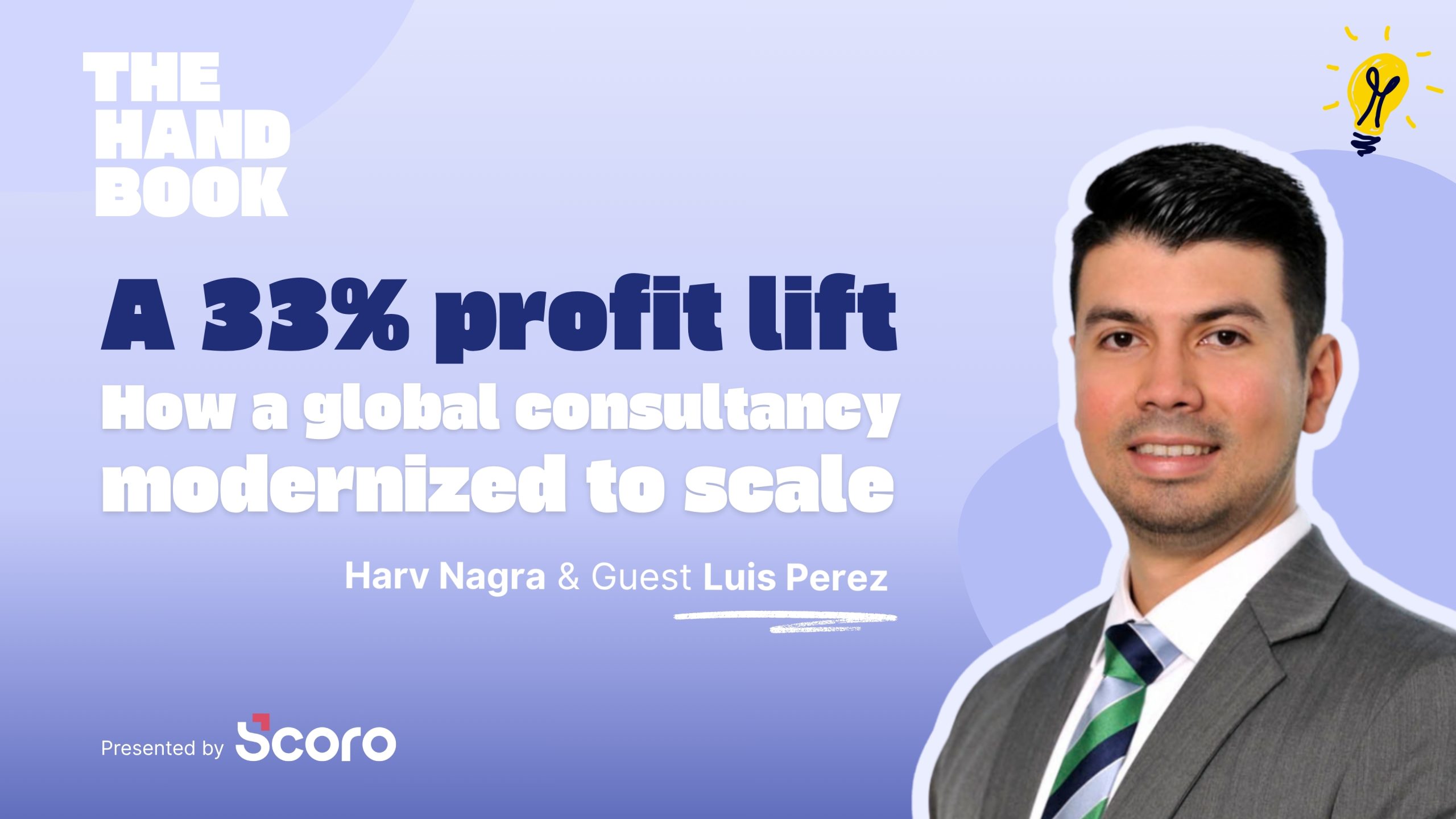


When firms merge, everyone celebrates the deal. But unless you’ve been through it before, few think through the nuances of what it takes to actually run as one business afterwards.
That was the reality Luis Perez walked into at DGA Group, a global geopolitical strategy consultancy. As Head of Group Planning, Analytics and Systems, Luis joined a business that looked fine from the outside – hundreds of people, multiple offices, growing fast – but underneath was still running as two separate companies.
Two accounting systems, two charts of accounts, and a reporting cycle so slow the board was seeing results that were two months old.
In this conversation, Luis walks us through how he and his CFO fixed it: how they defined what they actually needed, why they brought in outside help rather than going it alone, and how they rolled out a new stack across three continents in just seven months, all while keeping the business running.
Here’s what we get into:
- Why a business can look healthy on the surface while its systems are falling apart underneath
- How to define system requirements before you start shopping for software
- Why bringing in external help can be the difference between months and years
- The staggered rollout approach that got three continents live in seven months
- Why minimizing customization is the key to hitting your timeline
- How change management, not technology, is what actually makes a system stick
Plus, Luis shares the results: margins up a third, utilization up 20%, and group reporting cut from six weeks down to two.
Additional Resources:
👉🏽 Follow Luis on LinkedIn: https://www.linkedin.com/in/luis-c-perez/
👉🏽 DGA Group: https://dgagroup.com/
👨🏽 Follow Harv on LinkedIn: https://www.linkedin.com/in/harvnagra/
Transcript
[00:00:00] Harv Nagra: Hi all. Welcome back to the Handbook the Operations Podcast. I’m Harv Nagra. A couple of episodes ago, Andrew McBarnett talked us through the idea that AI can’t fix a business that doesn’t have its foundations in order. Andrew’s entire rebuild at Lucid Group was about redesigning the operating model first; one version of the truth, clean data, clear decision rights.
The systems came after, not before. Today’s episode is a practical follow-on where Andrew talked in principles, our guest today, has lived the execution. Luis Perez has spent his career leading FP&A functions inside global consultancies, LEK Consulting, Efficio, Deloitte, and DGA group among them. He’s shaped the financial architecture of multi entity businesses across multiple markets. It was at DGA where our paths first crossed. Luis was Head of Group Planning, Analytics and Systems there. And he joined about 18 months after the two businesses came together in a merger, only to find they were still running as two separate companies with inconsistent working practises and reporting that was taking literally months.
In today’s conversation, we get into how Luis and the team at DGA sorted this. How he and his CFO defined the requirements. Why they brought in outside help. How they manage the rollout across three continents in seven months. And maybe most usefully what he’d tell others that are struggling to get a clear picture of their business performance.
And a little preview, the results speak for themselves.
Margins up 33%, utilisation up 20%, and reporting cut down from six weeks to two. We’ll get into the conversation with Luis in just a moment.
[00:02:55] Harv Nagra: Luis, let’s start with a bit of context.
Just paint a picture for us on who DGA is, where you operate, the number of entities, how the group came together, all of that kind of stuff would be fantastic.
[00:03:06] Luis Perez: Yes, of course. So, DGA group is a global consultancy, specialised in geopolitical strategy. we advise major, corporations, in understanding how the geopolitical scenario is gonna affect their operations, their business, and if, any investment decisions need to be affected by those.
so the firm came from a, acquisition of a, an American firm, alre Sunbridge Group, and a European firm called Interel, joined together, by a private equity, house or backing. And, and that created the global firm. we got presence in the us, Europe, middle East, Africa, and Asia. So it’s quite global.
we have, nearly 400, employees now. We operate, across eight offices in major Cities across the world. And we are now, the two houses are now under the umbrella of DGA group.
[00:04:02] Harv Nagra: Excellent. Thank you so much for that. So, Luis, you weren’t at DGA from the inception, but you came in. Let’s talk about what you found when you joined.
[00:04:11] Luis Perez: Yes, thanks, Harv. So I joined probably about a year and a half or so after the, creation of DGA group. But despite that amount of time, the two firms were still operating fairly separately. You know, the US folks were doing their own thing. The European folks were doing their own thing.
So that created a challenge to see a view of the entire group. So we had two accounting systems with two different chart of accounts, operating at the same time in two different systems, right? QuickBooks and Deltek Economy. it didn’t help as well that some of those systems were operating in a very old version, not necessarily the newest, latest update.
because of that, we had an awful amount of spreadsheets going on for group reporting. Why? Because we needed to stitch it all up because they weren’t talking the same chart of accounts, they weren’t talking the same language, different accounting standards, so on and so forth. Mm-hmm. on the other side, on the operational side, we had, different practises across the two,businesses, right?
So the US folks weren’t used to tracking time. The Europeans were really good at it. Um, there was also, because of this, there was no visibility on utilisation of project margin because nobody really knew, okay, how much effort did you put on this project? Or an engagement?
What’s the project margin? Are we actually making money on this retainer or, or project fee? the invoicing was slow because the systems were, disconnected. Also, it was fairly manual, the whole process. So it was error pronged because of this, and the, the leaders relying on, on an external consultancy actually, to come in and help us get a view of the group.
So every month we will get the results of the US, the results of the European business, and then send it over to the external,accountancy to be able to create a view of the group. And we were reporting very far behind. So for instance, at the current month, we will report the results of two months ago.
So that was quite delay, and obviously that was creating a lot of issues in terms of decision making.
[00:06:12] Harv Nagra: you know, one thing that you mentioned there that I thought was interesting is that, the team was using very outdated versions of some of these systems, the accounting platforms I think you mentioned.
Yeah. Was there a reason for that?
[00:06:24] Luis Perez: Yeah, it was mainly because they were on-premise, systems, right? So, I mean, for the, for the, uh, audience, uh, familiar with this. So the, the, the classic, old school way of, of having systems was on premise. So you instal it in a server, the server gets accessed by the staff, and then is maintained by your internal IT team.
and then it’s, it’s, it’s a, it’s a bit more convoluted and, and time consuming to keep updated because someone has to do it. Whereas on a cloud based system, the updates automatically flow through because it’s all pushed on the web.
[00:06:56] Harv Nagra: Okay. I understand. the, the other thing I think is quite interesting there is maybe you could tell us a bit more about kind of the reporting.
So, you, you mentioned that people were compiling their own reports and sending them in. so there was no group level visibility there. It, it was all kind of, people take ages to reconcile what’s happening internally in their entity. They submit it centrally and then you, you even had to send it externally to to compile the results.
[00:07:22] Luis Perez: Yeah. Yeah. So it was necessary to do that because mainly the, the task of, translating the chart of accounts was, was significant. And also the fact that the US were using,QuickBooks, which, which is fine, for, for 90% of the small, medium businesses out there. But when, when you have a consultancy that operate with, over 150 consultants and working in over a hundred projects at the same time, it’s pushing to the limits.
Right. So that was creating a lot of data, unstructured data that needed to be kind of translated and put together in Excel manually.
[00:07:58] Harv Nagra: Understood. All right. So once you’d kind of recognised those issues, like you said you weren’t there at the inception, but you came in and recognised these issues.
Let’s talk about how you went about addressing those. first of all, before we get into it, I guess my other question is that, you obviously came in and recognised that this can’t continue. I, I think you were telling me, and, and there was a, there was a colleague of yours that you, you kind of decided that we need to do something about it.
Is that, is that right?
[00:08:24] Luis Perez: That that is correct, yes. So, our CFO, Susan Feilding and I, as soon as we walked in, one of the first things that we realised is the financial picture needs to be put together quickly or quicker. Mm-hmm. And the way that we’re doing, it’s just not gonna cut it. We were getting pressure from the, from the management team and the leadership team and the board to get more timely data to be able to see how the business operating and what decisions they need to make.
And, and, you know, we, they were flying blind, to a major extent. So there was a lot of pressure from, from leadership. There was also our own recognition of the way we are doing this isn’t sustainable, it’s just not gonna work. and if we do, another acquisition that adds another 50 or a hundred people, then that’s gonna be more complicated than what already is.
So we needed to change and we needed to change fast.
[00:09:11] Harv Nagra: I, I, I was just thinking how, just from my own experience, instinctively, you always know that this, the working practises you have when you’ve outgrown them and they’re no longer sustainable, it’s just very frustrating and things kind of grind down.
So it, it sounds like that’s, that’s what you were recognising. so you were telling me, previously that there was two important steps, defining requirements and getting help. So let’s get into each of those. Luis, what did you decide you needed in terms of requirements, and then how did you go about selecting the right product?
I, again, you, you were mentioning that you brought in an external consultancy, so how did they help you shortlist? So maybe you could get, go through both of those. Yeah,
[00:09:51] Luis Perez: yeah, definitely. Thank you. so, so basically the requirements we had weren’t out of this world is something that as, as professionals that come from a, a bigger organisation kind of realise, oh, you know what?
This, this actually works quite well for this, place. Then it should work here as well. Mm-hmm. So having that previous experience help as well. So we wanted something that could, support, a global consultancy. So multi-entity, multicurrency was a must. We, we needed something that we were going into a, a continent that had multiple currencies, it wouldn’t break, right?
We needed something that was cloud-based because it was something that we wanted to be easily accessible for everybody. It needed no manual handling in terms of updates or maintenance or requirements. It was everything in the cloud, which is the, you know, at, at still at this point in time, the, the norm and the standard.
[00:10:45] Ric at Sage: Mm-hmm.
[00:10:45] Luis Perez: we also wanted something that integrated natively with any system so that we minimised the manual, effort in terms of having to pull data from one place to the other. Right? So we had something that needed to come from here into there. Something that had the capability of creating integrations as well.
If you didn’t have it, at least can we, can we create it? So a strong API something that I can open up data to, to the world, safely, of course, securely, it’d be a plus. And then finally, I think something that as a consultancy for us, project based work is, is, is our bread and butter. So we needed something that help us keep track of the end-to-end project life cycle, right?
From lead to quote, to project, to invoicing, and to close. so we, we had a, a, a very clear, idea of what we wanted, and just we, we set out to, to try and get it.
[00:11:40] Harv Nagra: one question I have there, Luis, especially based on that point that you just raised there about the end-to-end workflow, is how was that being managed previously?
I know there was separate accounting systems, but it, was it just a bit chaotic in terms of how quotes were being built and how, how anything was being tracked?
[00:11:58] Luis Perez: Yes. So yeah, as I said, you know, even some, some business units within the different two practises were tracking their own, invoicing spreadsheets.
Right. And, and basically they were sending the, the, the invoices spreadsheets to finance. Revenue recognition, you know, like for, for us, it’s very annoying when a business come to us and say, Hey, by the way, my revenue should be a hundred. Mm-hmm. And then you’re like, what do you mean it’s a hundred?
Oh yeah, because this, this, and that, or this project, or you don’t have this project on your list, or, I delivered more. So it’s having quality numbers that the business will trust. And, and that was super important because we, we, if we couldn’t do that, then the business will think, oh, well these guys dunno what they’re doing and they don’t know they don’t have the right numbers.
I have the right numbers in my spreadsheet. Right. So that was key for us.
[00:12:47] Harv Nagra: Okay. so you kind of defined those requirements and like, like I was saying a moment ago, you brought in an external consultancy, so did they help you shortlist and, and how did that, process look?
[00:12:59] Luis Perez: Yeah, definitely. So we brought in the, TheBeanCounters, who are an Australian outfit. and they were super helpful. I mean, we couldn’t have done this with them at the pace we did it. they, they provided a, a, a great, assistance in terms of one, help us with the system selection,. Two, help us with the implementation and all the heavy lifting.
as well as, you know, giving guidance in terms of how to do this well. mm-hmm. And I think, you know, we did a great job. I cannot speak more highly than they’re great. and I think the other thing that the reason why we realised we needed external help was because the business will not stop and wait for us to get this done.
They will also expect the day to day to happen. They will also expect the BAU to happen. So even though we’re doing system implementation to get better, eventually the business will still want the results. Right. Can we have the management pack for this month or next month? Or where are we with this?
You know, invoices will still need to be raised. So we kind of stopped that. we needed to fly the plane while we’re changing the engine kind of thing. and having that external help in my opinion, is key because it provides the extra pair of hands you need in the meantime while you do that.
[00:14:08] Harv Nagra: Mm-hmm. Of course you can do this stuff, on, on your own with an in-house team and, and a lot of people do that, but then you just need to make sure you can carve out that, that time and headspace. But certainly, I, I, I think getting that external help speeds things along like it didn’t in your case.
Most definitely. Excellent. All right. So, tell us about the stack you landed on , And Why it was the right mix.
[00:14:33] Luis Perez: Yeah, absolutely. So the key thing as I said, was we needed systems that could talk to each other.
as a matter of fact, TheBeanCounters were the one that found Scoro first, And I was like amazed at how good it is. Scoro has a great API and has very good integrations.
We needed something that was really appealing on the UI side as well. Mm-hmm. That’s, that’s another thing that I forgot to mention in the requirements because if it’s not appealing on the ui, the, the staff are not gonna use it.
They’re gonna say, oh, this system is ugly. I don’t understand it, it’s too hard, I’m just not gonna use it. Can you just use my spreadsheet? so we, we brought in Scoro as a practise management system, which basically have our end-to-end life cycle. As I mentioned before. Sage Intacct our financial accounting system because as well, it’s, it’s a great robust system that integrates very well with different,other external parties.
expense management with brought Expensify because it had the connectors for both systems as well as Scoro and Sage Intacct. we decided to go ahead of ourselves and create a data lake. And then pull all the data from the systems into Azure so that we can create any sort of report combining the three, the, the, the other systems, including UKG from a HR perspective, because I knew from experience that sometimes you need multiple, systems data to create something meaningful from a reporting perspective.
So we brought a data lake in and Azure, because that’s our environment, and then overlay Power BI on it. And we have a, a, a set of four or five operational dashboards that are great and at, you know, at the moment, keep the heartbeat of the organisation and partners know what’s going on, and even project managers. For us on the FP&A side data rails was super important for us to create meaningful, scenarios, budgets, forecasts, quickly report management reporting, board reporting, all that sort of stuff.
So that was, that was the, the goal on having all this combination.
[00:16:26] Harv Nagra: Okay. Excellent. I, I mean, many of these platforms have native kind of reporting as well, but just given the group entity, structure and your reporting requirements and all that kind of stuff, it, it, you, you felt that, you, you needed to have Power BI and Datarails in, in place, is that right?
[00:16:44] Luis Perez: Yes, exactly. I, I think, I think all, all systems have their own reporting. and they’re good at it. but sometimes you just want something customizable, right? And then having that option is great if you can take the data out and put it somewhere else to combine it as well with the data from some, some other system.
Right. And that helps paint a story that is not normally able to be painted with the, the in inbuilt reporting capabilities.
[00:17:11] Harv Nagra: Sure. All right. So, given the size of your organisation, people might be surprised that the rollout only took seven months end to end, so that’s super impressive.
Tell us how you managed that and, whether you kind of rolled this out all at once across all entities and geographies, or you took a staggered approach.
[00:17:32] Luis Perez: No, we took a staggered approach because we thought that it was easier to do that and then have a big bang everybody on at the same time. to be able to achieve this timeline, I must admit there’s a couple of things that we or anybody that’s going through this journey must do to be able to do it quickly.
And we learned this from previous experience. One is minimise customizations. The more customizations you have or you want to have, the longer it will take for the systems to be implemented. Mm-hmm. So out of the box was a must. If he doesn’t do it out of the box, don’t worry. Let’s get on with it and see how we can work with it.
right. And then in terms of the implementation, we started with Europe because, I mean, my CFO and I were here in the uk. and it was easier for us to kind of manage that process from here. Also, it was a better time zone for the Australian folks, TheBeanCounters. And also the Europeans had a little bit more, a higher patience tolerance level than the, the other people across.
So we started with the Europeans and then we move on to the Americans, and then we went finally into the apac.
[00:18:43] Harv Nagra: Okay.
[00:18:44] Luis Perez: So we did it, we did it one month, one month, and then the next month, and then the next month. So by the end of the year, we had everybody on board.
[00:18:52] Harv Nagra: Right. Luis, we, we all know that change management is incredibly hard.
You know, people have a very emotional reaction to any, kind of change situation. and, and you’d mentioned previously that each entity was kind of working its own way. Some people weren’t bothering with tracking at all, and and so on. So let’s get into what you did to ensure that this transition would be a success. Please do talk us through it.
[00:19:16] Luis Perez: Yeah, definitely. I, I think, I mean, this is super important. The, the, the technology alone doesn’t fix a process or culture, you have to bring the people on board. And that starts from the top. So we had our CEO and our CFO sponsor the change clearly, and visibly explain to staff, why do we need this change?
Why do we need the new systems? Why would it make you life better, going forward? Uh mm-hmm. And, and then tell them that, you know, this is gonna be a good change. And, and give them a little snippets of what is it that we’re trying to implement, get their, get their opinion as well. So we were quite, forward on like surveys into like, Hey, what are the key things that you like on a practise management system, right?
Mm-hmm. And believe it or not, appealing attractive UI was the number one. Mm-hmm. They probably didn’t care what the system do, as long as it looks nice, they want that. Mm-hmm. the next thing is, training. Training is super key. do more than less. You know, overtrained to, to be fair, at one point we actually got some feedback from people saying like, you guys have done so much training, which is great.
I think just give us a month or two of no training so we can get on, using the system. And then we’ll let you know if we need more training. But for, for now, I think we’re good. so pre-launch and post-launch, monthly onboarding, quarterly refreshers, that’s super, super key for us. We still do them.
and then every now and then when a new feature gets released that we think everybody should know more detail about, we do special training sessions, but the monthly onboarding for new staff is key. The quarterly refreshers for anybody that wants to know more about something, people, they get promoted, for instance, and they didn’t use to do this piece of the system before.
They need to know more about it. They probably saw the initial learning, the initial training, and now they need to know a little bit more about it, then that’s a good, a good way for them to kind of get that knowledge back. And then also handbooks. so, having a document to refer to is super important.
And now with the, with the ventures of ai, we are now creating bots where we feed them the, the system handbooks, we feed them the slides, we feed them the sessions, and then the bot knows everything that is to know about the systems and then actually works, as a first front or first line of defence in terms of, system support, right?
So people can go to the, for instance for us, our,ChatGPT chatbot, and then say like, Hey, how do I, how do I create an opportunity, right? How do I, how do I close a project, et cetera, et cetera. And then the system will tell you exactly, we’ll give you steps or the chat bot, I mean. And then it was really easy for them to help.
And that could have been an email that we sent to a human. and then we’ll have to take the time to reply for it. So, mm-hmm. So yeah, it’s super, super helpful. And then the other thing that we did that worked really well was having a systems manager.
Do you have a system issue? This person can help you. Do we need to enhance an integration, this person’s job is that right. So every time, every month, every quarter, they’re looking into improving the the, the stack.
[00:22:14] Harv Nagra: Excellent, excellent. And, you know, just having gone through that process, managing that process, I, I, I think you’ve kind of, hit all of the points, right?
Constant communication from across the organisation and across management is so important. And, and that reinforcement that you did with the learning, the quarterly refreshers, I think just absolutely brilliant and just really important. Sometimes people forget how to do things or there’s certain processes that might be a bit tricky, so great way to reinforce that.
So let’s talk about the results and how did they affect how leadership ran the business?
[00:22:50] Luis Perez: Yeah, so it was, it was super positive. And to be fair, that that first year after rollout, we were super pleased with the results. I mean, in terms of profitability, we, we lifted the margins by a third across our portfolio, and that was mainly because we had a better understanding of how projects actually were running.
We knew how the retainers we had, the amount of hours we were putting to those, how they impacted the expenses, the, the external consultants that we were bringing on to help us deliver and all that help us create a really, like, you know, you don’t, you can’t improve what you’re not measuring. So improving the profitability was a result of having the data to see the actual picture.
also as a result of a very attractive UI and, and a very easy to use system, people were actually more enticed to the enter timesheets, which created the, the resolve actually us being able to see where people were spending their time, how they were being utilised, and who was under, who was over overutilized and try to balance that.
So the utilisation jumped 20% because we had a better view of who were doing what, and how we can get them to actually be, more productive. I mean, that obviously, the group reporting improved massively. it didn’t take us two months to report the, the results of the, of the month before.
it was now from six weeks to two weeks to close and to report to be able to provide the board some papers to be able to provide management, some papers to prepare the narrative for, for the board members. So that was also a huge win because we had at our fingertips, the data that we needed to create the packs and the spreadsheets and the analysis we wanted to kind of present and model.
and also the other thing is invoicing improve massively, which is key for us because, our DSO, is, is a key metric. and, and cash is king, right? So the, the quicker you invoice, the better you, the quicker you collect. So invoicing used to take, probably I’ll say more than a week, if I remember correctly.
And now it takes a matter of days, probably less, because people have now a, a better understanding of how to do things quicker. So yeah, billing improved really, really quickly.
[00:24:56] Harv Nagra: Excellent. There’s a few other, benefits that you mentioned to me previously so maybe, you could quickly just run us through some of those.
[00:25:05] Luis Perez: Yeah, definitely.
so as I mentioned before, having power BI overlay over data lake, was really powerful and allows us to create dashboards, operational dashboards. and then it focused the team on the project delivery. It, it creates a really good picture for partners on their pipeline and, and how they’re progressing and what sales they need to do to close.
It creates a, a focus on our project managers to make sure that the, the billing is happening on time, the timesheets are getting done, the margins are on track,and, and also it creates, an ability for people to see, okay, who do I need to bring on board or who do, who is charging too many time? And we kind of need to reduce that.
Leadership can see all these metrics live, and really easily. the new systems help us create better forecast, which, which our management team loves and the board members and the PE house loves as well. Like being able to create the scenarios and say like, Hey, what happens if we increase our rates, our, billing rates next year instead of 3%, 5%?
Yeah. as you guys know, the best way to increase your margin is to increase your price. and then, also that, you know, the, the feedback of the board and, and the management team is reporting is just a thousand times better. You know, if you see the, the packs that were, they were getting, back in the day and the packs they’re getting now, it’s a completely different picture.
[00:26:26] Harv Nagra: Excellent . So I wanted to talk about, your recommendations and what you’d advise another consultancy that’s about to go through a similar transformation. What would you tell them to prioritise? What should they avoid?
[00:26:39] Luis Perez: So the first one in my recommendation, the strong one, is you’re dealing with people. So people want to know what’s happening when they don’t know what’s happening is when they hesitate. So plan and communicate more than you think you need because the more people uh hear about what change is coming, the better they are adopting it.
the second one is probably, in terms of time: to make sure your project is kept on time and is implementation kept on time, is keep customization light. If possible, to avoid them. Because the customization is where the delays happen. Mm-hmm. And, because their customizations, nobody has that before. It’s not out of the box.
And also it creates complications. so that’s one thing that, I will advise people that want to get this, system stacks, done quickly is, is, is keep with customisations to a minimum. Uh, bring external help, don’t hesitate spending the money because you cannot believe how important it’s to have that extra pair of hands, not only to keep your project going, but also to allow you to have the time to do the BAU because the business is not gonna expect the BAU to stop.
Mm-hmm. Um, invest in training and support. So, having the, having the training sessions, key training sessions with the key material relevant for the audience. So, one thing I didn’t mention before is we didn’t have the same training sessions for everybody, so we divided it by, by our personnel levels, right?
So as a consultancy, we have the senior staff, medium senior, and then junior staff, right? So we had the three different audiences. We created the content that was interesting for them to hear about and learn about. So it’s not a session that is a catchall. And then because, oh, I’m never gonna do this.
I’m not gonna pay attention, I’m gonna do my emails while I listen to this, right? It’s create engagement. remember that technology alone doesn’t fix a process or a culture. You have to invest time in communication, in training, in, in, be able to approach people, bring them along, try to get them engaged through surveys, and try to get them to kind of collaborate with you on like, Hey, what would you like to see?
How would you like this to work? This is how we are thinking on doing this? Do you like that? Or no? If not, what would you change? And, and also don’t delay doing this sort of, changes. the best day to start is today, is now.
Bring experts in, in, on board, just even for a consultation is that, Hey, how do you, how do you think you can do that? Or we can do this, or how can we can change that? What about all my historical data?
Can I bring that along? Where do I put that? All that sort of stuff. Mm-hmm. So don’t delay it because the more you delay, the more you’re gonna have problems later down the track.
[00:29:18] Harv Nagra: That’s all really, really good advice. I, I think sometimes when it comes to, a transformation like this, it, it can feel intimidating, so people put it off longer than they need to.
Yes. And the situation just gets more and more complex over time, so Definitely, that’s a good point. you know, I, I just wanted to, highlight that customization point. So of course, with every system you bring in, there’s a degree of configuration, which is quite standard. You know, you, you’re kind of understanding how the system works and sometimes shifting your practises to align with it.
And sometimes, the systems can align with your processes. But I, I, I wonder what, when you talk about customization, that’s not the kind of customization you’re referring to, which is configuration. But are you, suggesting the kind of stuff, to avoid is where you’re kind of pushing the platform to change or build something in order to fit your working practises?
Is that what you mean?
[00:30:10] Luis Perez: Yes, exactly. Exactly. I mean, every system has a workflow. Yeah. Mm-hmm. And, and, and this is what I guess product managers in, in the software industry do, right. They understand my system does this very well, and it flows this way. Mm-hmm. And the customization is when you try to modify that flow.
when you change the core way of the system working just to, as you say, Harv, to suit your practises, that’s when it, it, it causes problems and it causes delays and it causes, you know, the customization to be a, a drag on the project.
[00:30:43] Harv Nagra: Mm-hmm. Really, really good point. Every platform has its conventions and you don’t wanna break that flow,because that’s where the complexity comes in.
[00:30:51] Luis Perez: absolutely excellent.
Thank you Luis.
And Luis, this is such a compelling story and such a huge success for you and the team. So huge congratulations to you for making this work. And thank you, thank you so much for sharing your story.
Not problem. Thank you so much for having me. And, especi thanks to, to you guys as well for, having a, a very strong, robust system that we can use.
[00:31:13] Harv Nagra: Thank you so much. And, Luis, if, if anybody wants to reach out to you or pick your brain about anything, they can go to LinkedIn.
[00:31:21] Luis Perez: Yes, definitely.
Please feel free to send me a message on LinkedIn. I’m more than happy to connect and, and be, be of help.
[00:31:26] Harv Nagra: A few things I’m taking away from this conversation. First, the same thread from Andrew’s episode shows up here. Success can mask dysfunction for a long time. DGA had hundreds of people and was operating fine on the surface, but underneath two businesses were still running on multiple disjointed systems and a mountain of manual reconciliation. It took someone coming in fresh to see how unsustainable that was for a growing and ambitious business.
Second the results: margins up a third, utilisation up 20%, reporting cut down from six weeks to two. It didn’t come from the technology alone. Luis was clear that none of it would’ve stuck without the training, the communication, and the leadership visibly backing the change from day one.
If you’re sitting in a business right now that’s grown through acquisition and things aren’t operating the way they should or you’re thinking about an acquisition and want to do it right, share this episode with whoever’s responsible for sorting that out. That’s it for me this week. I’ll be back with another episode soon.