








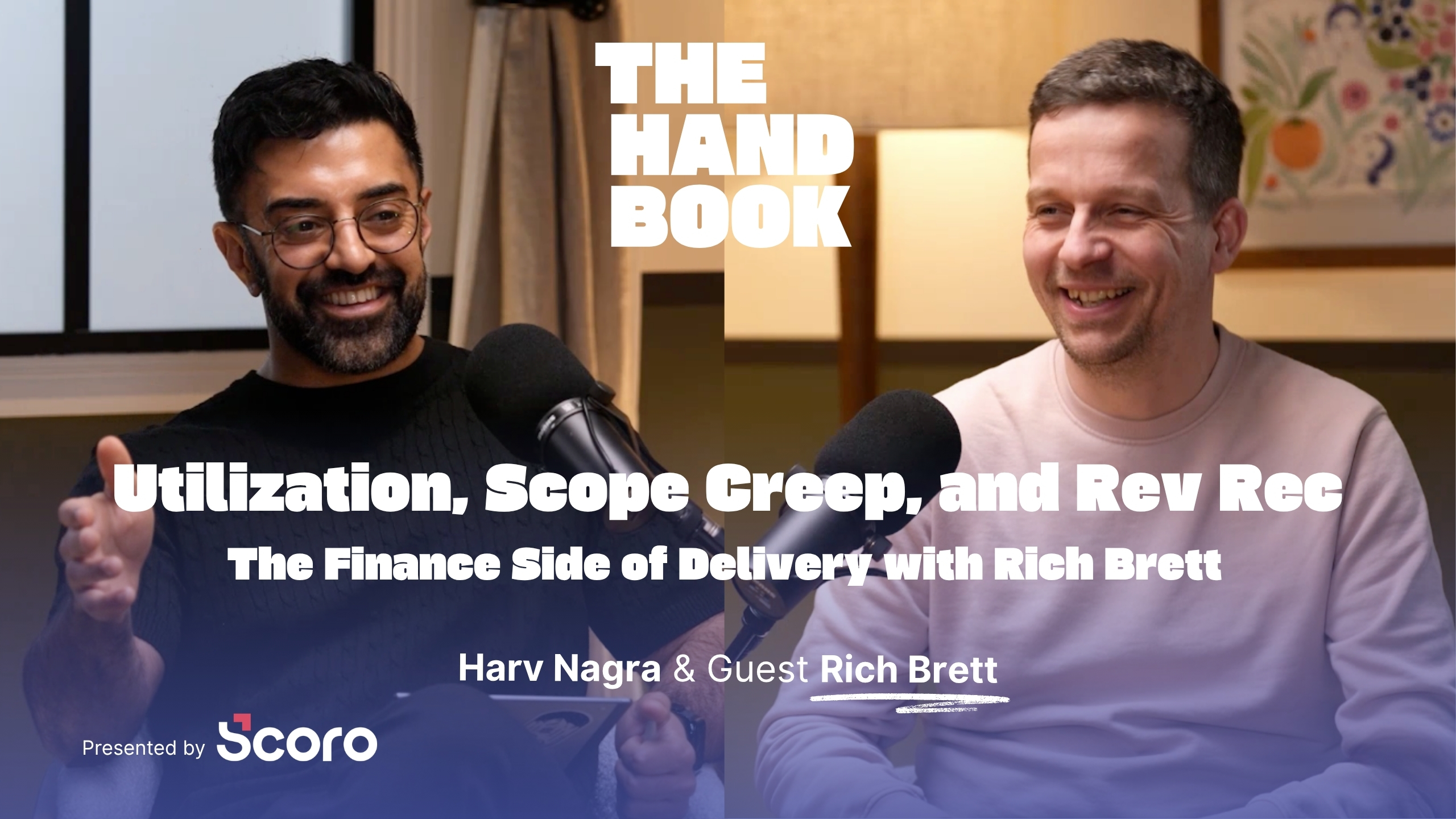


Everyone wants AI to fix their messy data. Andrew McBarnett will tell you straight: it won’t. In fact, it’ll just help you reach the wrong conclusion faster.
Andrew is Group Financial Director at Lucid Group, a PE-backed medical communications agency. He joined in 2020 for what was meant to be a four month contract. Six years later, he’s still there, and the numbers tell the story: EBITDA up from £3.6m to £18.1m, revenue more than doubled, legal entities cut from 25 to 15, and a finance team that’s shrunk in headcount while transaction volume has nearly doubled.
In this conversation, Andrew explains how he diagnosed a business that looked successful on the surface but was being held back by its operating model.
Here’s what we get into:
- Why numbers don’t explain your business, they just reveal where the pain is
- Andrew’s five pillars of an operating model that can actually scale
- Why “businesses don’t fail to grow, they fail to absorb their growth”
- How Lucid built single sources of truth across accounting, project delivery, and expenses
- Why AI was never the goal, it was the reward for doing the foundational work properly
- What changing the culture of a team actually takes (it’s harder than the tech, according to Andrew)
Plus, Andrew shares the real reason finance teams get sidelined in the business, and how to fix it.
Additional Resources:
👉🏽 Follow Andrew on LinkedIn: https://www.linkedin.com/in/andrewmcbarnett/
👉🏽 Lucid Group: https://wearelucidgroup.com/
👉🏽 AMB Associates: https://amb-associates.com/
👨🏽 Follow Harv on LinkedIn: https://www.linkedin.com/in/harvnagra/
💰 The Missing Finance Course (free): https://learn.scoro.com
➡️ This podcast is brought to you by Scoro, where you can manage your projects, resources and finances in a single system. Sign up for a free trial or a demo at https://scoro.com/demo – and for the VIP treatment, tell them Harv sent you.
Transcript
[00:00:00] Harv Nagra (2): Hi all. Welcome back to the Handbook, the Operations Podcast. I’m Harv Nagra. If we look back , The first wave of AI use cases in our space were focused on content, ideation or production Using AI as a tool to create or augment the delivery work we were doing. We had to learn the tools and the prompts, but it was easy to get our heads around.
What took longer was to get some clarity around how AI was going to help people behind the scenes in finance, operations, and management in running the business. Thankfully, that started to take shape. But there’s an assumption, or more like a hope I keep hearing, that AI is gonna swoop in and fix everything, that once you plug it in, it’ll make sense of all our messy data, the disparate systems, the spreadsheets that every person in the business has floating around and start giving you answers on what’s happening or what’s going to happen. I understand why it’s a compelling idea, but is it true? I wanted to bring in someone who’s lived this from the ground up, not as a consultant, but as someone who’s walked into a broken finance function and spent years rebuilding it properly. Today’s guest is Andrew McBarnett He’s a finance and operations leader with over 35 years of experience across PE-backed businesses, global corporations, and scaling organisations.
At Lucid Group, a PE-backed medical communications agency, what started as a four month assignment, turned into a six year transformation. They now have 15 entities, over 400 people. EBITDA grown from 3.6 million to 18.1 million. And a clean audit three years running. By the way, we’re gonna screen share some slides during this episode. It’s not essential to look at those, but it could be nice for additional context. If you’re listening on Apple Podcasts, you can open the app and switch to watching the video or check it out on YouTube.
We’ll get into the conversation with Andrew in just a moment.
Andrew, welcome to the podcast. Thank you so much for being here today.
[00:03:01] Andrew: No, thanks for inviting me, Harv. It’s it’s a pleasure to be here and I’ve been looking forward to this for a couple of months since you invited me.
[00:03:07] Harv Nagra: Thank you so much. You describe yourself as a finance guy who doesn’t really do a great deal of finance. Tell me what you meant by that.
[00:03:15] Andrew: Okay. so what I mean is, well, let me take you back a little bit. Um, I’ve always been fascinated by the way things work. So, growing up as a child, I was the kind of annoying kid that we kept on asking Why, why, why, until my parents brought me a set of encyclopaedia and I buried my head in those. But, when I was at school, I, I tended to sort of start to learn about systems and I, I basically realised that systems created out, outcomes.
businesses, of course are complex systems. And moving into accountancy, what I’d hoped is, the numbers would tell me and explain the business. Sadly, they didn’t, but what they did reveal were the outcomes. so they kind of tell you where the pain occurred, but they wouldn’t actually tell you what the source was. So, as an accountant, I use the numbers as a diagnostic tool basically. So what I tend to do is I look at the numbers and then I go upstream to find the root cause. So once I found that root cause then I redesign the system. So I don’t really see myself as a guy that produces finance information. I think of myself as somebody who basically redesigns operating systems so that the financial outcomes will be improved.
[00:04:29] Harv Nagra: I love that. so you’re at Lucid Group now and let’sset the scene. Tell us about the size and the make-up maybe when you, when you joined back in 2020 and versus what it looks like today.
[00:04:43] Andrew: Okay, so Lucid is a, a private equity, backed business. when I joined in February, 2020, they were operating from the uk, the US and Singapore. so our contrast 2020 to 2025. so in 2020 they had about 211 employees. They’ve almost doubled that now to 405. back then we had 25 legal entities. We’ve actually rationalised that down to 15. Revenue back then was 31 million. It’s now 76 million. And our EBITDA in 2020 was 3.6 million. It’s now 18.1 million. So guess the two statistics that really jump out the page really is we’ve more than doubled revenue, but our EBITDA has increased fivefold. and that would be, you know, a headline would be, it’s a, a growth story, but I think that’s an operating model story. a lot of businesses can grow their revenue, of course, but not many businesses can grow their revenue without the, the challenges of friction diluting profitability. And really that’s what I’ve been spending the last five years doing at Lucid, is actually trying to redesign the system so that friction doesn’t actually consume its profits.
[00:05:58] Harv Nagra: That is such, such an amazing transformation. We’re gonna dig into that in more detail, but can you tell us when you arrived back in 2020, what did you walk into? What were the challenges you were seeing?
[00:06:10] Andrew: It was very challenging. So I joined in February 2020, I guess for starters, finance, the finance team, they were working incredibly hard. But what I found was that the systems and the processes just were working against them. I joined, well actually on Valentine’s Day on the 14th of February and the company hadn’t even closed December at that point. So as I started to investigate different tasks and activities in finance, I found that revenue recognition, for example, wasn’t reliable because we had data scattered amongst many systems. the other thing I saw? Our billing accuracy was poor, was very poor. That meant clients weren’t paying us on time, therefore our cashflow was suffering as a consequence of that. I found the AP team and their processes weren’t particularly effective. And what that then meant was we had suppliers putting us on hold. but I think the biggest thing that really alarmed me have was the fact that, leaders were making decisions using data that was stale and outdated. So I could see that finance was struggling, finance was just the place where, where basically these issues were coming to a head. You know, the numbers were actually making them visible, but it wasn’t really driven by finance actually as being the cause. and I guess as I thought about it more, I looked at it and I thought, well, yes, you could think these are isolated problems. But actually on the whole, the issue was that the operating model that had taken Lucid a long, long way, they’ve acquired lots of businesses and done really well, was just basically not robust enough to actually take them to the next level. So they’d basically outgrown that operating model, and it was in, in desperate need for other redesign.
[00:08:04] Harv Nagra: When you, when you refer to operating model in, in that context, what, what kinds of things do you mean? Is it the, the systems and the processes, Can you just, uh, elaborate on that a bit?
[00:08:14] Andrew: I’ll summarise it in five pillars, that’s probably the easiest way. So one core element of the operating model is the decision architecture. So everybody know who makes the decision and what the authority rights are? That’s the first one. the second one I would say is data and information flow. Who owns that element of data? I dunno about you, but I’ve been in many companies where finances saying they own something and the delivery team say they own the same, same number, for example, you don’t have one version of the truth. The next thing I, I think about is process integration. So that is how is the workload moving, not just within a function, but across functions as well. Again, what you’re trying to do is make everything very efficient and you want to avoid any sort of duplication of effort. the other thing I would say is control and governance. You’ve gotta, you know, have a matrix in place, a structure in place so we know, or you know, if it’s, say for example, this invoice is this value, who signs it off?
Or if this decision needs to be made, who approves it? Or how many people sign that off? And then the final thing I think about is, has the company got that capacity for change? For example, transformation. If you are undergoing a project, will that succeed or fail? Sometimes you can see that before you actually implement.
If
you implement an ai, will that succeed or fail? If you buy a new company, will that integrate seamlessly and be successful? So I think those are probably the five pillars that I, I consider when I’m thinking about the operating model.
[00:09:50] Harv Nagra: Right. I, I think there’s an assumption, that people have that the bigger the company, you know, the, the, the bigger the head counts, the bigger the revenue. It must mean that they’re run really well and, you know, what’s your view on that?
[00:10:05] Andrew: To be honest, I think that’s probably one of the biggest misconceptions in business. having worked in some huge companies, and I, well just, here’s one example. I don’t, well, you probably haven’t had the opportunity, but I have had the opportunity to go into the store room of some of these major designer brands. It’s carnage behind there basically. The front of the store that everybody can see is beautiful and it’s, you know, a lot of money’s being invested in there. You know, you’ve got boxes all over the place. You’ve got clothes scattered everywhere. And I think that’s the kind of the facade that people see is they presume that because it all looks shiny on the outside, everything internally is, is correct, but the reality is, for every company, you know, your business is evolving faster than your operating model.
So it will take you so far to a particular stage of growth, but you do have to review it. I mean, I’m thinking of Kaizen as the phrase that comes to my mind that you’re also always gonna have to constantly improve. And, and that’s why I say, and it’s a phrase that I I use often these days is businesses don’t fail to grow. They fail to absorb their growth.
[00:11:17] Harv Nagra: you were saying that, you design an operating model for the scale you’re at, rather than necessarily where you want to be. At least that’s the situation people end up in. So how, how do you actually build a model, an operating model that can scale then?
[00:11:33] Andrew: So when you, so a, it takes planning, it takes a bit of vision, of course. but I think a, an operating model that can scale is one that can, that, I mean, your business is gonna become more complex. That’s a given. As you grow, it’s gonna become more complex. You’re gonna have more clients, hopefully more transactions.
You may have more staff, you may have more processes. So is a byproduct of growth. But what you want to try and avoid is that complexity, creating friction. So that’s the kind of thought process that I go through is, is are we building something that as we scale either reduces friction or the friction stays at that current level.
So characteristics that I’m thinking of when I’m looking at a business is things like, um, are ]your decisions becoming fast or slower? I’ve, I’ve been in a startup of one myself. I’ve been in startups growing from four upwards. You know, nothing to a million turnover in a year. And what you don’t want to do, slow down your decision making.
another thing that you find as businesses grow is information’s ceases to become trusted. Somebody has an opinion over there, another function has an opinion over, over here. you need your processes to integrate. so you want work to move seamlessly, basically, you know, the more efficient that is, the more profitable you’re gonna be, the more cash you’re gonna generate.
’cause you can build things much quicker. And also you want your controls to become stronger. So what I mean by that is you want to be able to be in a position where as you grow, you are using systems and processes to actually help you. So, you know, you’re small. Maybe you, you, you, you can check every invoice, but as you grow, you want the systems to be flowing invoices through and actually checking them if you’ve got purchase orders, matching them, posting them, things like that.
So, also you want your business to become adaptable. So as you add people, as you add clients, as you restructure your company, as you do M&A, you want that to be absorbed by the company, not okay. You know, something like that means you have to do a complete redesign. for example, at Lucid, if we acquire a new company, to spin that company up across all our finance systems probably takes us less than a morning to do. Yeah.
[00:14:02] Harv Nagra: That is incredible. I was expecting you to say a week or something, but that that’s.
[00:14:07] Andrew: so, yeah, and we built the system that way. For example, like the accounting system, it literally is a copy paste and we have a template company, so all I’ve gotta do is company name, address, branding. If I need to put a logo in there, it consolidates all the way through into the group accounts. It, everything is structured that way.
So it’s, it’s future proofing these things and thinking about, you know, where do you want to be, and then working backwards and building the, the operating model that can support that.
[00:14:36] Harv Nagra: Incredible. so you were meant to come in for a four month assignment at Lucid. but six years later you’re still there. What? What happened?
[00:14:45] Andrew: And they can’t get rid of me. it, it actually was supposed to be a, a four month assignment, so I was actually bought in as a contractor.
[00:14:53] Harv Nagra: Okay.
[00:14:53] Andrew: and I was bought in to actually implement an accounting system across the, well, it was the 25 companies at the time. I was hired by the CFO and we had a fantastic relationship, to be honest with you.
So we talked a lot about finance, but we also talked a lot about the business. And, what he would do is, you know, he’d tell me about the growth aspirations of the company, but as we’re talking about it, you know, in the background, we both sensing, but it’s a struggle now, to be honest with you.
How can we take more on with the, the operating model we’ve got? So it was clear that something needed to change. And I’ll be honest with you, I guess what struck me was that the board recognised the fact that they couldn’t take incremental baby steps if they really wanted to invest as they did, acquire more companies and really scale this business, it wasn’t tweaking at the edges. This needed a redesign of the, of the elements we discussed earlier. And that’s pretty well what I’ve spent the last five years doing. So, so as I said, I was bought in to do the accounting system. I think the next thing they asked me to do was to simplify the legal entities. so we, we took the UK trading entities down from five separate companies down to one. So that simplified all our billing. It simplified all the intercompany, it reduced all our compliance costs ’cause we didn’t have to audit five companies, and it reduced a lot of friction. and then pretty soon after that they, they created this, group finance director role, and offered it to me. And, here I am.
[00:16:24] Harv Nagra: Andrew, you were, you were sharing some slides with me previously when we hopped on a call, that, that set some nice context about what you, a, after you came in, you assessed the situation, you determined some of the stuff that needed to be done, what you communicated to the team and so on.
So, if, if you don’t mind, I’d love for us to walk through that together and you kind of explain, uh, take us through that.
[00:16:45] Andrew: Sure. Okay. Well first I’ll start with just, just to say that these slides that I’ve shared with you were first presented in November 2020. So I’d done my contract period. They then awarded me a, the full-time role and my first team presentation was these four slides. and these slides, I still present every quarter to the team just to remind them of the journey we’ve been on and actually, you know, just to keep us aligned and, and ensure that everybody is, is brought into to the vision.
So the first slide, was my vision. and basically what I was trying to, to demonstrate to the guys is there is a path for us to create more value to the business. but everything needed to be built on a solid foundation, which was going to be our new accounting system, which I was in the process of putting in. and my view was that once we had an accounting system, we could produce timely, accurate, and reliable data. And what that does is build trust in finance.
and then once people trusted the data, we could then improve our reporting. and then once we had good reporting, of course we could, I’m pointing.
Once we had good reporting, of course we could start analysing the data producing things like client profitability, project profitability, utilisation analysis, time analysis, et cetera.
Then basically we can then start to use that data to create dashboards, insights, and, and improve decisions report.
So destination was never really to improve reporting, it was to improve our information, because to me, once we have better information, it would lead to better decisions, which would drive better performance.
[00:18:29] Harv Nagra: And so at the time, like pulling together information like this in the business was virtually impossible or just very, very painful.
[00:18:40] Andrew: Virtually impossible. Virtually impossible. we had multiple systems. We had a myriad of companies. We had the delivery team have a view of, say, for example, I don’t know, utilisation. Their number is X, finances number is Y for example. trying to reconcile work in progress to do revenue recognition. Again, we needed governance around, you know, how far progressed has this project been for us to work out the actual revenue we could recognise. So all of that work had to be done in tandem with the operations team to ensure that we’re all aligned. We’re looking at the same data. We might be looking at it from our respective lenses, but there is one single version of the truth which we all believe in and we all trust.
[00:19:26] Harv Nagra: You know what’s interesting, Andrew, is that I think you already had 200 something employees at that time in the business. So I I think hearing your diagnosis is, well, to me it’s surprising that organisation was, was that large and that successful, but there was such a lack of visibility around this stuff, surprising.
I, I think, I don’t know if you wanna add a comment to that. Maybe it was surprising to you too, or not.
[00:19:49] Andrew: It, it, it was surprising, but I think, I think what you find Harv is that success kind of masks a lot of operational problems. When you’re doing well and you’re growing, just sees the revenue going up, the profit going up. The reality is profit could have been increasing a lot faster. So I think sometimes a victim of your own success and you don’t actually see what’s really going on.
And M&A’s a difficult one because when you are new companies, you’ve bought another company, there’s another culture, they’re working in their own system, their numbers and even their reporting structure doesn’t quite align. So you’re kind of, well, it’s kind of okay. So people accept all of that.
Whereas what we now have is one standard across even our charter of accounts, we only have one charter account. Every company in the group follows that same structure.
[00:20:46] Harv Nagra: Mm-hmm. And a as we go through this, Andrew, like for, for somebody listening, you know, businesses of all sizes, but when, when do you think, in terms of, is there a certain size in terms of headcount or revenue where people need to really start getting these better foundations in place?
[00:21:04] Andrew: personally, I, I would try and do it as quickly as you can. We started, I started a company, with three partners. We started up 65,000 pounds. I spent 16,000 pounds of that 65,000 pounds of startup capital on our accounting system. it enabled us to grow to a 3 million pound turnover with myself and assistant.
So the efficiencies we gained from having that, and of course our customers, were blue chip retailers, so they expected a certain quality and level of billing and visibility. When they rung up about a service issue, I could tell them, for example, well, this component’s on the right side of your door if you go there.
So this is what the system gave us, as opposed to running around like headless chickens without a clue, basically.
[00:21:58] Harv Nagra: Yeah.
[00:21:59] Andrew: it’s, it’s a worthwhile investment. I would do it as soon as you can, but also you’ve got to be realistic. If you are growing, you are going to have to constantly evolve basically, and try and stay ahead of the complexity because it will slow the business down.
[00:22:14] Harv Nagra: Hmm. Really, really good advice. I think. I think, a a a lot of businesses end up playing catch up ’cause they postpone the decisions and keep kind of clinging to that old operating model, old processes, systems and just hoping it’ll work and then it becomes a bigger challenge to untangle,
[00:22:29] Andrew: absolutely
[00:22:30] Harv Nagra: that much harder.
[00:22:31] Andrew: right.
[00:22:31] Harv Nagra: Yeah. All right. Let’s, take a look at your second slide. So for people listening, maybe you can just tell us what we’re looking at and, and then talk us through it.
[00:22:41] Andrew: Okay. So the second slide is my, is is my view of, of our strategy as a finance function. So traditionally finance spends a lot of time talking about and explaining what happened. I really wanted us to evolve from, well, my statement to that is if we’re only talking about what happened the company could outsource finance.
To be perfectly honest with you. The value is in explaining why it happened, what will happen, can we do, and also what lies ahead, because that’s really where we’re taking the company on. From the, on the journey, from hindsight to insight to foresight, that’s when we stopped becoming a reporting function and we become a decision support function. And that’s where the value lies in, in what we can do and what we can contribute. So, so that was the vision really. we were barely managing to say what happened when I joined, currently we’re, well, I’ve got an extension to this chart now where I’m now trying to talk about AI and tools like that, of how we can actually look beyond the horizon using AI and tools like that to help us be much more analytical.
But, but yeah, that was the vision, is to take the team from a, you know, let’s not spend all our time looking in the rear view mirror. Let’s look out the windscreen and really help the company steer a path towards, greater success.
one thing I I, this, I’m stealing this quote from somebody I used to work with at Vodafone, but one thing he used to say is, and he was in finance, he, he used to say, you know, finance has done their job when they’re at that top table supporting the business, and no serious meeting takes place without somebody saying, Hey, I want somebody from finance around the table.
That’s really when we are, you know, we are valued and, and we have, have worth in the company. So that’s really what I wanted us to, to do and to be is a team that if something’s, something’s taken place, a major decision, we are at that table contributing to that decision.
[00:24:39] Harv Nagra (2): Excellent. So Andrew, in, in your next slide, you, you talk about kind of the tech stack that you put in place. Maybe you could talk us through what you did there.
[00:24:49] Andrew: So to deliver that vision and to execute the strategy, my view is that everything had to be connected. one of the challenges we had when I was there, of course, was we had all these disperate systems around the company, but to me, everything had to be connected because that was the only way that we were gonna become efficient and much more accurate.
So basically Business Central was the core of our system. our project management system fed into that. That feeds in via an API. So the beauty of an API, of course, is as soon as somebody presses the button to raise an invoice that feeds directly straight into Business Central, we send it out via EDI to our clients.
So of our billing errors, wrong company, wrong currency, VAT when we shouldn’t, no VAT when we should, eliminated overnight, basically no human interaction. If the project is set up correct, then the invoice goes out correct. And of course, that therefore means the customer receives it. There’s no challenge. We wait Our, in our, in our business, most of our customers are on 90 day terms. Then we get paid immediately. I think at the end of June. I think we had 968 Ks worth of early payments from customers. so we have gone from a situation where our debtors ledger was a complete mess and we didn’t know what’s going on to now. Most months we have sub two or 3% past due at any month end.
[00:26:26] Harv Nagra: It’s shock.
[00:26:27] Andrew: pays on time.
[00:26:27] Harv Nagra: Shocking to me. Shocking. That’s that. I’ve never heard anybody say that, so that’s really, really impressive.
[00:26:33] Andrew: So, so that’s kind of the, the journey we’ve been on. but I guess when I joined we had the, the PSA system, we had that in place. So that was a given, I had to accept that that was the system and I needed to plug into that.
So, so that was a given. our payroll feeds in via flat file. We’ve implemented SAP Concur, which most people regard as the, the leading expense management system that’s in, entered via an API. So again, somebody raises the claim, it codes that claim, it posts that claim, it pays that claim. Nobody in my team touches that basically.
[00:27:10] Harv Nagra: Wow.
[00:27:10] Andrew: that happens seamlessly. and on top of it, we’ve got an FP&A system so we can do all our planning, all our reporting, all our forecasting. And then we have, another tool called Jet Reports, which is an, which is a nice tool that enables us to consolidate multiple companies in one Excel.
So it’s just much more efficient for our reporting. and then the other future project was going to be automated AP, but now with the government pushing ahead with e-invoicing, we are going to put that on hold until we understand what the government direction is, because otherwise we’ll put something in which we might have to strip out.
[00:27:45] Harv Nagra (2): Mm-hmm. When you, when you were designing this then you, you had your PSA, which means you knew what you needed to work with and what kind of APIs or, or connectors were available and whatnot. What, when, when it comes to these systems, you know, at a very high level, what, what are your key requirements?
[00:28:02] Andrew: well, what we do as a finance team, everybody’s involved. We do um, case studies.
so everybody will do a case study for what they have in mind and what they think, they see that we need. and then we basically evaluate it. So it’s not a case of looking at it thinking, AI is that the sexy thing will do AI or its process automation. what I look at is, you know, whether this will help us do it better, faster, cheaper.
That’s the first, that they’re the first criteria. And that gives us, at least from a business case perspective, the fact that we could argue that there are efficiency gains. The next thing we look at is effectiveness. effectiveness is more case of what does this process actually enable us to do.
So some things, for example, like our VAT, it was a manual process our group VAT, it used to take four hours. It now takes an hour. So we’ve shaved a tonne of time off of that. Decision quality. one thing that I’m big on if you don’t realised by now is quality information improves the quality of decisions.
So that’s something that, that I, I feel is very important. And probably the, the fourth thing that I think a lot of people overlook is capability. So as you can imagine doing all of this, and if we back to the first slide in terms of the vision, what this has done is taken away all the mundane, repetitive tasks, which means my team can spend more time on analysing data and business partnering and actually working with the company as opposed to in our little silo, just just processing transactions. So that’s much more satisfying and much more fulfilling for the team. And basically we have capacity we never had. So that’s the kind of, I think those are probably the four things that, that I look at when I’m looking at a system and where it is in the hierarchy of, of, of an implementation plan.
[00:30:01] Harv Nagra: Andrew, why don’t we move into your last slide where,I think you’re talking about your core values.
[00:30:07] Andrew: Yeah, so this one, yeah, this one was for the team. So it’s, as you, obviously it’s not about reporting, but it was about identity. as I said, the team were working hard. I don’t think they were probably as appreciated as they should because everybody was seeing the problems accumulating in finance, not realising that some of these were actually coming upstream into the finance function.
So I wanted the team to have an identity. I think that’s important. I also wanted the team to understand kind of what, you know, what’s important to us. If you’ve got a decision to make, look at this slide and this will be your North Star, basically. So of course, as a finance function, it’s critical that we protect the assets for the shareholders. We need to manage risk, we need to accurately report.
We need to be an efficient and effective function. nobody’s gonna throw money at us, basically, we’re gonna have to prove value for money.
But where we start to add value is in the performance management. Again, as I said, I want us to be there helping the business drive better performance.
And the business partner side of things is, is important. ’cause again, that’s more value. That’s where we are providing insights, analytics, thought leadership. We’re on the top table now, in the, in the, the core meetings.
And my and my goal is to ensure that I build a strong, a strong team so that hiring the right people, developing them, and investing in them.
So, I mean, yeah, so that’s basically the sum of it. I mean, to be honest with you. but I guess the measure of whether this has been successful, not only in the metrics, in terms of the, the performance and the efficiencies is our average tenure in finance is 6.2 years now. I think it’s, I think it’s worked and everybody is fairly happy with, the journey we’ve been on.
[00:32:01] Harv Nagra: One of the, my favourite things in what you just said is that one of the values of the finance team is to share thought leadership, and that’s not something you hear very often. Can you, can you explain what you mean by that?
[00:32:15] Andrew: so what I mean by that is I’ll tell you a story first and then I’ll come back. Hopefully the story might help. So, when I was at Vodafone, so I was part of the Vodafone team that acquired cable and wireless worldwide. then we had an integration meeting. So there was a bunch of guys from cable and wireless who understood the fixed infrastructure.
Then you had the Vodafone, people like me who understood mobile technology. So we’re in an integration meeting and, talking about various issues. I walked out of the, the meeting and I came out with a guy, his name’s Ed, from cable and wireless, and he turned to me and said, did you see that none of those Vodafone guys had a clue about fixed? And I thought that’s it. That’s, that’s what I want to, I want my team to do and the team to be. So it’s not just the case of understanding the numbers, it’s understanding the business and using the numbers to communicate to the business. So he thought I was a, a cable and wireless guy,
a
fixed guy, but I just invested my time under the skin of, of the cable and wireless business so that I could contribute.
So, so that’s the thought leadership. So it’s using, using our data, using, you know, market analysis, just pulling everything together so that, you know, we can actually, basically under, we have a good understanding of business, we have a good understanding of the environment, and we can contribute to, to meaningful conversations at the, at the higher level.
[00:33:43] Harv Nagra: Andrew, that, that’s really helpful. Thank you for sharing all of that. Now, let, let’s switch topics or switch gears a little bit to ai. There, there’s a belief that I hear a lot, I mentioned this in the introduction to the episode, that AI will be, that, that thing that takes all your messy data and all the problems that you’ve highlighted in at Lucid Group when you came in, for example, go away, that you can plug it in on top of whatever you’ve got and get those answers, get it to like, do everything for you.
I mean, you started this journey at Lucid before AI was part of the conversation. And, and so what’s your view on, on all of this?
[00:34:20] Andrew: It worries me because, it’s not impossible that AI’s gonna fix that. Basically, if you’ve, if you’ve got messy data that AI’s never going to address that. and I think a lot of people talk about AI readiness and everybody is, know, every new release of an LLM or an upgrade to ChatGPT or people are, you know, there’s loads of stuff on LinkedIn about prompts, et cetera. But I think that, that question is too low in the stack. Really what you need to do is build an environment that a machine can read and understand, as you saw by our architecture, having that was the reward, that we could actually layer AI over that.
I think every operational activity kind of leaves a data footprint. So a sale leaves one, a time sheet leaves one, a purchase order leaves one, an invoice leaves one. If you have all this data in fragmented systems, AI’s not going to have a complete view of your business. So AI’s not gonna help you solve that.
AI’s not gonna solve your problems. All AI’s going to do is magnify that and help you reach the wrong conclusion faster. If all your data’s not connected, then you are in serious trouble. And if your data’s not clean as, as you mentioned, then that’s a serious problem. So what we did, and as I mentioned earlier, is we ensured that we had one single source of the truth. We ensured that we had an environment that a machine could read and understand. So no, we weren’t preparing for ai, we were preparing for better decisions, but AI was that reward that we got for actually building a solid foundation.
[00:36:01] Harv Nagra: When you say single source of truth, I mean the stack we looked at had multiple systems, but you’ve tried to consolidate that as much as possible. remove, as much, stuff floating around in spreadsheets as much as possible, and then try to ensure that all of this is deeply automated and connected.
Is, is that right?
[00:36:21] Andrew: That’s kind of right. But we have single sources of truth. So accounting data, source of truth in the accounting system.
[00:36:29] Harv Nagra: Got you.
[00:36:29] Andrew: Project delivery data is in the PSA system. Expenses data is in Concur, for example. There’s only one version of those.
So for example, I’ll, I’ll try and describe it.
So you have the PSA has project number data. Of course, if somebody submits an expense claim, they need that project number to put against it. Every night, the API sucks the data out the PSA into Business Central, outta Business Central into Concur. So by the morning, if you set up a project today, by tomorrow morning, that project number will be there for you to submit your claim against.
[00:37:07] Harv Nagra: Got you.
[00:37:08] Andrew: there’s only one version of that project and that project number, it’s in the PSA.
[00:37:12] Harv Nagra: Okay.
[00:37:12] Andrew: what I mean by single, single source of the truth.
[00:37:15] Harv Nagra: That makes sense. That makes sense. Andrew, so we launched this report this spring called the Maturity Gap Report, and found that, I mean, it was shocking that only 13% of firms, that completed the survey said they’d automated any meaningful part of how they work. and that’s a sharp contrast to yourselves.
You, you were telling me that you’ve done an internal assessment and now it’s something like 44, 44% of everything you do in finance is either automated or AI assisted. So talk us through some of the benefits of the work you’ve done, particularly when it comes to automation, ai. I think you’ve highlighted some examples there about data flows, but, can, can you talk us through that?
[00:37:56] Andrew: I, I’ll, I’ll share an infographic with you, Harv, that you can share with, with your, your listeners, viewers, both. but, as I guess I, transparency, what I would say is that, AI and automation, as we discussed, wasn’t the objective. It wasn’t ChatGPT, it wasn’t even a thing back then. The objective was to basically create more value by supporting better decisions. What AI has done is it’s created a mechanism to help us get there faster. So, as I said, better, faster, cheaper is, is really the key there. But if, I mean, I don’t wanna run through those, those issues again, but if, if we look at the infographic, let me just pick some things out there.
So a new FP&A sitting on top of everything, we, we stripped out the existing one we had that generated, total cost of ownership savings of, of three years. I talked about effectiveness earlier. So we have a custom GPT that checks our W8s and W9s. that’s a us IRS tax requirement. So again, is checking everything consistently. You know, if a human does that, they’ll miss one thing or miss another that is 100% consistent. So that means that the system’s checked it. If, if that comes back and confirms that that form’s okay, our compliance with the IRSs is okay, we’ve got no, no issues there. So that’s a case of, of being more effective. I talked about the VAT one.
Um, concur expense claim. As I said, even for the delivery folk who are of course, billing and charging their time, having a system that now means that they can photograph the receipt, it posts it to the expense claim, they pay on the company card, it matches it to that expense. They don’t have to do any of that now. Um, I did a survey with the team and they were saying they were saving about 15 to 30 minutes per expense claim. So that’s 15 to 30 minutes more billable hours basically. So, so that’s another fantastic achievement.
Travel tracker, there’s always more compliance that finance have to, to adhere to. and global mobility is one of those. So we’ve built an automated workflow that if you’re going overseas, you just send an email and then the system reads that email populates an Excel spreadsheet. And at the end of tax year, I just use that to work out our global mobility tax liability, if any. So again, nobody’s spending any time on that at all.
It’s as opposed to without it AI and automation, I’d be saying, I need more people, I need more staff. We can’t cope.
Um, and as I said, in terms of AI agent adoption, as you can see there, five of the eight members of the team are using autonomous agents, and 44% of everything we do has an element of automation or AI supporting it.
[00:41:01] Harv Nagra: That’s incredible. Let’s talk about the kind of the culture element. You know, you, you’ve talked about it being harder than the systems aspect of kind of implementation and all that kind of stuff. what does changing the culture of the team actually require? Or in your case, what did it require?
[00:41:19] Andrew: It was hard. Um, and I thought, I’d actually thought the actual implementation would be the difficult part, to be honest with you. But, culture was much harder. I guess technology is logical, but people are emotional. So even, even trying to demonstrate that this will be beneficial for somebody, if they’re not there in the, their, the headspace, then they’re not going to buy into it.
And, and these guys have gone through years of frustration. They’ve been working really hard. As I said, the systems weren’t helping them succeed. So before I could change anything and get them on board, I had to build trust with those guys. So those four slides, they only looked like four slides, but they took me a very, very, very long time to, to create them because I didn’t want them to see this as, just another presentation.
That was my promise to them. My commitment to them is, you do this and this is what we’ll achieve. We work together and this is where we’ll be, you know, it’s the rising tide that tide rises will all benefit as a consequence of it. So what I was trying to do was to, to, to help them see that change was possible.
and I did a workshop with them. It’s, it was based on the book by Carol Dweck called Mindset. I dunno if you’ve come across it. And it talks about a fixed mindset. We’ve always done it this way. It’s never worked. No, nothing will change. To a growth mindset. Well, let’s give it a try. I’m open-minded, et cetera, et cetera. So we did this workshop and then I was able to call them out to say, nah, you’re demonstrating a bit of a fixed mindset there aren’t you?
[00:43:00] Harv Nagra: Oh nice.
[00:43:01] Andrew: Why, why, why don’t, why don’t we just test it? Why don’t we just, why don’t you just send that email this way and see what the response is? And every improvement became proof, basically. So was just a case of taking baby steps initially, as we gained momentum, the team saw that change was possible and then they bought into it even more.
[00:43:25] Harv Nagra: so five years ago you were something like 15 people in your finance team, I believe, and you’re now at 8.5, full-time equivalent, 8.6.
[00:43:34] Andrew: Yes.
[00:43:34] Harv Nagra: you know, handling much more in terms of transactions In a business that’s something like three times the size. Super impressive. How does the team feel about that trajectory?
has this impacted their work life balance or has the work you’ve done just completely transformed and, and just made you guys so much more efficient?
[00:43:53] Andrew: So it really is, it really is down to the transformation in finance, to be honest with you. So my goal was never to reduce headcount. I was under no pressure to reduce costs or anything. my goal, and from a leadership perspective was to remove the low value, boring, monotonous number crunching that finance people have to do. So what we actually did was we have, we, all we did was actually when somebody left, we just let the systems and the processes absorb that workload. So, the systems was doing that. We were replacing repetitive tasks with more automation, with the ai. So people began to focus on the more interesting tasks.
even in AP, you know, yes, you can sit there spending your time processing invoices or you can sit there, but spending your time analysing the number of, I don’t know, printers as we use, how can we rationalise our printers? Can we go to tender and get a better price and, and narrow it down? Things like that.
So we just made the roles more, more interesting and then retention improved, invested in their developments, so nobody’s doing the same job. and so I think really it, it’s kind of those sort of things that made the big difference. And there’s, driven our, our tenure to, to 6.2 years. And to me a much better metric than headcount saving.
so much more efficient. I think we are doing, I think in 2021 we were doing, I think it’s 500, no, 283 transactions per head per month. We’re now at 573 transactions per head per month. And that’s measurable in the accounting system. So that’s one measure I can objectively record. So, so yes, it’s virtually doubled.
but hours, nobody works really super long hours. I can’t even remember when we had to work a weekend, to be honest with you. Sometimes I do ’cause love my job, but, the team don’t have to. So it’s just a case of using the systems, removing the friction, and just, yeah, being more efficient and doing the more value adding jobs and tasks.
[00:46:01] Harv Nagra (2): Amazing. Talking about the role of finance and what it plays in your business. You know, this is one of the reasons Andrew, I, I, I wanted to create The Missing Finance Course, which you know about, in my experience, people’s eyes sometimes glaze over when there’s somewhat technical financial terminology used, and then the finance person assumes, everyone understands it, and, and you kind of lose them when you don’t have a narrative in mind that helps people understand what’s happening.
You know, and you’ve talked about linking kind of operational language to those financial outcomes, talking about utilisation and recovery, rather than margin and EBITDA and, and, so the delivery team can actually understand what’s happening. It, it sounds like you’ve recognised a similar problem to what I’m describing in that finance when they’re only talking about numbers
they’re not helping everybody else . Can you, can you just take us through that a little bit?
[00:46:55] Andrew: No, you’re, you’re right. And of all, some of my team members have done your course and they love it actually, btw.
[00:47:02] Harv Nagra: Amazing.
[00:47:03] Andrew: it’s fantastic. So you’re right though. but I don’t think it’s just finance. I think functions develop their own language. So yes, we talk about what do we talk about, we talk about margin, we talk about ebitda, we talk about cash. The delivery folk, as you said they talk about utilisation, and billing, but then you have hr, they talk about attrition and engagement. Sales are talking about pipeline funnels and conversions. So we all are describing the same business, but through our own respective lens. I think and, and the, you’re absolutely correct.
So I think the problem is that our own little worlds, we don’t recognise that. Well, we just assume that everybody understands our language and we don’t. So this was a big hurdle we had to come overcome in, in Lucid. I guess I quickly realised that if I stood in a delivery meeting and said to them, right, you know, what are we gonna do to improve margin, as you said, they would glaze over, checking their phones, they would be disinterested because they don’t manage margin. But if I spoke to them about utilisation, recoverability and over servicing and project delivery, those are the behaviours that they can control. So I guess there’s a little phrase that I have, I dunno if I’ll deliver it well, but, it’s, I think one of the most important things that leaders can do is not create more information, but they should try to create more understanding. So that is talking the same language as your counterparty. and it’s something I’ve always tried to do. So as with the, the Vodafone story, but I’ve worked in, in healthcare and I used to go on GP visits, so I used to go into hospitals to understand what are we actually, you know, what is, what are the service and the products we’re providing. I worked for BIFA Waste Services when I first started as a trainee accountant. and I went on half six getting up to go and bin collection to understand what is the business. and likewise in aviation, one thing that was important to me was understand how is a plane made? So I had the opportunity to go to Airbus to actually see how an aircraft is made, because then I can talk the same language as, as our engineers. And when they talk about the line, the foul, I understand, or I could say those sort of terms to them and I think, oh yeah, I know what he means and I know where he means. So to me, if you really want to change behaviour, I don’t think people change behaviour because they see the numbers, they change behaviour because they understand the impact of their behaviours on the performance of the business.
[00:49:38] Harv Nagra: Andrew. Uh, you spent 35 years across you know, working with founders, global corporations, PE environments. If an ops or finance person is listening to this and they’re sitting in a business right now that’s messy, they’ve got that scattered data, no single source of truth, pressure to do something with ai like a lot of us are under.
Where should they start?
[00:49:59] Andrew: I would start by asking a couple of questions. I think the first question would be, does the current operating model, or can the current operating model absorb the impact of ai? and we talked about disconnected systems. If your systems are disconnected, if your data isn’t cleansed, if you’ve got multiple versions of the truth, AI needs to be able to read your information and it needs to understand it.
I mean, you could, dabble at the edges with a custom GPT, but if you really want to, to use AI and agents and for example, incoming supports calls, for example, emails coming in, the agent being able to understand the client, the product, et cetera. You need a connected system. So, so you need connected systems, you need clean data. The system also needs to have some sort of understanding in terms of when does it decide, or when does a human decide, or where are those control points? and then ultimately I would ensure that, or I’d strive to have integrated systems. So it’s probably not the easiest answer, but I think if you really want to move forward, you may have to take a step backwards to be perfectly honest with you. But, um, and then ask yourself, you know, what decisions do we need to make faster and quicker? Because there, there will almost certainly be one particular issue in your business right now that you are thinking, we need more clients, or it’s the service calls that are killing us. Or, why, why can’t we, you know, take an order, deliver it, or ship something or, or you know, why are these projects so complex?
There’d be one burning question. I would focus on that and then work backwards. That would be my approach.
[00:51:48] Harv Nagra: Excellent advice. Andrew, this has been such a fantastic conversation, super inspiring. You’re, you’re kind of setting that benchmark for a high maturity firm for the rest of us.
I really appreciate you being here. I’m wondering if, if somebody wants to pick your brain, hopefully that’s okay. And,
[00:52:05] Andrew: Absolutely.
[00:52:06] Harv Nagra: can they reach out to you for some advice?
[00:52:09] Andrew: Okay. probably the best platform is LinkedIn. and also my website is amb-associates.com. So you can contact me via those two. But, um, yeah, happy to help if anybody’s got any questions.
or if there’s anything I can do to, to support, then, yeah, be delighted to.
[00:52:27] Harv Nagra: Excellent. We’ll put a link to your website and your LinkedIn in the episode notes so people can reach out to you. But once again, Andrew, thank you so much for being here.
[00:52:36] Andrew: Thank you, I really enjoyed our conversation. Thank you.
[00:52:40] Harv Nagra: What a great conversation. A few things I’m taking away from that. Firstly, Andrew’s framing of the role of finance. He said that if you’re only ever explaining what happened, the company could outsource you. The value is in explaining why it happened, what will happen, and what lies ahead.
Moving from hindsight, to insight, to foresight. From a reporting function to a decision support function. That’s a shift in identity, not just process. Andrew’s view is that if you want to change behaviour, people don’t change because they see the numbers. They change because they understand the impact of their behaviours on the performance of the business.
That’s exactly why Rich Brett and I created the Missing Finance course to bring senior leaders, finance, ops, delivery, and individual contributors together, and create a shared understanding around terminology and concepts, but also how each party can play a role in the success of the business.
Back to Andrew.
My last big takeaway from the conversation was on ai. He was pretty direct about this. If your systems are disconnected and your data isn’t clean, AI is not going to fix that. All it’ll do is help you reach the wrong conclusion faster.
Andrew didn’t set out to build an AI ready function. He set out to support better decision making and the business’s ability to scale by improving their operating model. The AI benefits they’ve seen are the reward for doing the foundational work properly.
Now if this episode was useful to you, please do share it with someone in ops or finance who’s feeling that pressure to sort things out right now. That’s it for me this week. I’ll be back soon with another episode.