












As an owner or managing director, you often assume ops responsibilities by default. But that’s a short-term solution. One that inevitably leads to problems and burnout as the business grows.
And being overwhelmed often leads to rushing your first ops hire. Then, instead of being able to fix problems, your new team member gets stuck firefighting.
Hire strategically instead, with our seven-step process. By thinking through your ops needs and goals ahead of time, you can find the right person and get value from them from the start.
Step 1: Define your biggest ops issues
If you’re reading this guide, you know you need an ops hire. But you might not be able to pinpoint which problems that new hire should focus on first.
Define the operational problems you’re facing and you can tailor the job description, interview questions, and 90-day plan around them.
And that’s the difference between hiring someone who can start fixing things right away and hiring someone who has to play ops detective for months to try to figure out your biggest struggles.
When we surveyed 303 professional services firms for the “Maturity Gap Report,” we found the most common ops issues were in the “Data,” “Technology,” and “Process” categories.
These patterns stood out across responses. And they might stand out for your business, too:
- Limited data and minimal data-driven decisions: Only 13% of firms use live margin data to guide decisions mid-project. Only 24% can forecast revenue, margin, or capacity with confidence.
- A messy tech stack: 80% of firms don’t have their operations joined up in a single system. Only 12.5% have automated any meaningful portion of their workflows.
- Little or no documentation: Only 21% of firms have documented best practices. Meaning the remaining 79% are running on shared institutional knowledge that could disappear if certain people resigned.
If you’re not sure whether these issues apply to your firm, ask yourself:
- What are your most profitable clients or project types? Can you prove it in under five minutes? If not, you’re probably dealing with limited data and data-driven decisions.
- Can your project management, time tracking, and finance tools talk to each other automatically? Or does someone copy/paste between them. Or worse, maintain a spreadsheet that bridges two?
- If you onboarded a new client tomorrow, would every project manager handle it the same way? Or would it depend on who picks it up? If it’s the latter, you’re probably dealing with little or no documentation.
Harv Nagra, Head of Brand Comms at Scoro and host of “The Handbook” podcast, has watched this pattern play out across dozens of firms:
What I’ve seen happen is firms hire ops without knowing what they actually need – tactical improvements or strategic change. The new person comes in, sees twenty things broken, and ends up addressing whatever’s loudest. Six months later the founder’s frustrated nothing structural has changed, and the ops hire is exhausted from firefighting.

If you’re still not sure where your biggest gaps are, take our Business Maturity Quiz. It’s the same assessment we used for the report. Three minutes, five pillars, and you get a specific breakdown of where your firm sits.
Step 2: Make the financial case
73% of top performers in our research had dedicated ops, finance, and resourcing roles. Only 22% of bottom performers did. Top performers staff these roles. Bottom performers don’t.
But these roles are non-billable, and the cost is visible in a way the return isn’t. That’s why ops hires often get delayed longer than they should be.
Harv has seen this pattern across every firm he’s worked with:
At a lower end of maturity, founders or MDs are quite anxious about hiring non-billable roles. But a role like operations lead pays for itself—because of the structure and the rigor and the visibility they give you on how your business is running.
Get past that anxiety by putting real numbers on what the problems from Step 1 are already costing you.
For example: a firm where four billable people spend 15% of their time on ops work at $750 a day is losing roughly $112,000 a year in capacity.
Plug in your own numbers and see what ops drag is costing you. And how that stacks up against the cost of an ops hire.
Ops capacity calculator
Plug in your numbers. See what ops drag is costing you in billable capacity, side by side with the cost of an ops hire.
Number of billable people
Anyone whose time is billed to clients — regardless of seniority.
Average day rate
Average billable rate across your team, per day.
$562,500/year
Full-time ops manager
Recovered capacity only becomes revenue if you have demand to fill it. If you’re turning work away or pushing deadlines out, this is money on the table. If you’re not, the gain shows up as breathing room instead.
One caveat worth being honest about. Recovered capacity only becomes revenue if you have demand to fill it. If you’re turning work away or pushing deadlines out, this is money on the table. If you’re not, the gain shows up as breathing room and less burnout instead.
Top Tip
Salary ranges in the calculator reflect 2025–2026 US market data for agency, consultancy, and A&E operations roles.
Verified against SPI Research’s 2026 Professional Services Maturity Benchmark, Promethean Research / The Bureau’s State of Digital Services 2025, the AIA Compensation & Benefits Report 2025, agency-specific benchmarks from Karl Sakas, and Salary.com’s Professional Services Manager and Director of Professional Services cuts. Cross-checked against Glassdoor, Indeed, Built In, ZipRecruiter, and Robert Half’s 2025 Salary Guide. Figures are base salary; total cash comp typically runs 10–20% higher.
Step 3: Define what the hire owns
You know what’s broken and what it’s costing you. Now define what the new hire is responsible for.
Go back to the patterns you identified in Step 1:
- Limited data and minimal data-driven decisions → the hire owns the reporting infrastructure. Building and maintaining the systems that give you real-time visibility on utilization, plus project profitability and pipeline. So leadership can make decisions based on data, not guesswork.
- A messy tech stack → the hire owns the tools. Auditing what you have, identifying overlaps and gaps, consolidating where possible, and owning ongoing governance so the stack doesn’t drift back into chaos.
- Little or no documentation → the hire owns process standardization. Building structured approaches to project onboarding, delivery workflows, and best practices. And making sure they’re actually followed.
Most firms will see themselves in more than one area. So, prioritize by cost. Step 2 gave you one total, so split it by judgement: of all the ops time your team loses, roughly what share goes to each problem? If chasing numbers for reports eats half of it and inconsistent onboarding eats a quarter, you have your order. And a rough figure per problem to put in the remit table.
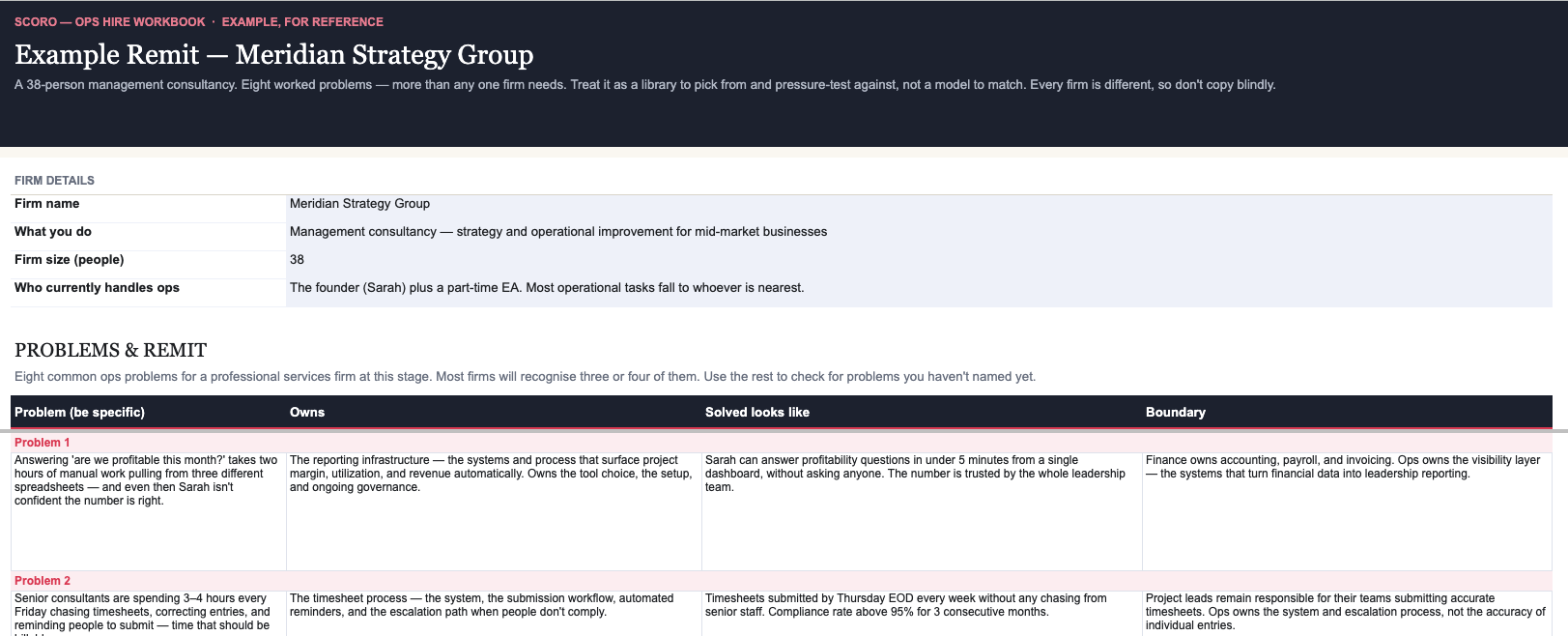
Then get specific about each one. Here’s what a defined problem looks like:
“We can’t see project margin until the project closes. The ops hire owns real-time margin tracking in our PM workflow. Solved looks like: any PM can see margin on any live project in two clicks, and monthly profitability reviews run without anyone assembling data by hand. Finance still owns invoicing and rate cards.”
Four parts: the problem, what they own, what solved looks like, and where their remit stops. That last part prevents the most common failure. The ops hire quietly absorbing work that Finance, HR, or delivery should own.
The dollar figures from Step 2 are what make “solved” concrete. If chasing numbers for reports is eating half your ops drag, and Step 2 put your total at $120,000, then instead of “improve visibility” you can write “recover $60,000 in billable capacity by eliminating manual reporting.”
A peer who has made this hire will spot the thing you have scoped too broadly. That is the failure mode: a remit that reads fine to you and impossible to the person doing it.
You don’t have to build the remit table from scratch. Download the Ops Hire Workbook. It comes with a worked example to copy from. Open the Example Remit tab first. Three or four problems is plenty.
Keep that file. At the end of this guide there’s a prompt that turns it into a job description, interview questions, a 90-day plan, and an honest list of the ways you’ll get in your own way.
Step 4: Decide on part-time vs. full-time and seniority
Now that you’ve outlined the new hire’s core responsibilities, you can figure out the hours and seniority level that match.
Part-time vs. full-time
Look at the remit table you filled in. How many problems did you list? How complicated are they? And how much time do they currently take up?
If you ran the calculator in Step 2, you have your FTE figure, how many full-time people’s worth of capacity ops work is eating.
That’s your clearest signal:
- Under 1 FTE → a fractional hire (2–3 days a week) can absorb it
- 1–2 FTE → either could work; start fractional
- Over 2 FTE → one person full-time, and you’ll still be prioritizing
The logic is arithmetic: if the drag is less than one person’s worth of work, you don’t need a whole person. If it’s more than two, one hire won’t clear it, they’ll be triaging from day one, which is worth knowing before you write the job description.
Starting fractional has a practical advantage even if you suspect you’ll go full-time. After three to six months, you’ll have watched someone do the work. So you know which problems were bigger than you thought, which weren’t real, and whether the workload needs a full-time hire. The full-time job description then writes itself, based on observed reality instead of theory.
Headcount can also give you a loose reference point. Most firms under 20 people can start fractional. And most firms over 30 with a full remit table need a full-time hire.
After 20 people, if you’re still just trying to wing it, you’re going to be playing catch up. It’s better to do it when you’re about that size, and about to exceed it, to get that discipline in place.
Still, a 15-person firm running 40 different client engagements will probably have more operational tasks than a 35-person firm on simple retainers. Let the workload drive your decision, not the org chart.
Seniority
This depends on what the ops problems actually require, not what you think you’ll need in three years.
- Systems and maintenance work. Reporting dashboards, workflow documentation, onboarding processes → a mid-level ops manager with a few years of experience in a services environment can handle it. They’ll need clear direction from leadership, but the work itself is execution, not transformation.
- Cross-functional change management. Restructuring how teams work together, negotiating process changes, owning the relationship between delivery and finance → you need someone more experienced who has done that before and doesn’t need to be told what to fix.
- A COO? Rarely, and not at your size. Executive-level coordination is a job that exists once you have multiple function leads to coordinate. Realistically past 75–100 people. A firm of 15–50 doesn’t have that structure. Hire at that level and they’ll arrive expecting to lead a team that doesn’t exist, and end up either bored or doing work beneath them.
Step 5: Post the job in the right places
Most firms default to a generic job board posting and wonder why they get generic candidates.
The pool of ops specialists with services-firm experience is narrower than general ops roles, the strongest candidates are often passive, and senior hires in this space tend to come through referrals and direct outreach more often than application forms.
Harv has seen this pattern too:
What I’ve seen is the strongest ops people don’t come through the application form. They come through a conversation. A peer recommendation, a LinkedIn message, someone you’ve met at a conference. The really good ones are already employed and doing well at their current firm. They need to be pulled out, not waited for.
Make the most of your search by looking:
- Inside your firm first. Before you go outside the company, ask yourself if someone already in the business could be the right fit. An internal hire often has the advantage of already knowing the firm’s quirks and relationships. If someone on your team is already doing informal ops work well, that’s worth exploring.
- Your network. Ask peer firms in similar verticals who they’ve used. Full-time hires they’re happy with, or fractional consultants who’ve worked well. When a name comes up, ask for an intro: “Would you be willing to put me in touch with [their ops lead] for a quick 20-minute conversation?” A warm conversation tells you more about fit, market rates, and what good looks like than a pile of cold applications can.
- Ops-specific communities. Operations Nation, a community and job board for ops professionals in professional services, is the obvious place to start. Candidates there are usually working in similar firm environments.
- Fractional and interim networks. If you’re starting fractional, the same two sources above are still your best route — peer firms who’ve used someone, and the ops communities, where a lot of members do fractional work between permanent roles. Marketplaces exist, but most skew towards fractional CFOs and COOs rather than the ops manager you’re after, so expect to filter.
- LinkedIn, used properly. Don’t post and hope. Search for ops leads at firms of similar size and sector. Including those marked “Open to Work,” who are often strong candidates between contracts or returning to the market. A direct message with a specific scope tends to land better than an application form.
Step 6: Review and interview candidates using your remit as the guide
As applications start coming in, review them alongside the remit table you built in Step 3. That way, you can narrow the candidate pool to people who can solve your specific problems, and assess whether someone can offer tangible value from day one.
Job titles tell you almost nothing. Ops Manager, Head of Operations, Business Operations Director. Naming conventions vary wildly and none of them says whether someone can do the job.
What to look for in resumes and cover letters
Use your remit as a filter. For each problem you defined, ask: has this person solved something like it before?
- Specific outcomes. “Reduced onboarding time by 40%” tells you something concrete. “Managed the onboarding process” doesn’t.
- Professional services metrics. References to utilization and project margins mean they’ve worked somewhere that measured them.
- Buy-in before building. Look for situations where they got people on board before changing how things worked. Even smart process changes get worked around when stakeholders weren’t part of designing them. A candidate who starts with buy-in understands that adoption matters more than design.
- Insight into your firm. A strong cover letter should tie together the candidate’s experience and how it applies to your company’s unique situation and culture.
What to ask in interviews
Alongside questions built from your own remit table, these four dig into how someone works:
- “You join the firm and within your first week, the founder tells you their project margin reporting is broken and needs to be fixed before the board meeting in 30 days. Walk me through what you do.”
This tests whether they act under pressure or default to understanding. A weak candidate jumps to fixes—which tools, which dashboards, which framework—implementing the wrong thing with confidence.
A strong candidate pushes back: they want to understand who uses the current reporting, what’s broken from the founder’s perspective, and what the board needs to see, before committing to a fix. The skill is slowing down a frustrated founder without losing them.
- “Tell me about a time you had to get people to do something differently, even something small. How did you get them on board?”
This tests buy-in instinct at whatever scale they’ve worked at. A strong candidate describes a real situation, names the people whose buy-in mattered, and explains how they got it (involving stakeholders early, surfacing concerns before designing the fix, finding a small win to build credibility).
A weak candidate describes the change they made without engaging with the people side. Or worse, frames buy-in as something they had to “manage around.” Even mid-level ops work needs this skill in miniature; senior work needs it at scale.
- “How do you think about the relationship between delivery and operations? Where does the tension usually sit?”
A strong candidate names the tension specifically. PMs want to bend processes for difficult clients, ops needs consistent data for forecasting and capacity planning. They’ll describe how they navigate it without flattening either side.
A weak candidate sides with one camp, dismisses the other, or pretends the tension doesn’t exist. The last one usually means they haven’t worked at the intersection of both functions.
- “What would you want to know about your authority and decision-making power before you accepted this role?”
This is the most revealing question. A strong candidate names specifics: reporting line, decision-making scope, budget authority, who protects them when their decisions are unpopular. A weak candidate gives vague answers (“just want to feel set up to succeed”) or doesn’t engage with the question at all.
The specificity matters because ops people who don’t think about authority upfront are the ones who get stuck six months in, unable to make changes leadership has technically endorsed but practically isn’t backing.
Step 7: Set the hire up to succeed
The most consistent reason ops hires fail isn’t the person. It’s the organization not setting them up to do the job.
Telling your new hire “you have authority” means nothing if everyone else in the firm doesn’t know it. Before they start, you need to do two things: agree on the terms of their authority with them, and communicate it to the rest of the organization.
Have a conversation and lay out:
- Meetings with leadership. A standing weekly one-on-one with the MD or founder, plus a place in leadership meetings where operational decisions get discussed. Without standing access, ops issues queue behind whatever’s louder that week. And by the time they surface, the small problem has compounded into a big one.
- Audit rights. They can examine any system, process, or workflow without needing to justify why. If someone pushes back with “why are you looking at this?”, the answer is “because it’s my job.” And leadership needs to back that up.
- A clear escalation path. When they identify something that needs a decision above their level, there’s a clear way to get it in front of the right person. A standing slot in your calendar, a Slack channel where you commit to responding within 48 hours, or a regular decision review at leadership meetings. Not “flag it and hope someone reads the email.”
- Public backing when things get uncomfortable. They will push for changes that step on toes. Standardized processes take away flexibility some people liked. Reporting exposes underperformance. Tool consolidation removes someone’s preferred workflow. When Harv moved Saentys onto a matrix reporting structure, that meant telling people who they now reported to. The kind of change nobody thanks you for in the moment. You and the rest of leadership need to back them visibly when it lands: in team meetings, in one-on-ones, in the way decisions get communicated.
With the rest of the organization, communicate three things:
- What the ops hire’s role is and why it exists
- What authority they have to examine and change how things work
- That leadership is behind this, and engaging openly with the ops hire is now part of how the firm operates
When Harv was given that kind of backing at Saentys, a London property marketing agency, he used it. Within 18 months the firm had moved onto Slack, Dropbox for Business, and Scoro; adopted a matrix reporting structure across its entities; and documented its processes in a new business and ops handbook. None of that happens without the authority to change things and buy-in across the org.
Walk through your remit table and the 90-day plan with your new hire on day one. Those documents shape their first three months.
Check in against them at six months, and if the hire is still firefighting rather than building, it’s almost always because the founder hasn’t actually let go.
Turn your remit into a hiring pack
You now have everything the hard part needs: the problems, the cost, the remit, the shape of the role, and what backing looks like. This prompt turns it into the documents.
Fill in your firm snapshot, then upload your completed workbook alongside the prompt in ChatGPT or Claude. Both read Excel files, so there’s nothing to copy and paste. It produces five things, a job description, five interview questions tied to your specific problems, a 90-day plan, a founder commitment section, and a fresh-eyes gap analysis.
| ## Firm snapshot (fill these in before running) – Firm size: [e.g. 25 billable people]- Firm type: [e.g. B2B marketing agency / management consultancy / structural engineering firm]- Current ops owner: [e.g. the founder, alongside client work / a senior PM at ~30% of her time / no one consistently]- Geography: [e.g. UK / US / EU / Australia] If any of these fields are still in [bracket] format when you process this, stop and ask me to fill them in before continuing. ## Role You are working with the founder or managing director of a [firm type] of [firm size]. Currently, ops is handled by [current ops owner]. The firm is based in [geography], so use cost ranges and currency appropriate to that market. I have filled in a structured ops hire workbook (attached). The “Your Remit” tab contains my firm details and remit table. The “Example Remit” tab is a worked example for format reference only — it is not my firm. Operate as five separate experts in sequence. Do not let one expert’s output bias the next. When the workbook lacks context, flag it explicitly — never invent firm details, generalize to a “typical agency,” or fill gaps with generic ops advice. ## Instructions Produce five outputs in order. Each is handled by a distinct expert. The fifth reviews the workbook with fresh eyes — they have not seen the earlier outputs. 1. Expert Writer — Job description Write a 500–700 word job posting with four sections:- Why this role exists — the operational problems we want fixed, drawn from the Problem column- What you’ll own — drawn from the Owns column, written as outcomes not duties- What success looks like in year one — drawn from the Solved looks like column- Who this is for — the kind of operator who’d thrive here, in plain language Second person (“you’ll do X”). No generic responsibility lists, no boilerplate requirements, no benefits or comp section. 2. Expert Hiring Manager — Interview questions Write five interview questions. Each must be tied to a specific Problem from the remit table — quote the problem above the question. Put the candidate inside our actual situation, not a generic “tell me about a time” frame. For each question, include:- Strong answer signals — specific, asks clarifying questions, references comparable past work- Weak answer signals — generic playbook, jumps to solutions, doesn’t engage with our specifics 3. Expert Operations Consultant — 90-day plan Build a 90-day plan in three phases. For each phase, name 2–3 specific actions, each tied directly to a Problem from the remit table — quote the problem above each action. – Days 1–30: Observe and audit — map current state, change nothing- Days 31–60: Diagnose and propose — recommendations with rationale- Days 61–90: Start building — first concrete deliverable for each problem If the workbook doesn’t contain enough context to make an action specific (for example, I haven’t named which tools we use, or who currently handles a process), flag what’s missing instead of guessing. 4. Expert Executive Coach — Founder commitment For each Owns area in the remit table, produce three things:- Undermining behaviours — specific founder or MD behaviours that typically wreck this kind of work- What “getting out of the way” looks like — concrete: decisions to stop making, meetings to skip, instincts to override- One readiness question — a single question I should ask myself before this person starts that would tell me whether I’m actually ready to let go No generic coaching (“communicate clearly,” “trust your team”) — only specific, observable behaviours. 5. Expert Strategic Reviewer (fresh eyes) — Gap analysis You have not seen outputs 1–4. Read the workbook independently. Identify:- The most likely gap or risk I haven’t accounted for — specific to my firm and my remit, not generic- Which parts of the remit table are too vague to act on, and what would make them concrete enough to hire against A real gap looks like: “You’ve defined three problems but haven’t named who currently owns invoicing — without that, the new hire can’t fix the cash flow issue.” A non-gap looks like: “Communicate well.” Don’t produce non-gaps. ## Constraints – Quote workbook content verbatim where instructed (problems, ownership areas)- Flag missing context rather than guess — say “the workbook doesn’t specify X; with that detail I could produce Y instead of Z”- No platitudes, no generic ops advice- Each output stands alone — I may use them separately- At the top of each section, one sentence stating which Problems from the remit table it draws from |
Treat the output as a strong starting point, not a finished product. The job description and interview questions should be reviewed by someone who’s hired for ops roles before.
The “Founder Commitment” section especially needs your honest input. The AI can list common undermining behaviours, but only you know which ones you actually do.
Final thoughts
Most of the work here happens before anyone’s hired. The problems you name, the number you put on them, the remit you write, the authority you agree. That’s the job. The hire is the easy part by comparison.
One thing to do this week: write the four-part sentence for your single most expensive problem. If you can’t describe what solved looks like in observable terms, you’ve found the thing to think about before you post anything.
For more on building a high-performing services firm, listen to the “How to Build More Engaged, High-Performing Teams” episode on The Handbook podcast.