













Everyone talks about being “data-driven,” but many professional services businesses are drowning in data, not actually using it.
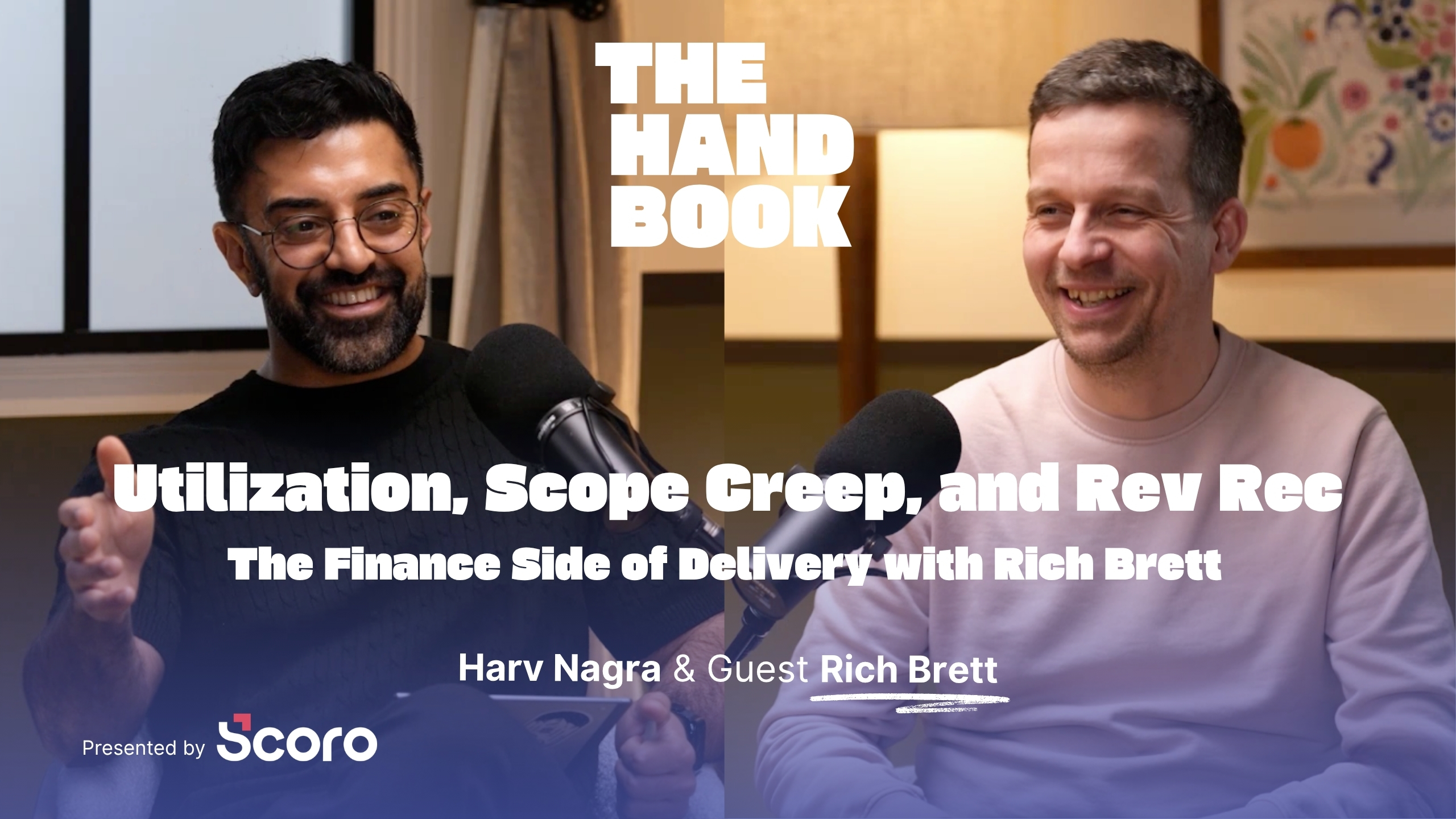
Rich Brett is back for episode three of our mini-series from inside The Missing Finance Course, the free FinOps course presented by Rich and Harv Nagra built to close the gap between finance and delivery.
This episode leans into the delivery side of the business – the day-to-day decisions that end up written into your numbers, whether you meant them to or not.
Here’s what we dive into:
- Why utilization and capacity are two sides of the same coin, and why utilization should never be a surprise at month end
- Where delivery leads go wrong on scoping, and how a duplicated quote can set a project up to fail before it starts
- Why over-servicing to keep clients happy is often a decision nobody actually made, and how to take back control
- What revenue recognition really means (it’s simpler than it sounds), and why doing it once a year isn’t good enough
- What “recovery” actually measures, and why comparing it to an invoice tells you nothing
- What being genuinely data-driven looks like, versus just having a lot of reports nobody reads
Plus, Rich and Harv get into why the best businesses are already looking at what’s going to happen next month instead of just explaining what happened last month.
The Missing Finance Course is free, self-paced, and built for three audiences: leadership, delivery teams, and individual contributors. Head to https://learn.scoro.com to get started.
Additional Resources:
👉🏽 Follow Rich Brett on LinkedIn
👨🏽 Follow Harv on LinkedIn
Transcript
[00:00:00] Harv Nagra: Hey everyone. Welcome back to the Handbook, the Operations podcast. I’m Harv Nagra. We’re continuing our miniseries pulled directly from inside the Missing Finance course. The Free finops course. Rich Brett and I built to level up everyone from leadership to individual contributors at agencies, consultancies, and professional services firms.
It’s hosted at learn.scoro.com. We’ve had over 300 people sign up for the course in the several weeks it’s been live. So if you haven’t taken it and rolled it out as part of your team onboarding and training, you are missing a trick. Here’s some nice feedback I’ve received recently.
It says, I’ve just completed the course and had to message to say how incredibly useful it is. I can’t thank you and rich enough for putting it together. I feel like so much of what I’ve been learning has finally clicked, and I can make lots of improvements to our reporting to make it more actionable.
Love that. Now for anyone that’s just joining us, rich Brett is a finops consultant who spent 15 years in finance and now works with professional services businesses to bridge the gap between finance and operations. This episode leans a bit more towards the delivery side of the business. We start with utilisation and capacity.
Two terms that get used a lot, but aren’t always well understood or well implemented. From there, we get into setting up projects for commercial success, keeping them on track, and how to have those difficult scope and budget conversations with clients without turning into professional yes people.
Then we move into some of the more advanced concepts, revenue recognition, recovery, and what it actually means to be data driven, not just having lots of data sitting across systems and spreadsheets.
Of course, this is just a teaser of the deeper dive we get into in the actual course. Ready? Well, let’s get into it.
Alright Rich, we’re gonna be talking about, of
course, utilisation and capacity. And utilisation is a word that gets used a lot. Mm-hmm. So at least that’s one term mm-hmm that is quite widely used. Yeah. I’m just not sure everyone kind of understands it, or, or is, you know, implementing it the best way and all that kind of stuff.
What, what’s your experience with this?
[00:02:11] Rich Brett: I think utilisation can mean different things to every single person. Um. And that’s because it can be calculated in multiple different ways. I think the important part of utilisation is understanding how it’s calculated. I have my method that’s in the course of how I would calculate utilisation and how I would report it.
Mm-hmm. But it’s super important that everyone knows what their role to play in it is, what the categories mean. Because if that’s not clear, then the data you’re gonna get is not clear.
[00:02:38] Harv Nagra: Mm-hmm.
[00:02:38] Rich Brett: Utilisation is, is something that if you get that right, it often means capacity will be, planning will be better.
Mm-hmm. And resourcing will be better because you probably have pretty good foundations in your system to be able to build out good time sheet tracking and utilisation. If you’ve got that, it normally rolls that you’re able to then do better capacity planning and resource planning. But you’ve gotta remember utilisation is, it’s historic. Mm-hmm. What you want to get to as you move up, that maturity level is more towards resourcing and capacity, because what that is doing is kind of predicting or planning for what your utilization’s gonna be. Mm-hmm. Utilisation shouldn’t really be a surprise at month end. That means you’re not in control of what’s happening.
Right. You should really be planning for what your utilisation is going to be. If you then get variances at the end of the month, that’s something that you need to investigate. ’cause that means you’ve got something wrong somewhere along, somewhere along the line.
[00:03:25] Harv Nagra: Right, and, and to your point, utilisation capacity, like two sides of the same coin, really?
Mm-hmm. One looks back, one looks forward. Yep. Uh, but it’s all about time and where you’re expecting people’s time to go or where people’s time has gone.
[00:03:36] Rich Brett: Yeah. And a lot of people will say, yeah, but I’m doing value-based pricing, outcome-based pricing. You still need to know about time. You are a service-based business where people are delivering work.
I think you can do value-based pricing and still do timesheets. You can do value-based pricing and still do resourcing because you still have to plan for that work to happen. Right. That is still useful data. Mm-hmm. Whether you use it to price or not, it’s useful data to go, okay, but was that value-based pricing project that we sold actually profitable, and what was the team that was needed to deliver it?
That’s good data.
[00:04:10] Harv Nagra: Mm-hmm.
We also talk about how to set up projects for commercial success, how to keep them on track mm-hmm. And how to have those difficult conversations with clients, uh, around scope and budget and all that kind of stuff. From your experience working with kind of firms, where do delivery leads go wrong in, in this kind of stuff?
[00:04:28] Rich Brett: It’s probably better to ask you. You’ve been in that, um, in that role more than I have, but I mean, generally from a finance view is, I think it’s about communication again, it’s about knowing. Your source of truth?
[00:04:38] Harv Nagra: Yeah.
[00:04:39] Rich Brett: Um, from a finance perspective, that is the key part. If we know as much as we can about this, then that’s the most important part, but I would probably say the best person to tell us about.
How to do this best is probably you rather than me. So I’d ask what do you think?
[00:04:54] Harv Nagra: There’s kind of two, two things I was thinking about here, when you’re in a lower maturity firm, first of all, you’re, you’re not building budgets in the best way.
Let’s start there, right? There, there can be a lot of kind of duplication of old projects, old quotes and stuff like that.
[00:05:08] Rich Brett: Or, no budgets at all.
[00:05:09] Harv Nagra: Yeah. Yeah. And, and that, and so I think the issue is quite obvious there, you take somebody’s previously scoped quote, that might have a set of assumptions, a certain kind of scope that was planned and maybe even discounts. Yep. And then you go and copy that and send it to somebody else. Yep. Now think about that kind of legacy of discounts that’s been inherited there. Right? So the scope is gonna be completely out of whack,
for the scope of, uh, the new client. So you’ve set yourself up for failure. And then it’s inconsistent tracking. You know, if people are not going to all track their time right, there’s no point in doing it because that’s like, I, I, and I’ve been in places like that and, and seen that happen is like, well, the account managers or the project managers don’t bother.
But you know, the ICs are meant to, well, what is the point? Mm-hmm. Because then you have no idea. And, I think we say somewhere in this course that, um, a lot of professional services firms either don’t charge enough for project management or sometimes don’t charge, charge at all.
[00:06:09] Rich Brett: Yep.
[00:06:10] Harv Nagra: And then you’re saying that you’re not tracking their time.
[00:06:12] Rich Brett: Yep.
[00:06:13] Harv Nagra: So it’s just going into kind of a black hole, right? Yeah. So that, that is a disaster. So. The lower maturity side of things. I think those are the key challenges you were about to say.
[00:06:20] Rich Brett: I think the thing as well is about the scoping bit is if you, if you duplicate a, a quote
[00:06:24] Harv Nagra: mm-hmm.
[00:06:25] Rich Brett: But you don’t check what actually happened.
[00:06:27] Harv Nagra: Yeah.
[00:06:27] Rich Brett: So yes, you might, that quote might be Right. Right. That is what we should be selling at. But if the last four projects all over service by 130%
[00:06:35] Harv Nagra: Yeah.
[00:06:36] Rich Brett: Why are we even selling at that level? And I think that is part of the problem, is you’ve got to think, and that’s again about being data driven is. It’s okay to use a template.
[00:06:44] Harv Nagra: Mm-hmm.
[00:06:45] Rich Brett: But we need to also make sure that that template is still accurate. Mm-hmm. You know, it might have, you know, with ai, is this now much quicker?
[00:06:51] Harv Nagra: Yeah.
[00:06:51] Rich Brett: But we can still charge for it. Whereas two years ago it did take this much time. But we may have over service a little bit. It could be that those things are changing, doesn’t mean you should change the price.
That’s becoming more of a value based piece. But I think, yeah, if you’re not tracking this stuff correctly, we have to assume that anytime that’s not billable is you’re not working on anything client based. So therefore, if you’re at 50% every month and that’s all we can see, then being brutal about it, then we only need half a person.
[00:07:17] Harv Nagra: Yeah.
[00:07:17] Rich Brett: And if I see two people in the same role at 50%. Then I only need one person. Why are we paying two people? Mm-hmm. That is the commercial reality of, of businesses trying to make, to make payroll. Mm-hmm. To make profit is why do I need three people when the system shows me I only need two? And that’s where the job of finops is to go, yeah, but there’s a different story here. You can’t just take the data as is. Mm-hmm. And that is where it’s very difficult for a finance person to say, or anyone in the business to say, no, we do need to keep these three people because. Because if the data’s not there, it’s gonna be really hard to convince someone that that’s not the case.
[00:07:52] Harv Nagra: Yeah.
[00:07:53] Rich Brett: And I think I’ve been in that situation and been like, yeah, but I know that we do need this person.
[00:07:56] Harv Nagra: Mm-hmm.
[00:07:57] Rich Brett: Then why aren’t we getting the time from them? Or why aren’t we getting the data from them? Okay. It’s because it’s hard. Okay. Then how can we make it easier for them to do that?
[00:08:04] Harv Nagra: And there are, you know, I’m going on a tangent here.
And, um, there, there are different ways of tracking time that go beyond the kind of classic grid, right? Mm-hmm. So there’s probably gonna be a companion video to this where we can show some of that kind of stuff. But there’s a lot of, ways to track time that doesn’t feel as laborious, and that can be as easy as just kind of plotting out what you did over the course of the day in your calendar and linking it to a task.
Yeah. So that is a really easy way for, for somebody to maybe do that who’s not used to or are happy doing it in, in kind of more traditional ways.
[00:08:36] Rich Brett: I mean, I chase timesheets for 10 years.
[00:08:38] Harv Nagra: Yeah.
[00:08:39] Rich Brett: And when I became an advisor, I had to start doing them. It’s really easy.
[00:08:42] Harv Nagra: I do. I
[00:08:43] Rich Brett: mean, it’s really easy.
[00:08:44] Harv Nagra: I do timesheets.
It’s like now I think you do timesheets
[00:08:46] Rich Brett: still. I do. I got here today. Yeah. And I put, took my time sheet on. Yeah. So I know how long I’ve been doing this for.
[00:08:51] Harv Nagra: Mm-hmm.
[00:08:51] Rich Brett: And I’ve just got a little extension in my browser that I click on. I press a button.
[00:08:55] Harv Nagra: Yeah.
[00:08:55] Rich Brett: And when I finish the call, I turn it off like mm-hmm.
I think there’s a lot the business has to think about in this sort of stuff. And the systems that you’re using, make sure it’s not always that there’s one way to do it.
[00:09:05] Harv Nagra: Yeah.
[00:09:05] Rich Brett: People’s brains work in different ways. Mm-hmm. So just try and make sure that there’s multiple ways that the person who’s doing them can do them.
Mm-hmm. But make it the smallest part of the day. Mm-hmm. Like it should just be, I finish that, press a button. Mm-hmm. Or at the end of the day, they write it all up and they do it in one go. Yeah, that’s fine. As long as it’s accurate. But I think there’s no excuse just to not do it because it’s too difficult.
I think that is just a cop out, if I’m honest.
[00:09:27] Harv Nagra: You know, we were talking, you, you asked me the question about the challenges, I see. And we talked about some of them. So like bad quoting, bad tracking and that kind of thing. Um, the other thing I think sometimes is still very prevalent, even in kind of a mid maturity kind of business, is scope creep.
Mm-hmm. And client management. We want to be client friendly and sometimes, you know, no one takes the, the responsibility of training people often on how to manage those clients and have those conversations. Mm-hmm. And we end up becoming like very Yes people. Yep. And just saying yes, you know, yes to everything.
And then, um, and then wondering why everything is always over serviced in the name of being client friendly and not wanting to lose the client, but we have to get better at that.
[00:10:11] Rich Brett: Yeah, and I think a big part of that is resourcing and planning. Yeah. I think so many businesses wait until the end of a project for that conversation to find out how can we afford to do this?
[00:10:21] Harv Nagra: Mm.
[00:10:21] Rich Brett: If you are tracking time spent and you’ve got a really good resource plan. Yeah. At any point when someone says, can you do this for me? You can at least make a judgement call and go, look, we’ve under serviced a little bit on that bit so we can probably fit it in. Or do you know that’s gonna send us over, let’s make a decision on it, or we’re gonna have to charge them for it.
I think too many people are just too quick to go, we actually don’t know mm-hmm where we are with this project, they don’t even know they’ve over, they’re over servicing. Yeah. They don’t know that they’re not making any money on it. So then when they do that, they’re just compounding it. Mm-hmm. I think that is where more mature businesses are better is that they should be able to say, this is where we’re at and this is where we’re gonna finish. Yeah. If decisions have to be made within that, it’s easier for us to do it. Mm-hmm. And everyone should have that information open to them. Who’s making a decision on that.
It shouldn’t be, you have to wait three weeks for finance to tell you. Mm-hmm. Can we make this decision? Because by that point, it’s too late.
[00:11:07] Harv Nagra: Mm-hmm. I sometimes get a bit nervous if you’ve got multiple deliverables in, in a project. Um, if you look at some clients ask for something and you think, well, you might be working on multiple things in tandem, and they’ve asked for something that’s slightly outta scope, and you think, okay, well we’ve underserved over here so we have enough budget.
I don’t love that always. No. Making that saying yes to that because it’s like you don’t know how the rest of those deliverables are gonna go. So you have to be really careful about that.
[00:11:36] Rich Brett: And also that under services margin.
[00:11:38] Harv Nagra: Yeah.
[00:11:39] Rich Brett: You know, if you then just give it, if you, if you give away the thing that was meant to help you make profit
[00:11:43] Harv Nagra: Yeah.
[00:11:43] Rich Brett: You’d never, never making any money. Exactly. Like it’s, a lot of people do say that. It’s like, well, we’re under service there by six hours, so why don’t we just put that six hours onto that thing they want us to do.
[00:11:51] Harv Nagra: Yeah.
[00:11:52] Rich Brett: If they want it. Get ’em to pay for it.
[00:11:54] Harv Nagra: Yeah.
[00:11:54] Rich Brett: Like that’s a judgement . It might be they only pay for three hours of it.
Yeah. ’cause you take the other three. But that is where that communication, again, is so important. Communication with the client, relationship with the client, building that so it’s a strong one that you can push back. Yeah. But yeah, don’t just say, well we, we’ve under serviced by 25%, so we’re gonna give that money back to you.
Why? If you said you were gonna do something and you’ve done it, why should you give the money back?
[00:12:17] Harv Nagra: Yeah.
[00:12:18] Rich Brett: If you’ve said you were gonna do something and you haven’t done it. Then you probably might need to give the money back, but even then, don’t give it back. Just move it somewhere else.
[00:12:24] Harv Nagra: Mm-hmm. I, I think the other thing about that, and I don’t want to go on and on about this and be like, I, I am terrible with clients and I always say no to everything.
That’s not what I’m saying, that there’s kind of, you, you, you have to use your judgement , but it’s like, um, you, if, if you do allow this to happen constantly, you’re conditioning your client that this is just the way it works and they can ask for anything and always get away with it within the budget that’s been defined, within the scope that’s been defined.
And you don’t want to get into that. I don’t think you want to condition people to expect that whatever they ask for is gonna fit within the budget, because something else may be, you know, they don’t know that you’ve underserved on something. No. And so,
[00:13:06] Rich Brett: and they shouldn’t need to. Yeah, you shouldn’t.
Unless there’s something in the contract that says you need to show that.
[00:13:09] Harv Nagra: Yeah.
[00:13:10] Rich Brett: You
know? The point of a statement of work is this is what we’re going to deliver. Obviously there’s a budget in there. Yeah. That says this is the hours. Obviously try not to show the hours and the rates you’re gonna use.
Mm-hmm. That’s not value pricing. If you don’t show it, it’s just that you’re not showing how it’s up. So someone can go, well, you said you were gonna do use 12 hours of design. How many did you actually use? It’s like, we use nine. Well then you’re gonna give the three. But no, like, that’s what we thought You, you agreed the price.
You didn’t agree the people and the time you agreed. The deliverable and the price. That’s what you’ve agreed. Mm-hmm. But I think moving money out and saying, well, you’ve underspent and putting it over there. It’s kind of counterintuitive, like you’re not doing the thing that you’re trying to do, which is we’re always trying to work as efficiently as possible.
[00:13:47] Harv Nagra: Yeah.
[00:13:48] Rich Brett: And spend less time doing things as we can because if we can do that and then work on something else, you know, let’s be honest, that means you can do double the revenue. Yeah. We should be trying to do that. Right. As long as it’s not affecting quality of work. Because I think that is the overriding factor, and I think finance have got a lot, a big part to play in that is the quality of the work is more important than anything else in most cases.
If you keep delivering good work, you are more likely to keep your clients, you’re more able to pay or charge your client more money. Mm-hmm. And you’re more likely to keep good people.
[00:14:18] Harv Nagra: Yeah.
[00:14:18] Rich Brett: So finance shouldn’t just be saying, well do it cheaper, do it quicker. And definitely they wouldn’t say the discount, but the quality of work is key.
Most good businesses, professional services businesses, agencies, consultancies are delivering good work. Mm-hmm. And that is the core part of why they’re making money is ’cause they just do good work.
[00:14:35] Harv Nagra: Yeah.
[00:14:35] Rich Brett: And that needs to be embedded into finance as much as anybody else. Mm-hmm. We can’t just always do it cheaper, cheaper, cheaper.
[00:14:41] Harv Nagra: Yeah. ‘
[00:14:41] Rich Brett: cause then the quality will reduce. Mm-hmm.
[00:14:44] Harv Nagra: Uh, I, I think the last thing I wanna discuss is, uh, something you said a few minutes ago about learning. I just think it’s so important for us to emphasise that, that kind of repeating the same mistakes is not something you want to do.
The fact that you have great templates, fantastic. Right. It helps you deploy those quotes and those budgets really quickly. Mm-hmm. And easily and customise them and all that kind of stuff. But if you’re not learning from what’s happening, are those always over servicing? Are certain clients always over over servicing?
[00:15:13] Rich Brett: Yeah.
[00:15:13] Harv Nagra: Are certain kinds of projects always over
[00:15:16] Rich Brett: certain, certain person always doing
more
[00:15:17] Harv Nagra: work? A certain person in your team? Yeah. Right. And And you have to learn from that. Yeah. I’ve had clients in the past. That are a pain, and they can be like 10 times as painful to work with than any other client.
Mm-hmm. So then why do they get the budget that’s the same, right? Yeah. And if they, if they kind of choke at the price, then maybe it’s not such a bad thing that they don’t want to pay for that, and you don’t want to keep them on as client, they’re not a good client for you. Right.
[00:15:42] Rich Brett: Yeah, that’s, that’s, again, it comes down to, for me, it’s two things.
One is relationship. You know, if, if you have an abusive relationship, then you just stop it, right? If that client is not. Helping you make money. Yeah. And you stop it. But if you’ve got a good relationship with that client and you can openly discuss it, that’s about being a good partner to a client. And the second thing is that if you’re gonna, you know, make decisions that affect your numbers, you have to make them on a educated front.
If you just suddenly got rid of all the clients you didn’t like mm-hmm. You might have to get rid of four or five people.
[00:16:09] Harv Nagra: Mm-hmm.
[00:16:09] Rich Brett: So you’ve just gotta be a bit careful. And I think that’s again, where a good UpToDate understanding of where your business sits mm-hmm. And what decisions you can make.
Finance going, okay, look, what can we do to make this work? Rather than just saying, well just get rid of them or just charge them more.
[00:16:24] Harv Nagra: Mm-hmm.
[00:16:25] Rich Brett: We all know that that’s not possible. Like there’s often finance often have to have caveats saying, look, this is what we need, but I’m aware that it’s not gonna be as simple as that.
Yeah. But this is what we need to try and achieve. How can we do it? Rather than just go, you need to do it. Mm-hmm. Because that’s not gonna help anyone feel good about the numbers if all they just say is, well, finance told me to.
[00:16:41] Harv Nagra: Right.
[00:16:42] Rich Brett: Because a creative agency or creative professional services business, if they just say, well, finance told me to.
I’m fairly sure most of your clients would be pretty pissed off about it.
[00:16:50] Harv Nagra: Yeah.
Let’s get a Little bit more sophisticated. Mm-hmm. Topics like revenue recognition, recovery, billable, paid, um, these are concepts I think that even experienced business leaders mm-hmm get intimidated by. And I have to admit, like I used to break out into a sweat when somebody said rev rec.
Mm-hmm. Because I didn’t know what it meant and I, it sounded complicated. Right. What are we trying to help people understand through this? Can you, can you talk us through that?
[00:17:15] Rich Brett: I think that actually it’s not as complicated as you think. A lot of revenue recognition principles are really quite simple, which is what is the value of work that we have delivered?
Mm-hmm. You know, in your business, you could just say, we’re gonna just decide to recognise it based on a percentage that every project that is a certain value, we’re gonna do 40%, 40%, 20%. That, that is still a principle. It might not be perfect, but I think what you wanna try and do is clarify, are we able to actually understand how much work has been delivered?
That’s gonna be how you set up your systems. Have you got a quote that tells you what you sold, who you sold, and how much you sold it for? Have you got resourcing and timesheets that allow you to track against that quote? All revenue recognition is doing is just recording a number that you’ve delivered.
[00:17:59] Harv Nagra: Mm-hmm.
[00:18:00] Rich Brett: I think it’s quite easy to think that revenue recognition is a financial thing. It’s not. Yeah. It is a number that is representing the delivery of the delivery team. So if the delivery team know what they’ve done, they’re just applying a number against that. Like, that’s actually not that hard.
Most agencies, professional services business, consultancies should know what have we delivered to the client this month? We’re just asking you to then put a number against it. But I think that is where it becomes a thing of, well, we dunno how to do revenue recognition. Yeah. But you know what you sold and you know how much you’ve delivered.
[00:18:31] Harv Nagra: Yeah.
[00:18:31] Rich Brett: So let’s just take that as an approach.
[00:18:33] Harv Nagra: It’s also referred to as percentage of work complete. So that, that’s another way to look at it, which would help you understand that, it’s just about how much work have you done so far.
[00:18:41] Rich Brett: Yeah.
Maybe we’re getting ahead of ourselves here, but why is it important to do thisMm-hmm.
[00:18:46] Harv Nagra: Why does it matter?
[00:18:48] Rich Brett: I mean, it matters because when you invoice isn’t always when you’ve done the work. Yeah. You might be really lucky and you might be able to invoice your a hundred thousand pound project upfront and it takes six months.
That means you get all that revenue in month one. Yeah. And all the effort in the month two to six.
[00:19:01] Harv Nagra: Yeah.
[00:19:02] Rich Brett: So your P&L is gonna look brilliant in month one because you’ve got a hundred thousand pounds in there.
[00:19:06] Harv Nagra: Yeah.
[00:19:06] Rich Brett: Next five months is gonna look terrible because all the work and costs and freelancers are going out over that period.
[00:19:11] Harv Nagra: Mm-hmm.
[00:19:11] Rich Brett: So revenue recognition is about trying to align your P&L and your revenue to the work being delivered. Mm-hmm. That’s time through timesheets and the cost of those people being your staff costs.
[00:19:21] Harv Nagra: Mm-hmm.
[00:19:22] Rich Brett: So it’s really about trying to get something that actually shows what have we actually done with the people that we’ve paid for to do it this month.
[00:19:30] Harv Nagra: Right.
[00:19:30] Rich Brett: And I think a lot of people, I feel, say we do revenue recognition, but they do it at the end of the year. Mm-hmm. So they make an adjustment at year end and say, oh yeah, but we invoice that million pounds on the 31st of December for next year. Brilliant.
[00:19:43] Harv Nagra: Yeah.
[00:19:44] Rich Brett: Let’s defer it to next year.
That is still revenue recognition, but you need to be doing that monthly, not just annually, because otherwise that board meeting you sit in, where you look at performance is just showing an invoice number.
[00:19:55] Harv Nagra: Mm-hmm.
[00:19:55] Rich Brett: So therefore you can’t really understand what you’re actually doing and how well you’ve performed.
And if you try and match that revenue to timesheets or recovery, it’s not gonna mean anything. Even your EBIT percentage doesn’t mean anything if you’re looking at profit from invoicing rather than profit from revenue delivered.
[00:20:11] Harv Nagra: Mm-hmm. And I think if anyone listening to this right now is saying, okay, I am already confused.
Don’t worry, we haven’t gotten to the course, we just got ahead of ourselves. So just bear with us once you start watching this stuff, you might need to watch it twice.
[00:20:23] Rich Brett: Yeah. I forgot about that.
[00:20:24] Harv Nagra: But you’ll get that. Right. And, and even the term recovery, like that might be a new term to you, but it’s really just about overservicing, isn’t it?
Yeah.
[00:20:32] Rich Brett: It’s just over service or under service. But I think why it’s not necessarily called that is because that makes it more about delivery. Actually recovery is about how many of the hours that we’ve done are we being paid for or have we, if we’ve done more hours than we should have done, how many aren’t we getting paid for?
So that is under service or over service. But again, if you’re comparing that against an invoice, it really doesn’t mean anything. Right. Because you might have invoiced upfront or you might be invoicing at the back end of the project.
[00:20:57] Harv Nagra: Mm-hmm. When people say that we need to be data driven, that that gets said, I say it, other people say it.
I think we all walk away with a very different idea of what that means also. Mm-hmm. Right. Because there’s utilisation and resourcing being data driven. Mm-hmm. Like, I suppose it could be, but so is, um, rev rec and recovery and billable paid and all this kind of stuff. Does implementing this stuff does that make your business data-driven?
Mm.
[00:21:22] Rich Brett: I think data-driven means that you have good data, it’s reliable, and then you act on it. Like there are a lot of agencies who have a hell of a lot of data who say, oh, we are data driven, but they never look at that data. Mm. So therefore what they’re doing is doing loads of timesheets and then downloading the report from some system and then looking at it and going, oh, okay.
But is that data driven? No data driven is looking at that data going, does it make sense? Is there ways we can be more accurate? But also the main thing about being data-driven is, is driven, is moving forwards. It’s like taking that data and going, but what can we do about it? Like, how can we better be better at what we do?
So I think this will help you understand how important data is.
[00:22:05] Harv Nagra: Mm.
[00:22:05] Rich Brett: But actually the real benefit of the course is that actually it wanted to help you understand what to do with that data. Mm-hmm. And how it can actually help you improve how your business is run.
[00:22:13] Harv Nagra: Right. I think it is quite a milestone for a professional services business, to even be generating good data, right?
Mm-hmm. Because in the beginning, in a lower maturity kind of state, it’s a bit chaotic.
[00:22:25] Rich Brett: Mm-hmm.
[00:22:25] Harv Nagra: It’s very patchy. People are using kind of tracking things in very different ways mm-hmm if at all. So I think there is, um, you know, it’s good to pat yourself in the back if you’ve got to the point where you are generating that good data, but to your point, you have to then start doing something with it.
Yeah. And, and you know, also being able to look forward rather than just looking backwards in the rear view.
[00:22:45] Rich Brett: And that’s the thing that you see at the lower maturity levels is that a lot of people are looking at data that is historic.
[00:22:50] Harv Nagra: Yeah.
[00:22:51] Rich Brett: And saying, well, what happened? My view is that as you get bigger and you grow, and actually you need to take that data and go, we knew that was gonna be the data.
Mm-hmm. But what we’re trying to do is say, how can we influence the data that we’re gonna see this time next month? That’s when you know, you’re getting to a really good point because actually you see something and go, that doesn’t look right. And you can then go in another system and go, ah, I can see why that doesn’t look right.
Mm-hmm. I think that is when you really realise this company is working really well, because things that don’t look right probably aren’t, or at least you can explain them. And that’s, I think, being data-driven as well.
[00:23:26] Harv Nagra: Excellent. I’ve, um, gone through this material in preparation of the course, and I have to say…
[00:23:31] Rich Brett: poor you!
[00:23:31] Harv Nagra: I, I have genuinely learned a lot and things that I was nervous about or kind of not confident around, I have a grasp of it, so I hope…
[00:23:40] Rich Brett: it’s good to hear. It works!
[00:23:41] Harv Nagra: Yeah. I hope anybody watching this will feel the same way and, um, yeah. Watch it twice if you need to. Yeah. But you’ll get it. It’s really, really valuable content.
So that’s episode three of this mini series from Inside the Missing Finance course. A couple of things stood out for me listening back. I like the moment where Rich points out that utilisation shouldn’t be a surprise at the end of the month.
If it is, that’s a sign that something is out of control. I also think the explainer on rev rec is worth remembering. It’s not a huge finance exercise and hard to understand. It just means putting a number against the work the delivery team already knows is done. These terms like rev rec, recovery, billable paid, used to make me sweat a little when I heard them.
It sounded complicated, I used to get intimidated around the numbers, and no one had taken the time to explain this stuff to me patiently. In creating this course, I’ve got over that fear and I’m confident it’ll help you and your team as well.
If you like what you heard, subscribe to the course yourself and share the relevant paths with your team. There’s a path for leadership, a path for delivery, and a path for your individual contributors as well.
It’s free. You can track your progress. There’s quizzes to reinforce your learning, and you get a Rich Brett certified certificate at the end. Get started at learn.scoro.com. And if this episode has you thinking about utilisation, rev rec, or generally profitability in your own business, and you want one-on-one help getting it under control, rich Brett is the person to speak to.
He’s seen every version of these problems at agencies and consultancies of a huge range, and he knows how to fix these issues. Find him on LinkedIn or @agencyfinops.co.uk.
And if the gap for you is more operational, the systems and tooling that tie the delivery and finance side together, drop me a note. Scoro is what allowed my last business to get properly in control of quoting, resourcing, project, and budget tracking, reporting, invoicing, and so much more. I’m happy to tell you more about my experiences and how transformative moving to this platform was for us. Find me on LinkedIn. I’m Harv Nagra. That’s it for me this week. I’ll be back with the next episode soon. Thanks so much for being here.